

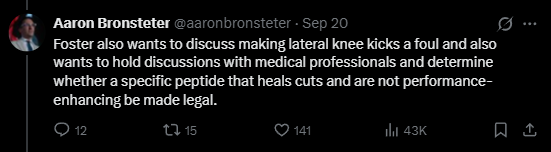
California State Athletic Commission executive director Andy Foster is pushing to get lateral knee kicks off the table entirely. The proposal surfaced during the commission’s post-event debrief following UFC 331 in Los Angeles on September 20, according to MMA reporter Aaron Bronsteter, who was in the room.
Foster wants officials to formally discuss “making lateral knee kicks a foul” under the Unified Rules of MMA. Nothing has been decided. For now it’s a talking point, not a rule, and any real change would still have to clear a full regulatory process before it touches an actual card.
But the conversation didn’t come out of nowhere. Oblique kicks, the lateral strikes that drive straight into the knee joint at an angle no ordinary leg kick approaches, have been a simmering issue in the sport for a while.
Ian Garry gave that debate fresh urgency at UFC 310. Garry leaned on the technique repeatedly against Shavkat Rakhmonov, and afterward he wasn’t shy about what he thought it accomplished, posting on social media that the kicks had done real damage to Rakhmonov’s knee and helped push the welterweight out of action for more than a year and a half.
Replays of the exchange showed exactly what people were reacting to: Garry catching Rakhmonov’s advancing leg right at the knee, a strike that behaves nothing like a standard kick to the body or thigh.
There’s a wrinkle in that story, though, and Rakhmonov himself supplied it. He wasn’t stepping into the Octagon with a clean knee to begin with. Speaking to ALF Global, he laid out just how compromised he already was heading into the matchup with Garry.
“I already had an injury going into the Ian Garry matchup,” he said. “I stepped up. I hadn’t competed for a year; I wanted to competed. Even before that, I had health problems, too, and it turned out there were only two weeks left before the Ian Garry match.”
He went further, describing a knee that had been swelling for weeks and a ligament that was effectively gone before he ever touched gloves with Garry.
“That old injury was still bothering me a lot. My leg was swollen. When he was striking me, it was probably because I completely lacked a ligament. I couldn’t really feel that strike, in general.”
It didn’t take long for the theme to repeat itself. At UFC 331, middleweight Edmen Shahbazyan appeared to flag the referee after eating a side kick to the knee during his unanimous decision win over Brunno Ferreira. Nothing was called, because under the current rulebook there was nothing to call.
That’s the crux of what Foster wants examined: a technique that athletes and coaches routinely treat as something to be careful with in the gym is still fair game the moment the cage door closes.
History offers a reminder that these rules aren’t fixed in stone. The 12-to-6 elbow sat banned for more than two decades over fears that a straight downward strike could cause serious harm to the skull, until closer analysis showed a vertical elbow carries no more risk than one thrown at an angle.
The Association of Boxing Commissions scrapped that ban in late 2024. Soccer kicks and stomps on a grounded opponent have gone through their own rounds of scrutiny and restriction over the years too. Lateral knee kicks could be the next technique to get that treatment, or they could stay exactly as they are.
The debate over lateral knee kicks also has a long history among athletes, with Jon Jones openly acknowledging the mentality behind using them. In an interview, Jones explained that he was taught to attack an opponent’s knees without hesitation, even when the technique could potentially cause injury.
“I have zero mercy in the ring,” Jones said. “I was taught by one coach, he’s like, ‘I’m an athlete who stomps other athletes’ kneecaps,’ and a lot of people find that to be slightly unsportsmanlike. And you could cause somebody a career-ending injury doing that.”
Jones said his approach came from viewing the damage athletes inflict on each other as part of the inherent risk of competing in MMA.
“But the way that I was trained was like, hey, if somebody punches you in the brain, your memory starts to subside, your ability to enunciate words starts to subside. He’s trying to give you brain damage,” he explained. “So it’s a very dog-eat-dog world. And inside the Octagon, you have to have that mentality going in there, or else you’ll get hurt.”
