

Federal pardon requests typically move through a formal Justice Department review process, but a 60 Minutes hidden-camera investigation suggests a far less official channel has sprung up around the Trump administration, one built on cash and claimed connections rather than paperwork.
The investigation centers on Jacob Wohl, a conservative operative previously linked to Andrew Tate’s inner circle through the online forum known as “War Room,” and his longtime partner Jack Burkman. According to the report, the two men have positioned themselves as brokers who can shepherd a pardon request to President Trump’s desk for a price. That price, in the case documented by 60 Minutes, was $300,000.
To test the arrangement, 60 Minutes enlisted Ammon Covino, a man convicted a decade ago on illegal wildlife trafficking charges whose pardon request had already been turned down through the standard Department of Justice channel. Covino reached out to Wohl and Burkman, and the pair responded within seven minutes. They agreed to meet Covino and his wife, Crystal, at a hotel lounge in Virginia, not realizing hidden cameras were capturing the entire conversation.
What followed was a candid pitch about how influence supposedly works at the highest level of government. Wohl and Burkman described a strategy of applying steady pressure until the president simply gives in and signs.
“You have to put pressure on the president from all directions in a consistent way to force his hand,” one of them told Covino. “We literally want to put the pen in his hand and get him to sign it because he’s tired of hearing about it.”
They also outlined what they called a “pincer movement,” a coordinated push involving lawmakers and unnamed influencers who could get close to the people capable of making a decision like this happen. When Covino pressed for specifics on what the six-figure fee would actually buy him, the answers ranged from attending Mar-a-Lago functions to potentially purchasing a $10,000 ticket to a presidential fundraiser. Part of the money, they explained, would go toward “influencers that know other people that can put us in the vicinity of the people that can make a difference.”
The Covino case was not presented as an isolated example. According to the report, Wohl and Burkman previously collected close to a million dollars from the owner of a nursing home chain who had been convicted of tax fraud, and $600,000 upfront from a rapper facing a firearm conviction. Both clients were promised a presidential pardon. Neither one materialized.
Texts obtained by 60 Minutes also claimed the two men had lined up a roster of prominent names to help push their clients’ cases forward, including activist Laura Loomer, Erica Kirk, House Speaker Mike Johnson, and presidential aide Natalie Harp. All four have denied any involvement in the scheme.
Once confronted with the hidden-camera footage, Wohl and Burkman did not disappear from view. Instead, they sat down for an on-camera interview to defend the business. One of them argued their work was no different from the lobbying industry that has operated in Washington for generations.
“There’s nothing corrupt about it. There’s nothing improper about it,” he said, adding, “We don’t work for free anymore than you do.”
The White House distanced itself from the arrangement entirely. A spokesperson told 60 Minutes that “anyone spending money to lobby for pardons is foolishly wasting their money,” and maintained that President Trump “performs his constitutional duties in an ethically sound manner.”
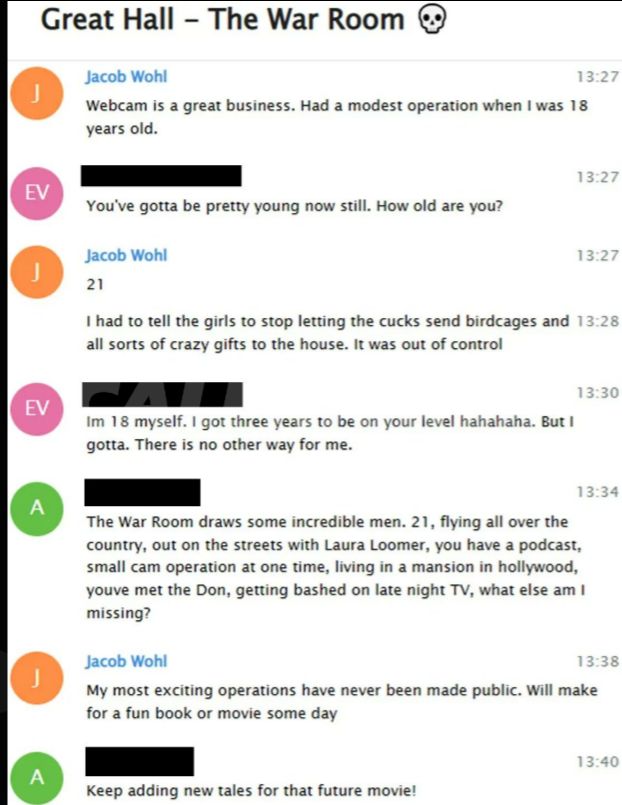
Wohl’s connection to Tate’s network went beyond simply being a member of the War Room. Leaked group chat messages show Wohl discussing business, women and influence with members of Tate’s inner circle.
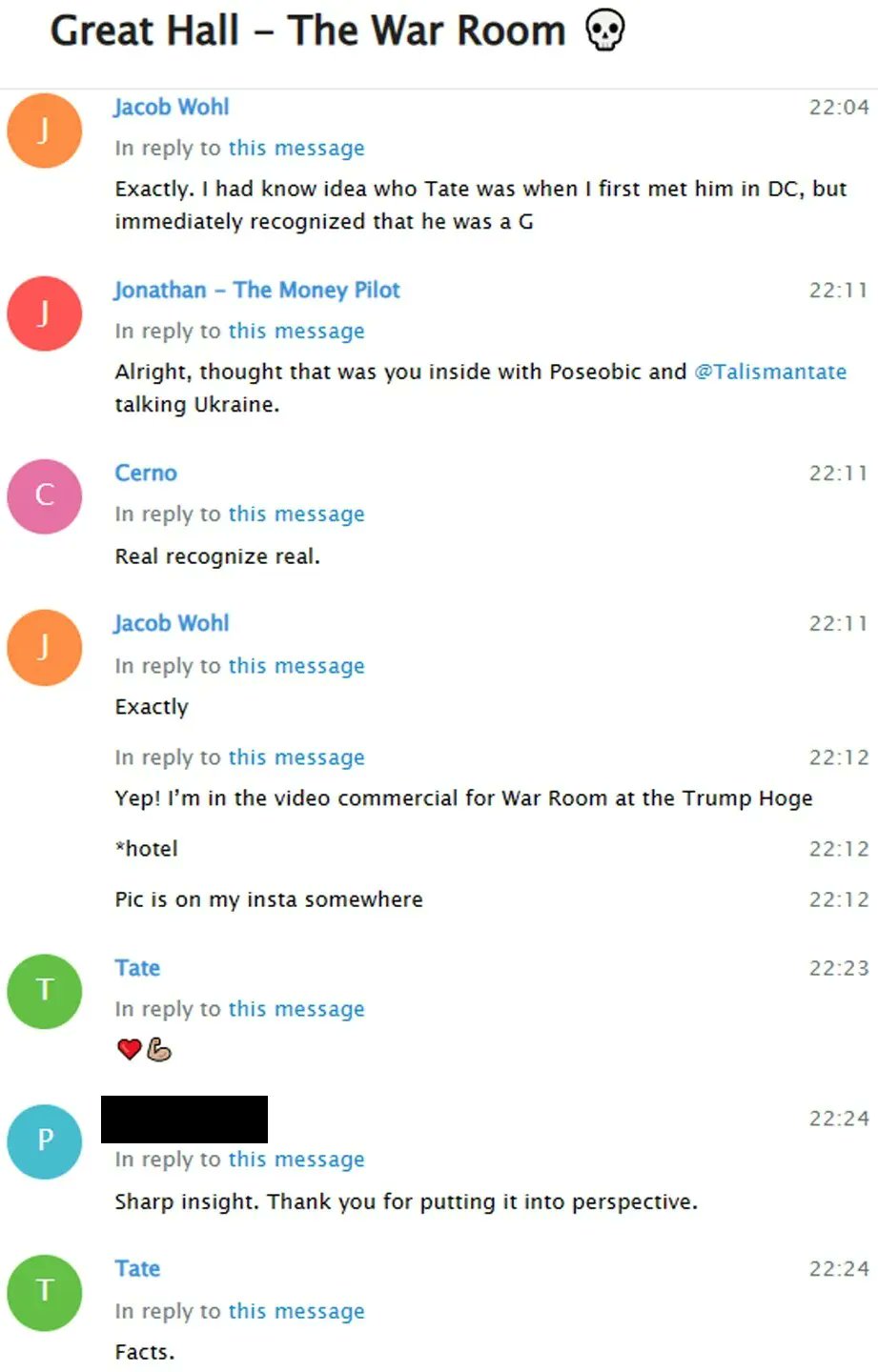
In one exchange, Wohl reportedly told the group that he had recognized Tate as a “G” when they first met and described his own experience running a “modest” webcam operation when he was 18.
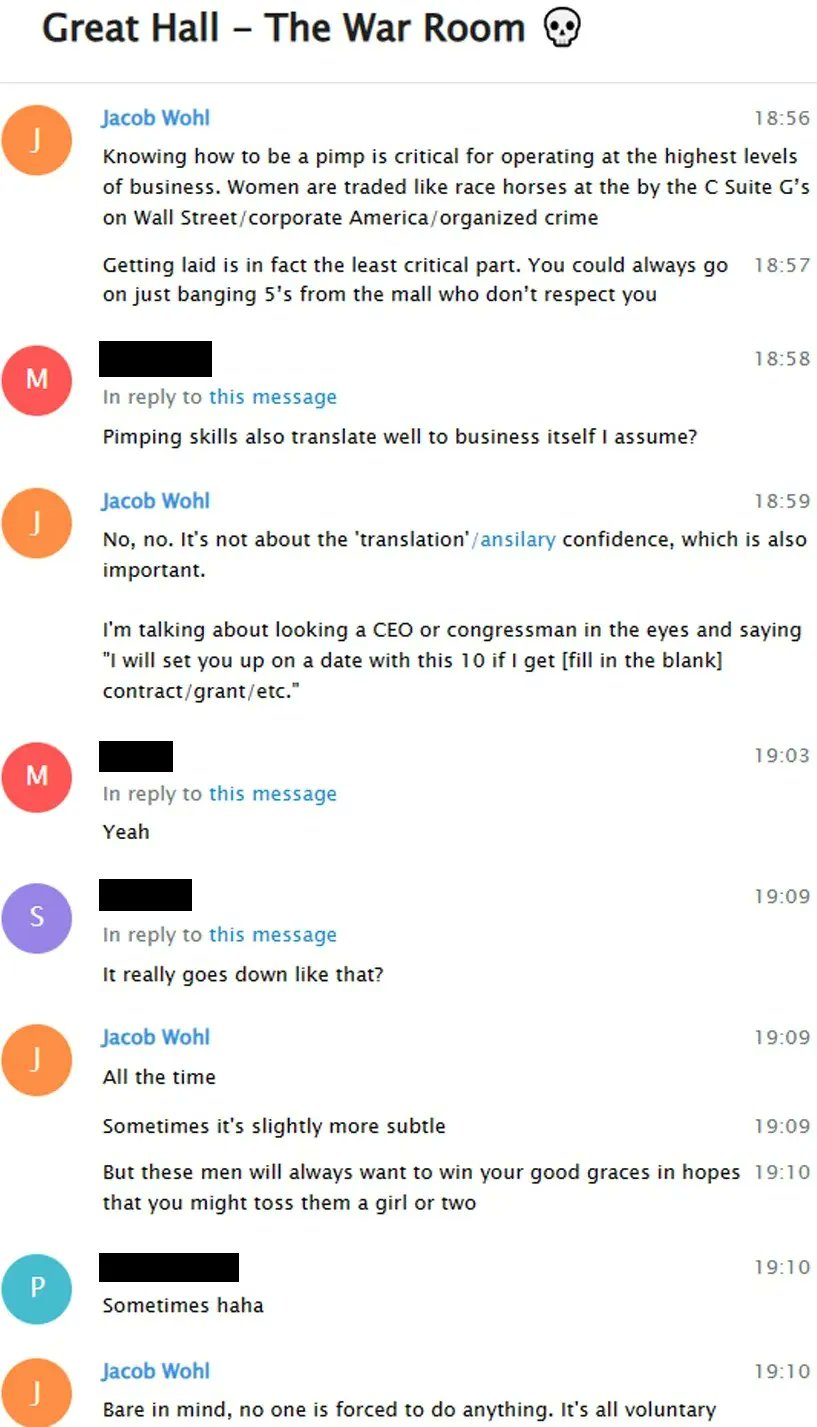
The messages also show Wohl discussing the tactics he believed were necessary to operate at the highest levels of business. In one conversation, he argued that “knowing how to be a pimp is critical for operating at the highest levels of business.”
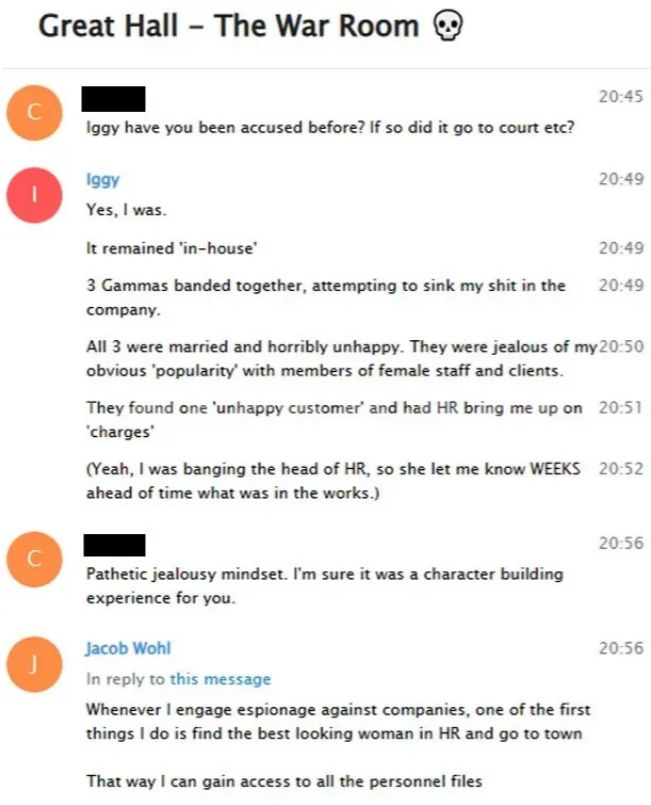
He also described using women to gain access to corporate information, claiming that when conducting espionage against companies, he would find the best-looking woman in HR to help him obtain access to personnel files.
Wohl has a long and controversial public record. He and Burkman were previously convicted over a robocall campaign aimed at discouraging Black voters from casting ballots in the 2020 election, a scheme that drew widespread condemnation at the time.
