
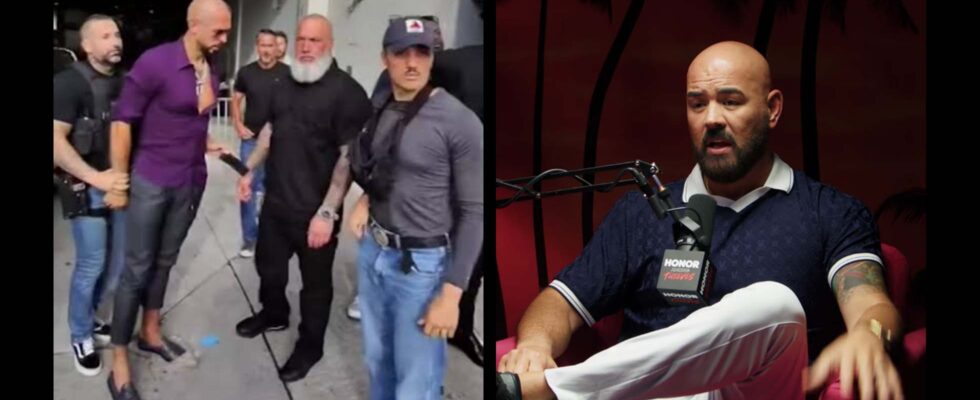
Joseph McBride, the attorney representing Andrew Tate and Tristan Tate in their ongoing extradition case, says the courtroom and the ring aren’t so different. In a recent appearance on the podcast “Honor Among Thieves” with host Nelson Rodriguez Jr., McBride laid out a theory of trial advocacy rooted in his own upbringing, where he learned to box and train in mixed martial arts long before he learned to litigate.
“My father was a figh†er. My father taught me how to figh†. I grew up boxing, mixed martial arts, the whole thing.”
He described growing up in New York in the 1990s, where figh†ing was part of everyday life, and drew a sharp line between people who talked tough and people who actually fough†:
“There was a difference between actual figh†ers and people who talked. There’d be a lot of people who talked and then when you punched them in the face, bow, you hit them.”
McBride described the difference between people who talk tough and people who are willing to stand their ground, a distinction he says carries directly into how lawyers behave when a case gets difficult.
“I feel like every trial lawyer should have some degree of boxing or mixed martial arts training. You have to know what it’s like to step in a ring, to square off, to whatever it is to understand that you can take blows and you can give blows, you can get knocked down, you can get back up, and what it’s like to actually figh† your a*s off, because if you don’t have that capacity from life, you’re never going to have it in the courtroom,” he said.
McBride argued that this physical toughness translates into a willingness to confront prosecutors, judges and even colleagues, something he says most attorneys avoid because they worry about their standing in the legal community. He pointed to his work defending January 6th protesters as an example, describing a room of lawyers who refused to publicly advocate for their clients out of fear it would cost them politically.
“Most people who become trial lawyers just don’t have that backbone,” he said, adding that he has burned professional relationships by refusing to back down for the sake of a client.
The comparison fits into McBride’s broader pitch about representing the Tate brothers, whom he insists are being punished for their message rather than any proven conduct.
Whether or not every lawyer needs to have sparred in a gym, McBride’s larger point is about having the temperament to stand up for a client and keep pushing, no matter how unpopular that client might be in the court of public opinion.
