
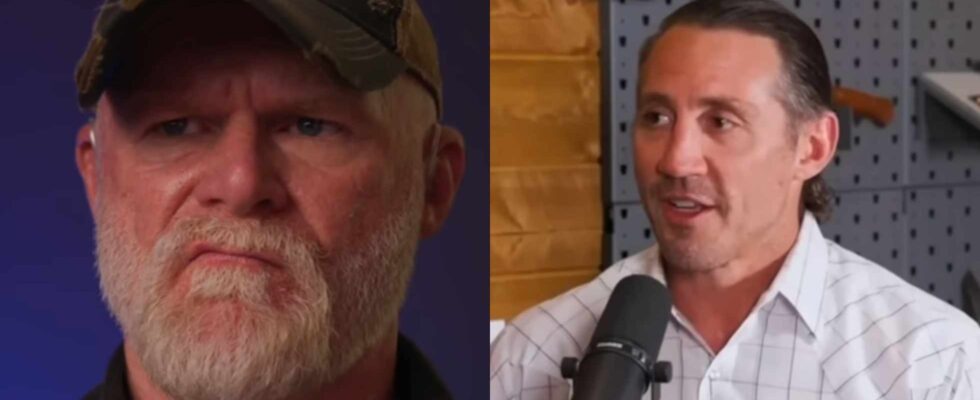
Tim Kennedy recently dropped a new podcast that racked up 60,000 views in its first three hours, but the numbers told a different story: only 11 likes. That ratio says something before a single word is analyzed.
Kennedy, a former Green Beret and public figure who built a brand around his military service, sat down to address longstanding stolen valor allegations. What followed was a series of admissions that did more damage than the original controversies.
On the subject of his book and public statements, Kennedy acknowledged telling “fish stories,” saying critics “have every right to be” critical and that their complaints were “well-founded.” When pressed to call them what they actually were, he agreed: “lies, embellishments, exaggerations.” That is a significant admission. A fish story is when you caught a 6-inch bass and called it 12 inches. Applying that framing to military service records is not a minor thing.
The Bronze Star with Valor Device was addressed directly. Official records show Kennedy received the Bronze Star Medal for meritorious leadership and service, without the valor device.
In a 2017 interview, when asked about it, he confirmed the valor claim rather than correcting the record. His explanation was that he was distracted, “on a phone call,” and “trying to sound awesome.”
Those are two very different reasons, and he offered both in the same breath. If you genuinely did not hear the question, you do not answer it to sound impressive. One cancels the other out.
On the Ranger School honor graduate claim, Kennedy admitted: “When I was writing the book, I said I was an honor graduate. That is inaccurate. I should have said I was the leadership recipient.”
He then noted that he read his own book on tape after it was already published, recognized the problem, and said nothing because it was too late. If you are reading your own words aloud and recognize an error, that is precisely the moment to say something, not a reason to stay quiet.
The deployment count was also addressed. Kennedy claimed “dozens of deployments” that included contracting, nonprofit work, and government assignments, not exclusively military service. His response: “Should I have been way more clear? I was intentionally unclear.” For a figure whose entire public identity rests on his military record, intentional ambiguity is not a defense.
His advisors did not serve him well here. The podcast was an opportunity to draw a clean line and move forward. Instead, it produced fresh admissions without clear resolution, and the audience noticed. When someone with a public platform says he was “trying to sound awesome” as an explanation for confirming a military honor he did not earn, the credibility damage is self-inflicted.
His critics, as Kennedy himself acknowledged, “have every right to be” exactly that.
