
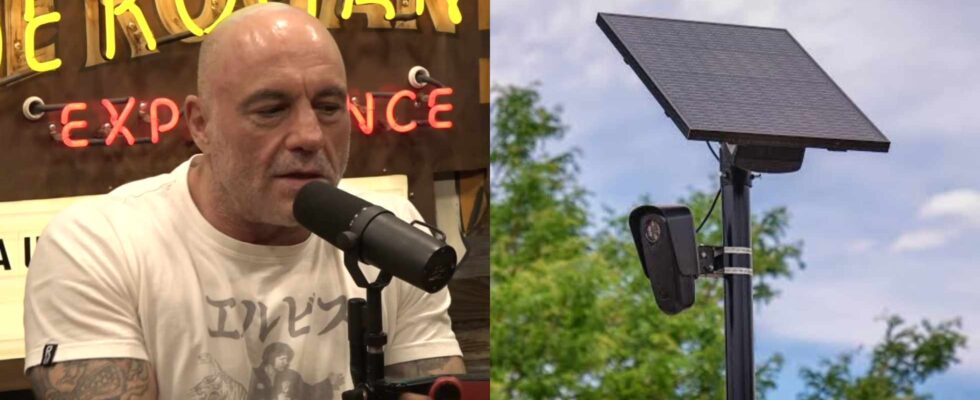
When Joe Rogan sat down with billionaire venture capitalist Marc Andreessen on The Joe Rogan Experience, the conversation ran without interruption or pushback.
Andreessen, a co-founder of the influential investment firm Andreessen Horowitz (a16z), is among the financial backers of Flock Safety, and Rogan gave him an uncontested platform to promote it.
What neither man paused to examine was the substantial and well-documented evidence suggesting that Flock Safety operates one of the most ethically troubled surveillance networks in the country.
Flock Safety is an Atlanta-based technology company that has deployed more than 90,000 cameras across the United States. Its products include AI-powered automated license plate readers (ALPRs), acoustic monitoring devices, and high-powered pan-tilt-zoom cameras designed to identify and follow individual people. The company sells its hardware and software to police departments, municipalities, private businesses, and federal law enforcement agencies, all of which feed into a shared data network.
The reach of that network is considerable. A single client in Bessemer City, North Carolina runs roughly 20 cameras, logged over 72,000 vehicles in a 30-day period, and shares that data with nearly 2,000 other organizations across the country, including federal agencies.
Flock publicly maintains that its license plate readers “do not and cannot track vehicles, much less individual people,” describing them as capturing “a point-in-time image of the rear of vehicles on public roadways” that are “incapable of tracking the whole of anyone’s movements.” That statement grows harder to reconcile with the system’s actual scale and reach with each passing disclosure.
The company’s product line extends well beyond license plates. Flock manufactures microphones called Ravens, marketed as tools to “detect community disruption, expand awareness of non-violent threats, including sideshows, fireworks, and other disruptive community activity.” It also sells AI-powered Condor cameras purpose-built to pan, tilt, zoom, and lock onto human targets.
Security researchers discovered dozens of Condor units with live feeds sitting openly accessible on the public internet, where outside observers could watch in real time as cameras zoomed in on phone screens and surveilled playgrounds, walking paths, and store entrances.
The company’s internal conduct has drawn equally serious scrutiny. Public records obtained by researcher Jason Hunyar revealed that Flock employees had been regularly accessing client camera footage, including live feeds.
Among those named was the company’s VP of Business Development, Bob Carter, who allegedly accessed multiple cameras, including one inside a children’s gymnastics room at a local Jewish community center, reportedly as part of a sales demonstration.
The same records indicated that Flock staff had been suppressing certain account searches from appearing in audit logs and granting third-party API access without informing the clients whose cameras were involved.
In early 2026, following public disclosure of the unsecured cameras, Flock quietly revised its terms of service. The update removed an entire section covering gross negligence and willful misconduct, significantly reducing the legal recourse available to anyone harmed by the company’s deliberate or reckless actions.
Flock’s own FAQ page states: “Nobody from Flock Safety is accessing or monitoring your footage.” The documented public record directly contradicts that claim. The company has also blocked its website from being indexed by public internet archiving services, a step rarely associated with organizations confident in their accountability.
Freedom of Information Act requests have since confirmed the cameras are being used for traffic citations, monitoring of public protests, and supporting Immigration and Customs Enforcement deportation operations.
None of this surfaced during the Rogan-Andreessen conversation.
That omission became more pointed just days later, when Rogan recorded an episode with singer-songwriter Skylar Grey and returned to territory far more familiar to his regular audience.
The two discussed Michael Moore’s documentary Roger and Me and the hollowing out of the American automotive industry, and Rogan’s language took on a sharp edge toward concentrated corporate power.
“It’s a horrific depiction of what can happen when greedy people decide that they’ll completely sabotage an entire city so they can make, you know, X amount more dollars and move all the factories to places where you can pay people a dollar a day or whatever the f*ck they’re paying them,” Rogan said.
He pressed further into the specifics of what those factory relocations meant for the workers left behind abroad.
“You know, that’s the dirty thing about what they did with Detroit,” Rogan said. “Like, they decided that they’ll take advantage of these people that are ultra poor, that are willing to work. And it’s not just that they get paid a dollar a day or whatever they get paid.”
“There’s no health care. There’s no benefits. There’s no retirement. There’s no dental. There’s no nothing. You just get that money and then figure it out on your own. And then, you know, you buy a Ford car and you think it’s made in America.”
When the discussion turned to global income inequality, Rogan offered a two-word explanation: “That’s capitalism.”
He also gestured toward a structural argument about how American economic prosperity gets maintained. “I bet there’s probably some truth to in order for the United States to have such a high income, these other countries have to get f**ked over,” he said.
On the flow of public money, Rogan voiced skepticism about where it ultimately lands. “The amount of money that goes through, you know, various corporations and NGOs, and the amount of loans that all this different s**t, where our tax dollars go, and you look at that, and you’re like, that seems so short-sighted,” he said.
The distance between those remarks and what happened earlier in the week is difficult to ignore. Rogan spent time criticizing corporations that exploit labor, evade accountability, and operate beyond public scrutiny, then turned right around and handed his platform to a billionaire investor backing a company whose cameras monitor protest activity and assist in deportation operations, whose employees accessed footage of children without authorization, and whose legal team revised its terms of service to protect the company from consequences for its own misconduct.
