
Joe Rogan has built a significant portion of his brand around supplement endorsements, with Athletic Greens, now rebranded as AG1, being one of the most recognizable names attached to his podcast.
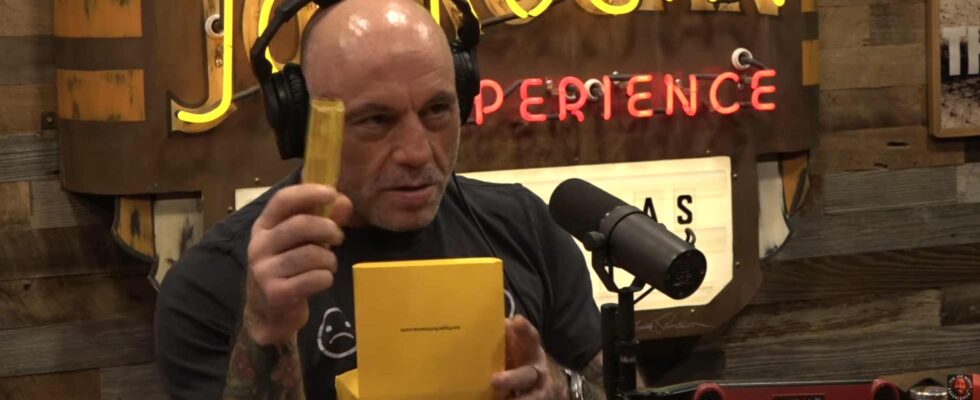
So when episode 2519 of The Joe Rogan Experience featured actor Scott Eastwood walking in with a box of supplements from a company that nobody had heard of, the moment carried a certain weight, and Rogan himself seemed to recognize it immediately.
Eastwood arrived carrying North Performance, a daily vitamin pack sourced from Japan, America, and Switzerland. The company was founded by a Stanford physician named Dr. Massi, who according to Eastwood began the project as a wealthy adventure athlete in his mid-50s, someone who simply wanted the best supplements available regardless of cost and eventually recognized he had something worth building a business around.
“It’s got all the amino acids, your creatines, your NMN,” Eastwood explained, pulling out a large powder sachet. “70 plus vitamins in there.”
Rogan, who takes Pure Encapsulations men’s ultra packs alongside other daily supplements, was clearly engaged but also candid about the situation developing in front of his audience. “By the way, this is not an ad,” he said, then caught himself. “I mean, I guess it is for Scott, but…”
He clarified that he discusses products he finds genuinely interesting regardless of any advertising arrangements, and that any official promotional placement requires his prior approval. The disclaimer was honest, if slightly awkward in its delivery.
Rogan examined the volume of powder in the sachet, observed that it was roughly equivalent to grinding up all the individual vitamins he already takes each day, and expressed real appreciation for the simplicity of the approach.
This is not the first time Rogan has drawn attention for enthusiastically discussing products during seemingly organic podcast conversations. Critics have previously accused him of delivering what they describe as “stealth ads,” pointing to moments where he casually showcases products while insisting the discussion is not sponsored.
In another episode with Joey Diaz, for example, Rogan spent several minutes recommending different nicotine pouches, comparing strengths and flavors before expanding into a broader endorsement of nootropics and cognitive-enhancing supplements. Similar criticism surfaced after another episode in which he gave an extended demonstration of Samsung’s Galaxy Fold, walking viewers through the device’s features while praising its design and usability.
The timing of this moment is difficult to separate from a conversation currently circling the supplement industry. Longevity entrepreneur Bryan Johnson has made AG1 one of his primary targets, calling it “one of the lowest value health products in the world despite being the most heavily promoted.”
Johnson reviewed a clinical trial that AG1 funded itself, a four-week study involving 30 participants, and concluded that the results showed no meaningful health improvements. “They just completed a clinical trial and the results show no clinical benefit,” he wrote in a post that generated over 1.4 million views. “AG1 has no real product substance and is fundamentally an influencer heist.”
Johnson also laid out the financial architecture behind AG1’s dominance. According to his analysis, the company pays influencers up to $60 per new subscriber plus $30 in monthly recurring payments, with some receiving equity. He summarized the economics bluntly: “Retail price $79, Ingredients ($5), Packaging ($3), Manufacturing ($4), Shipping ($7), Total costs ($19), Gross margin $60, Gross margin% 75.9%.”
Rogan reportedly earns approximately $10 million per year from AG1. Andrew Huberman is estimated to bring in between $20,000 and $50,000 weekly from the same brand. Johnson believes those financial ties explain why neither host has invited him onto their show.
“It’s accurate that neither Rogan nor Huberman has invited me on their pods,” he confirmed on social media. His view is that his public criticism of a shared major sponsor is the reason.
AG1 has pushed back on Johnson’s characterizations, stating that its research “showed improved nutrient status and digestive quality of life, consistent with multiple randomized, placebo-controlled AG1 trials.”
Johnson was not moved by the response. “You pay influencers money to promote. Not because it’s worth $79, but because you all get rich,” he replied. “The health benefits of AG1 are worth $30, max.”
AG1 has responded to the criticism by cutting its marketing budget by 40% and committing more than $10 million to clinical research, with an additional $20 million in trials planned. The company has also shifted away from traditional influencer arrangements toward partnerships with nutrition students and expanded its retail presence into channels like Costco.
Despite the scrutiny, AG1 reported a 40% increase in Black Friday sales, which suggests that consumer loyalty remains strong regardless of what critics say about the science.
That context makes Rogan’s spontaneous endorsement of North Performance all the more interesting. Whether intentional or not, a competing supplement got a detailed, enthusiastic presentation in front of one of the largest podcast audiences in the world.
