
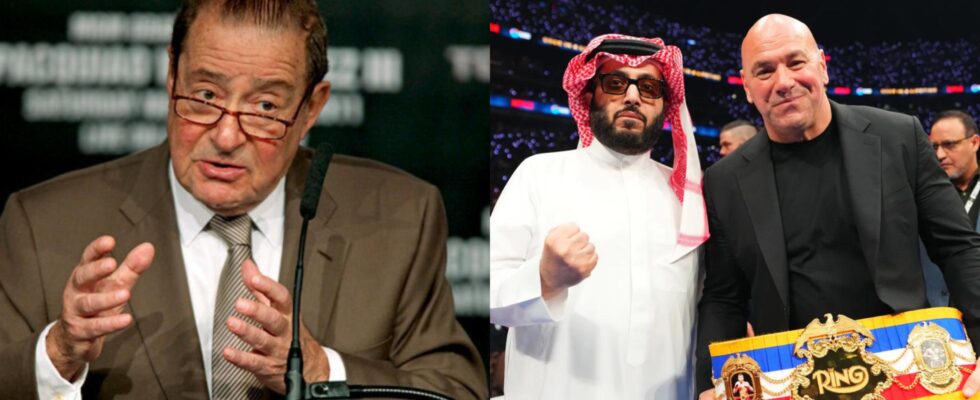
Bob Arum has never been one to mince words, and when the subject turns to Dana White and the prospect of Zuffa Boxing gaining a foothold in the sport he has spent decades building, the Hall of Fame promoter’s assessment is blunt and unsparing.
“Dana White really is a cancer for boxing,” Arum said in an interview. “Because you come in and you want to get rid of all the sanctioning bodies, and we know where that’s going to lead.”
Arum’s warning comes at a particularly charged moment. The proposed Ali Revival Act, backed by White and Saudi entertainment chairman Turki Alalshikh, is currently moving through the Senate. The legislation would create a new category of organization called Unified Boxing Organizations, allowing them to function as both promoter and governing body while setting their own rankings, titles, and access standards.
Critics argue that the framework effectively imports the UFC’s closed-system model into a sport that, despite its flaws, has historically maintained more external oversight.
For Arum, the UFC’s financial history offers a glimpse of what boxing could become under such a system.
“We know what happened with Dana White and the UFC and how they made a lot of money by underpaying the athletes,” Arum said. He then pointed to the organization’s legal battles, adding, “They just lost a lawsuit for $350 million. They’re about to lose another lawsuit for $400 million.”
According to Arum, the reason is straightforward.
“Why?” he asked. “Because they pay their athletes peanuts and they make all the money themselves.”
That antitrust settlement, reached by TKO Group Holdings after athletes alleged the organization suppressed wages and restricted competition, has become a recurring talking point throughout the legislative debate.
Oscar De La Hoya raised the issue during his own Senate committee testimony, arguing that bringing the UFC’s structure into boxing would reduce transparency, weaken athletes’ bargaining power, and concentrate revenue within a single entity backed by Saudi investment.
De La Hoya also compared the proposal to LIV Golf, describing it as an example of how foreign investment can reshape an entire sport.
“Zuffa Boxing is fully funded by the Saudis,” he told the committee. “We’ve already seen how that kind of funding reshaped another sport through LIV Golf.”
He went on to argue that the public should recognize the broader implications.
“We should be honest about what is happening here,” De La Hoya said. “That was sportwashing, a clear effort to use sports to reshape reputation.”
The Golden Boy Promotions founder also questioned why the bill does not extend similar protections to MMA athletes. Former UFC bantamweight champion Aljamain Sterling later echoed that criticism while responding to California State Athletic Commission Executive Director Andy Foster’s support for the legislation.
“If this is the case and his stance on minimum pay for those guys making a few hundred bucks,” Sterling wrote, “then why are we not also trying to do that in MMA? It’s literally the same thing.”
Foster, who was part of the California State Athletic Commission’s unanimous 6-0 vote in favor of the Ali Revival Act, has argued that the pay disparity narrative between boxing and MMA is often overstated. He has also highlighted provisions within the bill that would establish minimum purse standards, including a guarantee that a boxer competing in a four-round preliminary bout would earn at least $800 while receiving medical coverage.
Those assurances have done little to ease concerns from the Association of Professional Boxing Commissions. Its president, Albert Low, called the proposed legislation “a disgrace,” warning that it would allow a single corporation to regulate and promote the sport under the same banner.
Arum shares many of those concerns. While he acknowledges that athletes may initially benefit from access to a well-funded promotional platform, he believes those gains would be temporary.
“Initially they’d make money,” Arum said. “But ultimately they’d be like paupers.”
De La Hoya, who recalled signing his first professional contract at just 18 years old without legal representation after winning Olympic gold, framed the debate as one about avoiding the mistakes of the past.
He noted that the original Ali Act, passed in 2000 with support from Senator John McCain, was specifically designed to prevent promoters from controlling every aspect of a boxer’s career. Allowing one entity to govern, promote, and control the sport’s revenue streams, he argued, would undo those protections.
“When that happens,” De La Hoya told the committee, “it will not be the sport that failed them. It will be us.”
