
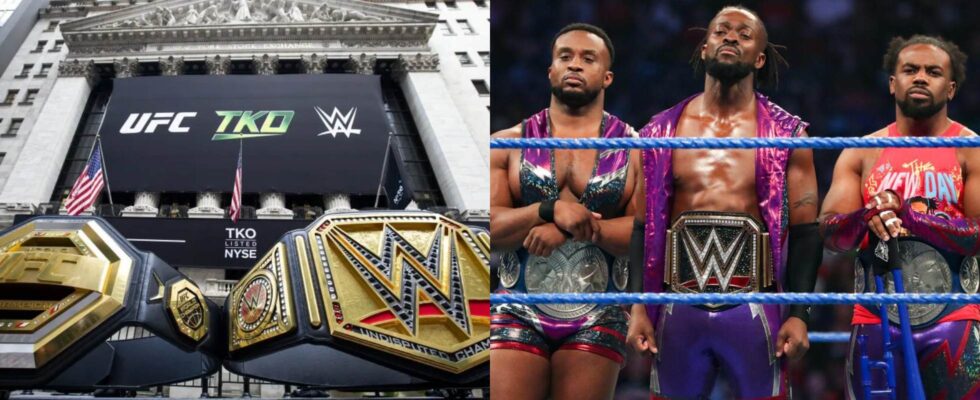
TKO Group Holdings, the parent company overseeing both WWE and the UFC, is reportedly pressuring a select group of WWE talent to renegotiate their contracts at significantly reduced rates.
According to Wrestling Observer’s Dave Meltzer, contract renegotiations themselves are nothing new in professional wrestling. However, what’s changed is how frequently WWE is now approaching talent to voluntarily accept less money, rather than simply releasing them outright as was more common under Vince McMahon’s leadership.
On F4WOnline, Bryan Alvarez explained that the cuts are not being applied across the board. Instead, they are aimed at a very specific tier of talent: primarily upper mid-card performers who signed lucrative deals years ago when the company valued them more highly than it does today.
“As best I can tell, the people who they perceive as the key guys, they’re not being asked,” Meltzer said. “It’s the guys who I would say… they would be guys who were at a higher level before than they are now.”
Top stars like Roman Reigns and Seth Rollins have not been approached, nor have lower-card wrestlers whose salaries are already relatively modest. The focus appears to be on long-tenured performers whose contracts no longer align with their current position on the card.
“The reason you would be asked to renegotiate is because the contract you signed was when they perceived you as being far more valuable than they perceive you as being now,” Meltzer explained.
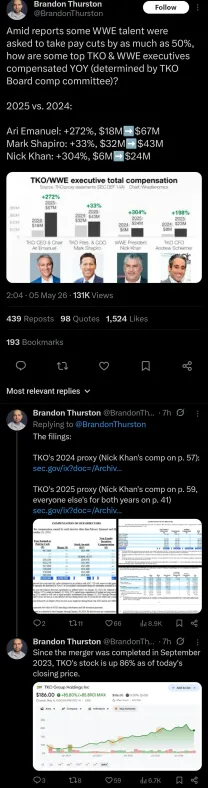
At the same time, the push for talent pay cuts has drawn even more scrutiny due to rising executive compensation within TKO. Recent figures show that several top executives have seen significant year-over-year increases in total pay.
Ari Emanuel’s compensation reportedly jumped from $18 million to $67 million (+272%), while Mark Shapiro’s rose from $32 million to $43 million (+33%) and Nick Khan’s climbed from $6 million to $24 million (+340%).
What has drawn the most backlash is the scale of the proposed reductions. According to Bryan Alvarez, TKO is seeking cuts of around 50% in some cases, a figure he described as excessive.
“I think they’re trying to restructure way too much,” he said. “They want a 50% restructuring of these deals. If it were like 20% or whatever… but they want 50.”
The company’s justification centers on how drastically the workload has changed in WWE’s current operating model. Talent today typically works fewer dates and spends less time on the road compared to previous years.
“Things are very different now than when you signed this deal,” Meltzer said, summarizing the company’s stance. “Yes, we are asking you to take less money, but you are doing significantly less now. You’re not doing four house shows a week… you’re wrestling maybe twice a month.”
Despite that reasoning, the situation has not sat well with many within the locker room. Meltzer noted that only a small number of wrestlers, roughly half a dozen, have been approached so far. While at least two are believed to have accepted the new terms, others have pushed back.
The New Day, for example, reportedly refused outright. Meltzer added that historically, most wrestlers presented with similar requests have declined, even if it meant eventually leaving the company.
There are also precedents for such cuts. Meltzer pointed to Ridge Holland as a recent example, noting that the NXT talent accepted roughly a 50% pay reduction to remain with WWE.
One of the key pressure points in these negotiations is reminding talent of how much they are already earning relative to the industry at large.
“These guys are all making way more money than they ever thought they would ever make as pro wrestlers,” Meltzer said. “That’s their dream job… they wanted it since they were kids.”
Even so, he acknowledged the emotional toll of the situation, calling it “a killer for morale.”
Bryan Alvarez added further context by recalling a similar situation following WWE’s acquisition of WCW, when talent were asked to give up their existing contracts in favor of new deals. With limited alternatives at the time, many had little choice but to comply.
Looking ahead, Alvarez believes this could signal a shift in how WWE structures talent pay. With revenue now largely secured through long-term television rights deals, compensation may increasingly be tied to a wrestler’s position on the card rather than their individual drawing power.
“I think a case could be made that they could actually come up with a salary structure of bottom tier, mid-card, upper mid-card, main event,” Meltzer said. “If you get promoted, you get a bump in pay. If you get demoted, you get a loss in pay.”
If that model takes hold, the current wave of renegotiations may not be a one-off, but rather the beginning of a fundamental change in how WWE values and pays its talent.
