
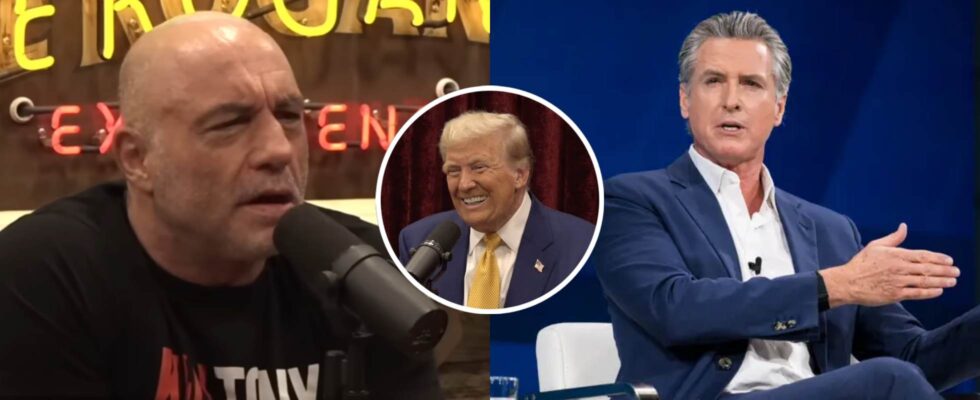
Joe Rogan dismissed Gavin Newsom’s public campaign to get onto the Joe Rogan Experience as desperate and misguided, calling it a bad look and a terrible strategy. But a closer look at recent episodes reveals a glaring double standard that comedian Shane Gillis has been quietly nudging Rogan toward acknowledging.
When Newsom began publicly taunting Rogan on social media, using all-caps posts, nicknames, and language that critics noted sounded straight out of Donald Trump’s playbook, Rogan’s response on his podcast was blunt.
Rogan said, “But it’s just st**id. It’s like this is a bad strategy. Like I probably would have had him on. Yeah. But now I’m like no. What are you doing?”
The problem with that logic? It is exactly what Trump did before Rogan had him on ahead of the 2024 election. After Rogan endorsed RFK Jr., Trump went after him publicly and essentially said he hoped Joe would get booed at the next UFC event.
What followed was one of the most high-profile podcast appearances of the election cycle, capped off with Rogan explicitly endorsing Trump for president.
Newsom, for his part, leaned into the confrontation. “I’m definitely in his head,” the California governor said. “Joe, bring it on. Let’s go. I got no beef with him. He’s got a beef with me.”
Newsom also coined the phrase “California derangement syndrome” to describe what he sees as Rogan’s fixation on the state he left during the pandemic to relocate to Austin, Texas.
Rogan has been openly critical of Newsom for years, regularly criticizing California’s governance on his podcast and arguing that people leaving the state speaks for itself.
“If people are leaving the place you’re in charge of, don’t be upset if people are critical of how you’ve been managing it,” Rogan’s guest Schulz said in a video.
Shane Gillis has become one of the few voices in Rogan’s orbit willing to push back on these takes in real time. Their dynamic has shifted noticeably over the past two years, with Gillis growing more comfortable challenging Rogan on political points rather than simply going along.
Whether the topic is Trump’s White House plaques, the Comey arrest, or ICE agents operating without visible identification, Gillis keeps returning to a simple argument: the problem is what is happening now, not what some future Democrat might do with a similar playbook.
Rogan can clearly see the absurdity of some of the current administration’s behavior. He read the White House plaques aloud and called them “crazy” multiple times. But his instinct is to route the criticism through a hypothetical Newsom presidency rather than address the source directly.
