
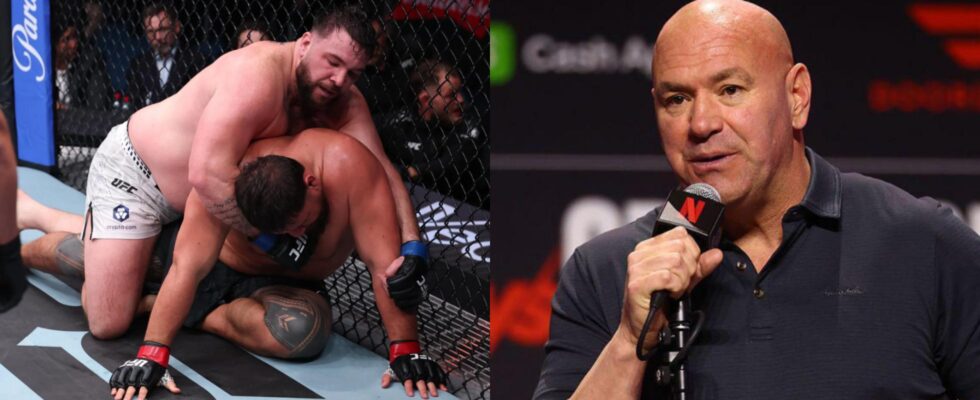
The UFC Perth card delivered a memorable main event, but it drew sharp criticism from analyst Luke Thomas, who pointed to a growing problem with the organization’s roster management, event frequency, and athlete retention standards.
In a recent video, Thomas identified three athletes on extended losing streaks competing on the same card.
Vince Morales entered on a six-bout skid. Gerald Meerschaert had lost five consecutive bouts. And heavyweight Tai Tuivasa arrived having dropped seven straight, to opponents including Sergei Pavlovich, Alexander Volkov, Marcin Tybura, and Jairzinho Rozenstruik. All three lost again.
The Tuivasa situation drew the most criticism. After nearly a decade in the UFC, Thomas noted that Tuivasa was still not using underhooks to defend takedowns, a fundamental grappling tool.
“This has been obvious for a while and now it is simply undeniable to the point where it is painful,” Thomas said.
He described watching Tuivasa get rolled twice with a fat man roll, a basic submission off the turtle position, and expressed genuine confusion about what was happening in training.
Thomas stated, “Dude, he just wasn’t using underhooks in this match,” Thomas said. “Not even using underhooks to defend takedowns.”
The criticism extended beyond individual athletes. Thomas observed that only two bouts on the entire card featured both competitors entering off a win. That figure, he argued, is a direct consequence of a bloated roster and a schedule that has simply outpaced the available talent pool.
“There’s too much bloat on the UFC roster,” Thomas said. “The events are too long. There’s too many of them.”
When asked who should be cut, Thomas pushed back on the idea that these are difficult decisions.
“Man, there’s low-hanging fruit,” he said. “It’s not difficult to ascertain who should be cut. These are not tough calls. These are easy calls, and they won’t make them.”
The Marwan Rahiki versus Ollie Schmid bout also came in for criticism. Thomas praised Rahiki’s performance but questioned why Schmid, who entered at four wins and three losses, was on the card at all.
“He should not be in the UFC,” Thomas said flatly. “This was an LFA match if anything.”
Thomas framed the issue not as a criticism of individual athletes as people, but as a standards failure by the organization itself.
“This organization should have the kind of standards where this kind of stuff is not allowed,” he said, “and they’re the ones who booked them.”
The cumulative effect, Thomas argued, undermines the credibility of the product. When too many bouts lack genuine competitive stakes or feature athletes who have long since passed their ceiling at this level, even strong performances elsewhere on the card get buried under the weight of what surrounds them.
