
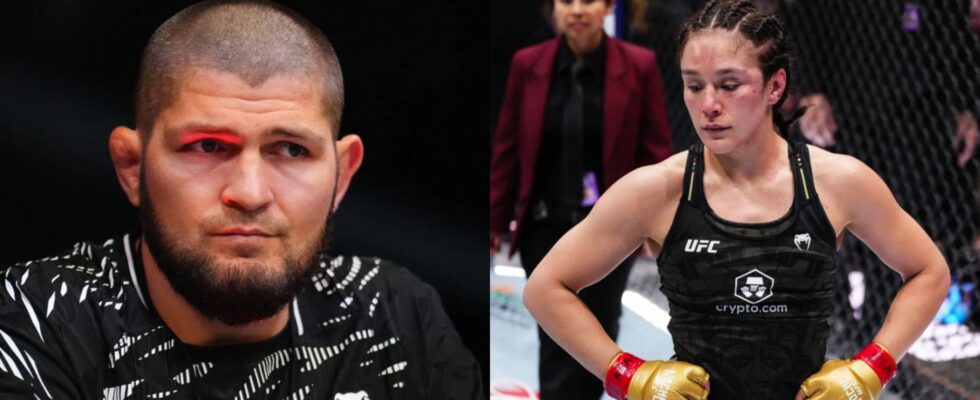
During a sit-down on Un Cafe Conmigo, UFC flyweight Alexa Grasso spoke about sexism in combat sports. When host Brandon Moreno brought up Khabib’s comments about women staying in their lane, Grasso offered a firm response.
“Well, no, I think everyone has a different perspective, right?” she said. “Obviously, their religion, their country, and the place they come from…their ideology is very different.”
She then contrasted that worldview with her own background.
“Obviously, someone coming from a Latin American country where there aren’t as many opportunities, where there’s a lot of machismo,” she explained. “I mean, you have to get ahead because a prince isn’t going to come and rescue you. There isn’t one, it doesn’t exist, you know?”
Grasso then pointed to her upbringing.
“I come from a family where my mother worked, she was a single mother. My grandmother was a single mother,” she said. “So, coming from something like that, you say, ‘Well, if I don’t hurry up, nobody’s going to come and help me.’”
She emphasized how that shaped her mindset. “It’s different. The ideology is different, and the way you live is different. And as a woman, it’s very different too,” Grasso added. “I don’t see myself waiting for someone to come and rescue me, no.”
Instead, she highlighted the values instilled in her growing up.
“I have to work,” she said. “And like my dad always told me, you’re going to work at whatever you want, and you’re going to get everything you want through your own effort and with your own hands.”
On the subject of age-related criticism aimed at female athletes, Grasso didn’t hold back.
“For us, it’s sometimes a little harder,” she said. “You go through menopause and it’s like, ‘She’s old now, she should just go to… washing dishes.’”
She made it clear that those comments weren’t hypothetical. “I saw it, I saw it,” Grasso continued. “There’s an athlete who made those comments.”
According to her, these attitudes reflect the social expectation placed on women. “The social burden sometimes placed on us as women is like, no you go home and raise your kids,” she said. “Sometimes, hey, leave me alone.”
She also pushed back against criticism of women competing later in their careers. “Don’t let it bother you that I’m competing in my thirties,” Grasso said. “It doesn’t matter.”
Grasso also shared her experience coaching on TUF, where she initially struggled to earn respect from male athletes.
“Full testosterone and they put a little girl to teach you,” she recalled. “I mean, everyone looked at me like, ‘What are you going to teach me?’”
The reaction, she admitted, was difficult to deal with. “It made me very sad,” Grasso said. “Because they didn’t listen to me, like they didn’t want me to.”
She described the dismissive attitude she encountered. Despite that, Grasso said the experience ultimately helped her grow.
“I also learned a lot from how, as a student, when someone arrives who isn’t in a good mood, who makes faces at you, who doesn’t want to do what you tell them, who seems to do it reluctantly,” she explained.
That perspective shift changed how she approaches her own training. “That also helped me realize that I always have to arrive in the best way possible,” she said, “to pay attention to my coach and to what they are saying and doing.”
She ended by reflecting on how it feels to be ignored in that position. “Because going there and nobody paying attention to you, and being told to get lost, feels horrible,” Grasso said.
[Editor’s Note: Quotes have been translated and edited for clarity and readability.]
