
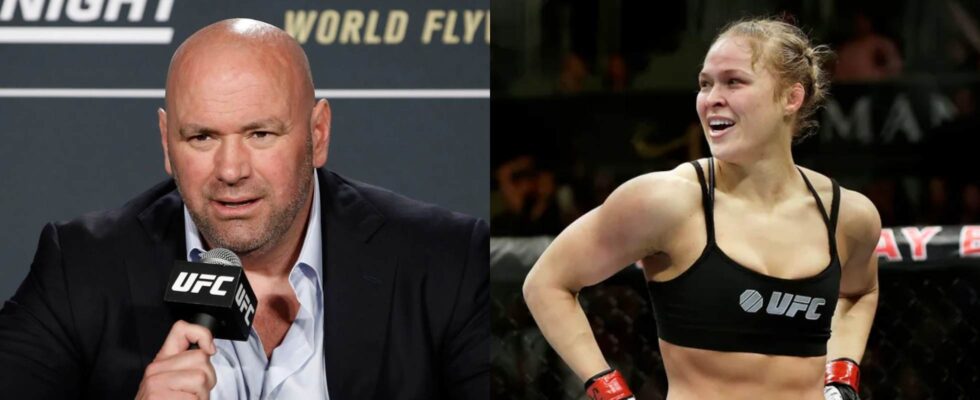
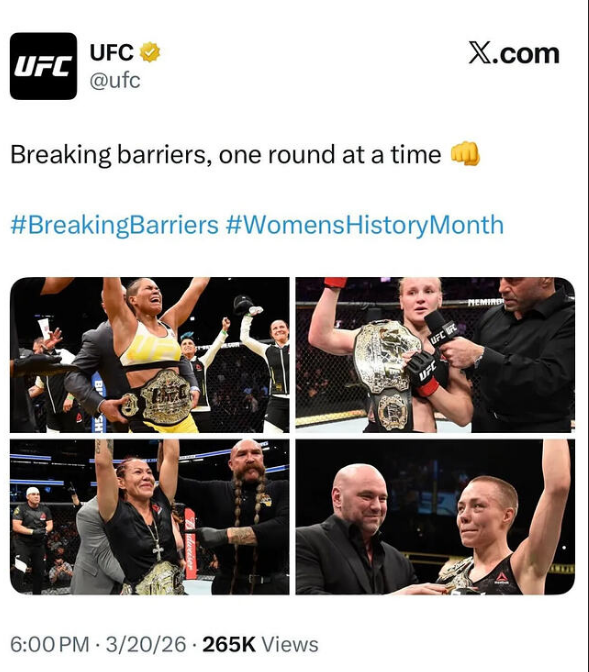
The UFC’s Women’s History Month tribute post was hugely criticized this week after fans noticed a glaring omission: Ronda Rousey, the woman most responsible for putting women’s mixed martial arts on the map, was nowhere to be found.
The promotion celebrated the occasion by spotlighting champions Amanda Nunes, Valentina Shevchenko, Cris Cyborg, and Rose Namajunas, describing them as “breaking barriers one round at a time.”
The sentiment may have been well-intentioned, but the absence of Rousey, the first woman ever inducted into the UFC Hall of Fame and the competitor who built the foundation those champions walked across, did not go unnoticed by fans.
The timing of the snub carries particular weight. Over the past several weeks, Rousey has been one of the most vocal critics of how the UFC handles athlete compensation, especially as the organization navigates a massive $7.7 billion deal with Paramount and its new status as a publicly traded company.
Rather than acknowledge her legacy during Women’s History Month, the promotion apparently chose to sideline it entirely.
Joe Rogan addressed Rousey’s compensation remarks directly on a recent episode of The Joe Rogan Experience alongside guest Dustin Poirier.
“Ronda Rousey, she’s promoting the Netflix match and she had this big long speech about the UFC selling for $7 billion. These athletes aren’t making enough money. And you know, look, she made some good points and the most important thing is that she gets the conversation out there and it puts pressure on the UFC to pay people more,” Rogan said.
The roots of Rousey’s rift with the UFC trace back to a deal that once seemed destined to happen. Nine months pregnant at the time, Rousey reached out to UFC CEO Dana White about a long-anticipated matchup against Gina Carano. His response was immediate and enthusiastic.
“He sent me this voice memo where I can tell when he’s super excited about something because he stutters and he was stuttering all over the voice memo,” Rousey recalled during an appearance on the Jim Rome show. “I’m like, oh, he’s down.”
White’s excitement quickly translated into action. According to Rousey, he returned with an offer unlike anything the UFC had ever placed on the table. “He came back and literally brought me a deal where I would make more per pay-per-view buy than anybody in history,” she said. “If I hit my historical numbers, which I know we would have been able to exceed, I would have made as much as I did in my entire career.”
Carano’s own enthusiasm for the matchup added momentum to those early conversations. “He reached out to Gina and she said that she’d already lost 25 pounds and this was like that walk back into the cage again. It’s something that she’s always wanted to do. And that’s when the talk started happening and got that interest from her,” Rousey said.
But timing became the deal’s undoing. Carano needed additional preparation time, which pushed the proposed event beyond a pivotal corporate transition for the UFC. “It happened to go to the other side of when the ESPN deal and their pay-per-view model would be ending and they would be going to online broadcasting,” Rousey explained.
Once the $7.7 billion Paramount deal closed and the UFC became a publicly traded entity, the calculus shifted entirely.
Rousey described the logic: “They didn’t want to set a precedent of giving me the guaranteed money that I deserve because once I raise that tide it lifts all the boats. They just made a 7.7 billion dollar deal at Paramount. So it’s in their best interest actually not to put on the best matches possible, but to spend as little money as possible so they can keep it.”
She also spoke candidly about the transformation in White’s role following the sale.
“Dana’s now legally obligated to maximize shareholder value. It’s not just about proving the concept of competing and putting on the best match possible and proving that this is a sport to be taken seriously,” Rousey said. “Now that they’ve sold the company, it’s out of Dana’s hands, unfortunately. And now it’s falling onto Hunter Campbell and UFC Corp where they don’t care about putting on the best match possible. They care about putting on the most cost effective matches possible.”
With those financial terms effectively off the table, Rousey drew a firm conclusion. “It no longer made sense for me to go over there because they didn’t want to pay us the money that we deserve because then for the rest of the time of the deal, they’re going to have to pay everybody else more,” she said.
Despite the parting of ways, White reportedly gave his blessing to the matchup. Rousey and Carano subsequently teamed up with Jake Paul’s promotion, with their bout now scheduled for May 16th at the Intuit Dome in Inglewood, California, airing exclusively on Netflix.
Rogan also framed the Netflix card as a potential inflection point for the sport as a whole. “If Netflix can become successful at MMA, if they can become successful putting cards together and pulling athletes away, like right now they’re doing a one-off, right? It’s a one-off and it’s kind of a gimmicky thing,” he said. “But if anybody’s got that kind of money, it’s Netflix. They throw around a lot of ridiculous money. They make so much money.”
