

A sweeping new survey of American young men is pushing back on some of the loudest narratives about what is pulling them toward online radicalization and manosphere content.
The Institute for Family Studies, working with YouGov, has published a study. It surveyed 2,000 men ages 18 to 29 between April 7 and 15, 2025, producing one of the most detailed portraits yet of how young men in America think about manhood, role models, and their futures.
When asked who they most looked up to as role models, the young men surveyed placed mothers first at 79 percent, followed by fathers at 69 percent, and then coaches and teachers at 57 percent.
Online influencers, by comparison, ranked near the bottom. Andrew Tate, who has become a central figure in discussions about toxic masculinity and manosphere radicalization, was the least admired person on the entire list, with some of the lowest scores for “a great deal” of admiration and the highest percentage for “not at all.”
Around half of respondents said they looked up to the online influencer they follow most closely “not very much” or “not at all.”
The findings complicate a prevailing media narrative. Coverage of the manosphere often depicts young men as deeply susceptible to extreme online content. A March 2025 article in the British edition of Glamour ran with the headline “My Friend was Radicalised by Online Misogyny. It Really is that Easy.”
The hit drama Adolescence similarly implies that ordinary teenage boys can be driven to violence through manosphere exposure. The IFS data, however, suggest a more complicated picture.
When asked about their values around manhood directly, young men expressed views that diverged significantly from what critics typically associate with manosphere ideology.
Eighty-nine percent agreed that “being a man requires a willingness to sacrifice for others,” and 85 percent agreed that “manhood involves strength, responsibility, and leadership.” Far from reflecting nihilism or misogyny, these responses point to traditional ideals centered on service and accountability.
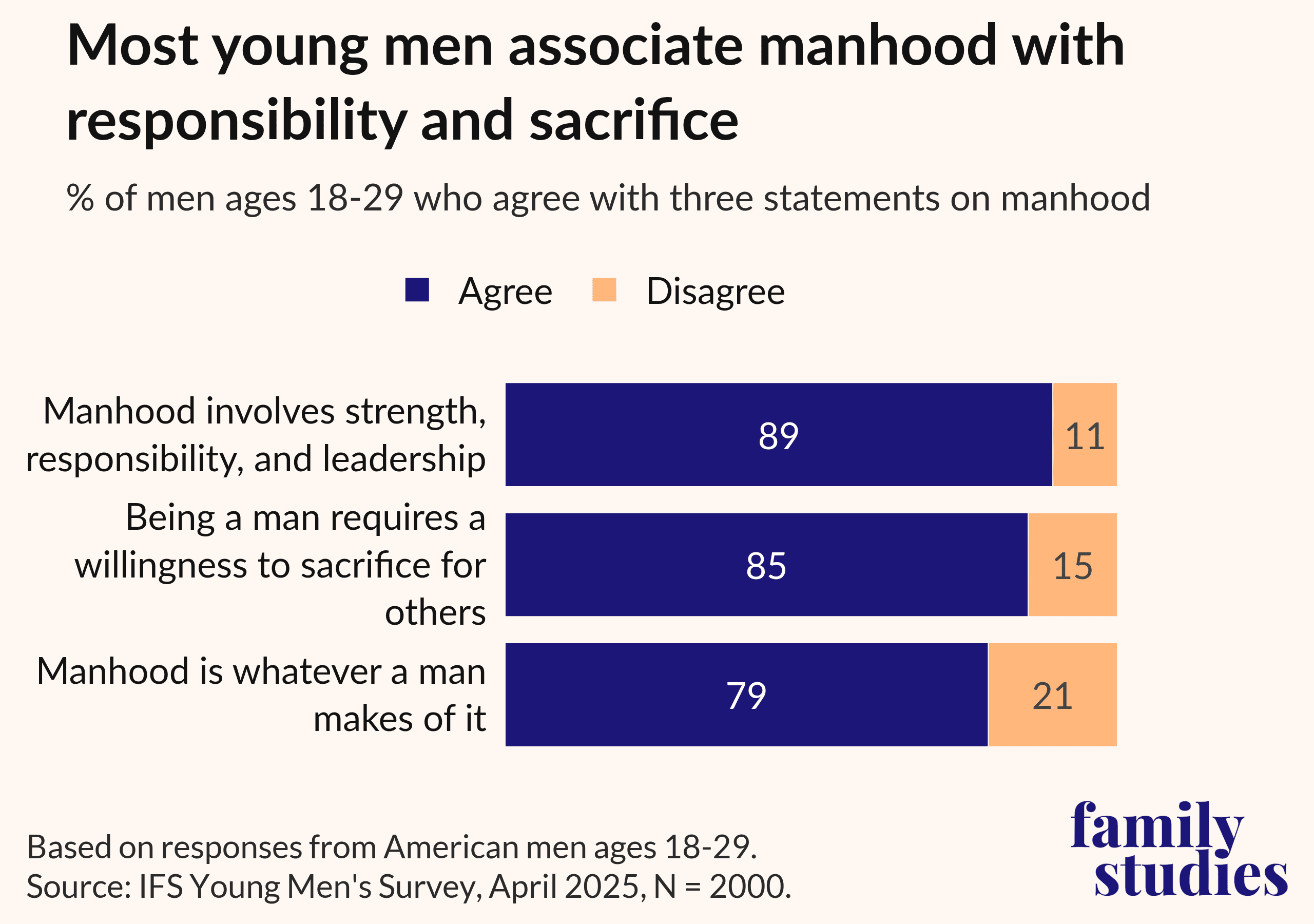
The survey also found that young men are not indifferent to relationships with women. Fifty-nine percent were not in a romantic relationship at the time of the survey, yet 74 percent of those without a relationship expressed openness to dating. Most unmarried men, 68 percent, said they wanted to get married someday.
The authors note that their findings do not rule out harmful influences for some young men. Around three in ten respondents still said they looked up to Andrew Tate to at least a good amount, and the researchers acknowledge that extreme content may be fostering resentment among a portion of young men who struggle to find romantic partners.
There have been other studies which indicate that media habits can still carry social consequences, particularly in dating. A recent survey found that more than half of young women view listening to The Joe Rogan Experience as a red flag, not necessarily because of the content itself, but because of what it may signal about a listener’s political identity and worldview.
Even if influencers like Rogan are not the dominant force shaping young men’s core beliefs, their association with certain ideas can still impact how those men are perceived.
Still, the picture that emerges is one of young men who are demoralized by economic pressures and social uncertainty, not one defined by radicalization. As the report concludes, their concerns are “mostly economic,” centered on whether they can build a stable life and fulfill roles they genuinely value.
