

A quiet regulatory filing buried in a Federal Communications Commission public notice from February 2026 has caught the attention of neuroscientist Andrew Huberman, and his response has set off a wave of concern across the science and wellness communities.
At the center of the controversy is Reflect Orbital Inc., a company that submitted an application to the FCC on July 1, 2025, seeking authorization to launch and operate a satellite called Earendil-1. The satellite, intended to orbit at approximately 625 kilometers above Earth at an inclination of 88 degrees, is described in filing documents as a testbed for “space-based reflector technology.”
In plain terms, it would bounce sunlight back down to targeted areas on the Earth’s surface, essentially redirecting the sun’s rays long after it has set.
According to sources, the FCC accepted the application for filing in its February 6, 2026 public notice, marking an early but significant step toward potential approval. The agency noted it reserves the right to return the application if further review determines it does not conform to commission rules or policies. Reflect Orbital also requested waivers of several FCC rules as part of its submission.
Huberman, a professor at Stanford University and host of the widely followed Huberman Lab podcast, took to social media on March 9, 2026, after being briefed by a colleague in the sleep science field. His concern was direct.
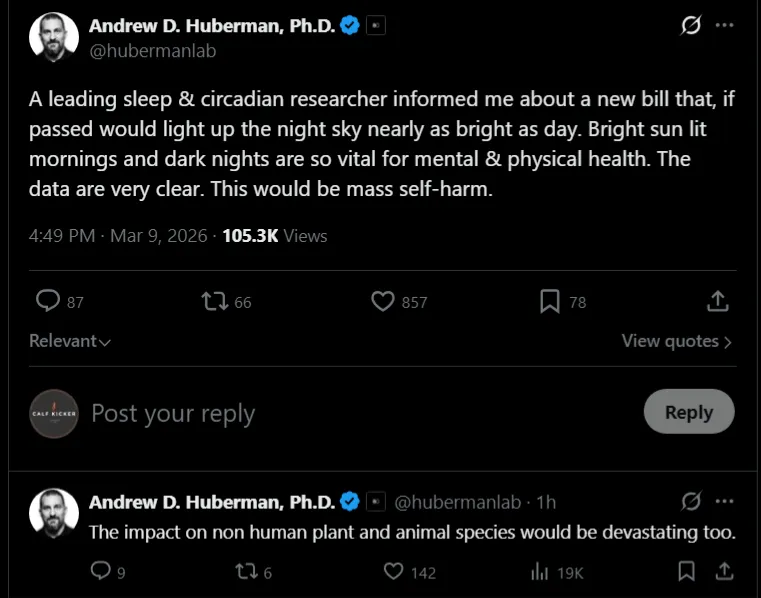
“A leading sleep & circadian researcher informed me about a new bill that, if passed would light up the night sky nearly as bright as day,” he wrote. “Bright sun lit mornings and dark nights are so vital for mental & physical health. The data are very clear. This would be mass self-harm.”
The warning tapped into decades of research on circadian biology, the internal clock system that governs sleep, hormone release, metabolism, immune function, and mood. Exposure to light at night, particularly bright or blue-spectrum light, suppresses melatonin production and disrupts the body’s natural rhythms.
Scientists have linked chronic circadian disruption to a range of serious health conditions, including cardiovascular disease, metabolic disorders, and psychological conditions. The prospect of a satellite system artificially extending daylight hours into the night raises legitimate questions about what that could mean at a population scale.
In a follow-up post, Huberman expanded the concern beyond human health. “The impact on non human plant and animal species would be devastating too,” he wrote.
Light pollution is already known to disorient migratory birds, disrupt the reproductive cycles of insects, confuse nocturnal animals, and interfere with the photosynthetic rhythms of plants. A satellite capable of reflecting concentrated sunlight onto specific regions would introduce an entirely new and controllable variable into that already fragile equation.
Huberman’s posts drew hundreds of thousands of views within hours, with responses ranging from alarm to skepticism to calls for regulatory action. While Earendil-1 is positioned as a technology demonstration mission, critics argue that proof-of-concept tests can quickly become operational blueprints, and that the time to evaluate the consequences of this technology is before it is in orbit, not after.
As of this writing, the FCC has not announced a decision on the application, and Reflect Orbital has not issued a public response to the growing backlash.
