

Stanford University neuroscience professor Andrew Huberman recently issued a public warning about a synthetic tanning peptide that has gained attention following reports of its use by the nation’s top health official.
According to sources, he took to social media to caution his followers about Melanotan II, a treatment that stimulates melanin production in the body. His warning comes amid allegations that Health and Human Services Secretary Robert F. Kennedy Jr. has used the peptide to darken his skin.
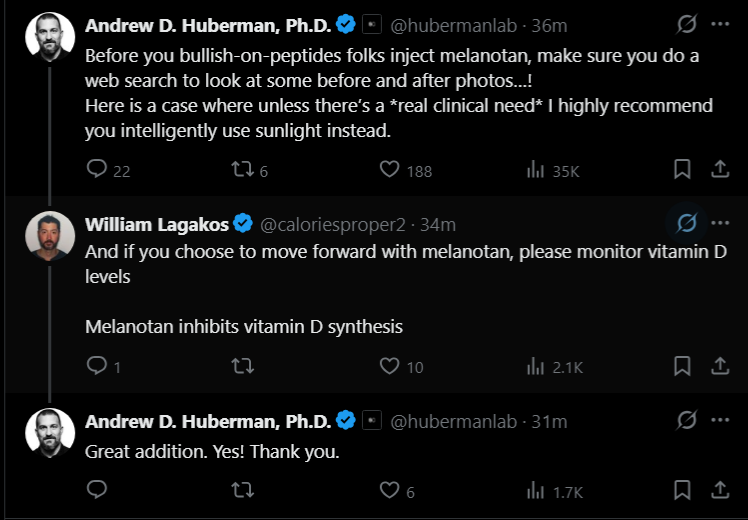
“Before you bullish-on-peptides folks inject melanotan, make sure you do a web search to look at some before and after photos,” Huberman wrote. “Here is a case where unless there’s a *real clinical need* I highly recommend you intelligently use sunlight instead.”
The neuroscientist’s concerns extend beyond aesthetic outcomes. In a follow-up post, Huberman revealed that people frequently contact him about Melanotan II after they have already taken it and experienced complications.
“Of all the peptides I get asked about this is the one I get asked after people have already taken it and they’re experiencing a range of perhaps permanent issues,” he stated.
Political commentator Kyle Kulinski brought attention to Kennedy’s alleged use of the compound during an episode of his show Secular Talk. “He takes a peptide that makes his skin darker. It’s like a bodybuilder thing that he does. Lord only knows why he does it,” Kulinski said, referring to what appears to be Melanotan II.
The peptide was originally developed as a potential treatment for certain skin conditions but gained popularity in fitness and bodybuilding circles for its tanning effects. It works by stimulating the production of melanin, the pigment responsible for skin color, without requiring UV exposure, though users often combine it with tanning to enhance results.
On the Iced Coffee Hour podcast, looksmaxxing influencer Clavicular recommended the treatment to host Jack Selby as part of his comprehensive approach to physical enhancement.
“That’s going to decrease your chances of getting skin cancer,” the 20-year-old content creator claimed, adding that “all you’re doing is preventing premature aging mechanisms by inducing melanogenesis so that the amount of UV exposure drastically decreases.”
However, experts have raised concerns about the compound’s safety profile and its effects on other biological processes. Researcher William Lagakos responded to Huberman’s warning with an additional caution: “And if you choose to move forward with melanotan, please monitor vitamin D levels. Melanotan inhibits vitamin D synthesis.” Huberman acknowledged this contribution, thanking Lagakos for the important addition.
Derek from More Plates More Dates, who has acknowledged long-term use of Melanotan II himself, has documented numerous side effects associated with the treatment. These include nausea, facial flushing, fatigue, appetite suppression, and changes in skin pigmentation such as darkening of freckles and lips, as well as an increase in the number of freckles.

The controversy surrounding Kennedy’s alleged peptide use is part of a pattern of unconventional health practices reported by the HHS secretary. According to Kulinski, Kennedy’s regimen extends far beyond Melanotan II. “He takes testosterone at 70 years old and he thinks human growth hormone is good for you,” the commentator stated.
Kennedy has also expressed favorable views toward nicotine, a position that conflicts sharply with established public health guidance.
“He thinks nicotine is good for you,” Kulinski noted. The HHS secretary is also reportedly focused on cellular health, with Kulinski remarking, “He’s obsessed with mitochondria.”
These personal health choices have created tension with Kennedy’s role overseeing agencies such as the CDC and FDA. His tenure at HHS has been marked by significant upheaval, including reported mass terminations and resignations. The CDC director reportedly departed after just one month, allegedly refusing to support policies that critics characterize as outside the mainstream of medical science.
Huberman noted that while prescription FDA-approved versions of melanotan exist for certain medical indications, the widespread use of unregulated versions presents a different situation entirely.
