
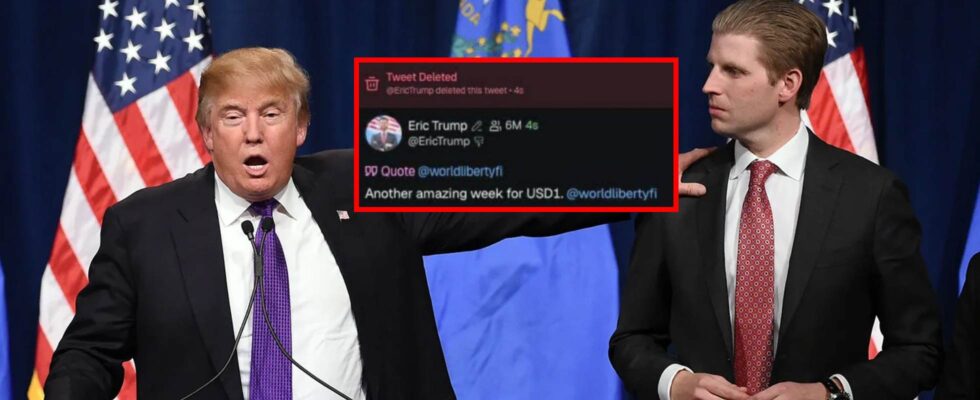
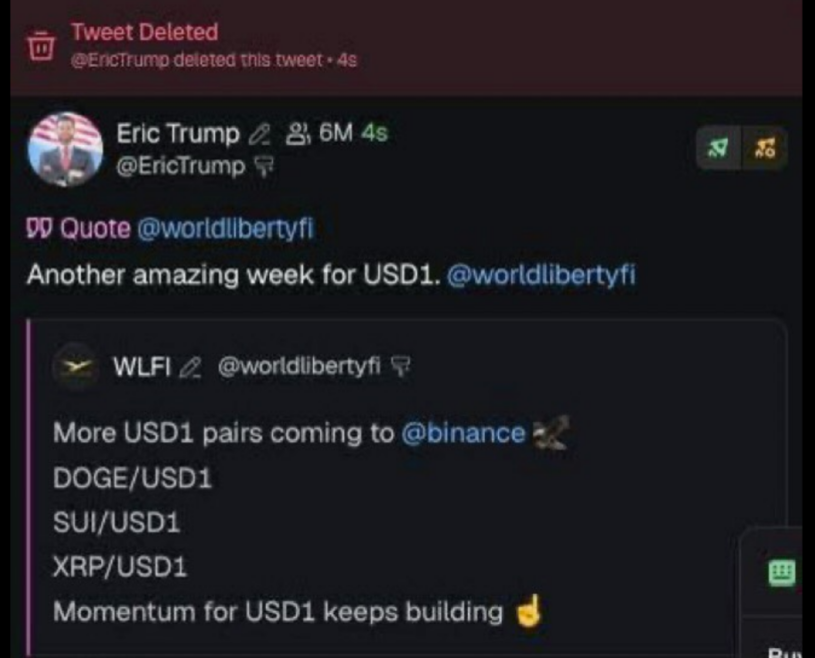
Screenshots circulated across social media this week show World Liberty Financial co-founder Eric Trump quietly deleting promotional posts about the Trump family’s cryptocurrency venture. This happens as digital asset prices continued their downward spiral despite what was supposed to be the industry’s golden age of political favor.

Among the vanished content is a tweet by Eric Trump retweeting and celebrating “another amazing week for USD1.”
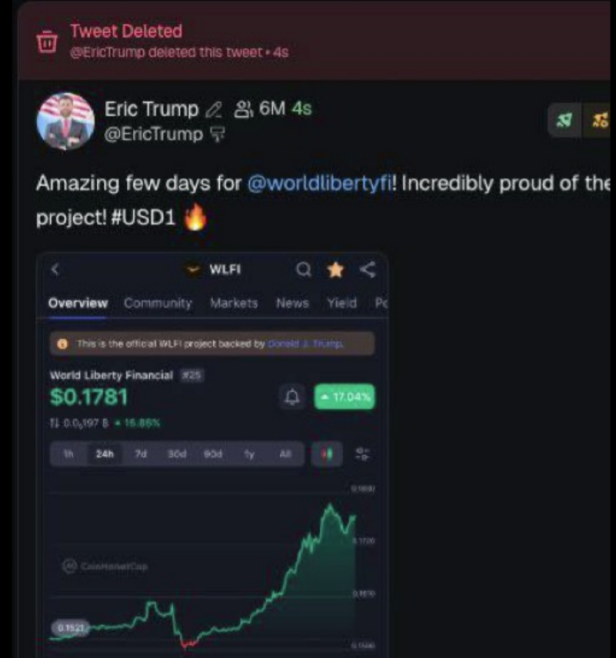
Another post shows him declaring “amazing few days” for the project alongside a price chart showing temporary gains.
The deletions came as Bitcoin shed roughly 45% from its October peak, trading down 23% year to date in early 2025, with a February 5th plunge of 13% marking its steepest single-day decline since the FTX collapse.
The timing represents an irony facing the cryptocurrency sector. After years of lobbying for regulatory acceptance and mainstream adoption, the industry finally secured everything on its wishlist: a supportive administration, a friendly Securities and Exchange Commission, and Wall Street exchange-traded funds channeling billions from traditional investors. Yet prices keep falling.
“Stablecoins are going to bring literally trillion dollars into the U.S. economy,” Eric Trump said at the World Liberty Forum held at Mar-a-Lago. “It arguably could save the dollar.”
He specifically promoted dollar-pegged stablecoins backed 1:1 by U.S. currency, arguing that global investors from countries facing corruption, weak governance, and “massive” inflation can now access dollar-backed assets tied to U.S. Treasuries and participate in the “greatest financial system” in the world.
World Liberty Financial’s USD1 stablecoin has reached a market capitalization exceeding $5 billion, making it the fifth-largest stablecoin and surpassing PayPal’s PYUSD and Ripple’s RLUSD in market size. The company has applied for a U.S. national banking license to issue and custody its stablecoin, a move that would grant significant regulatory legitimacy.
Yet the optimistic rhetoric stands in stark contrast to market realities. Bitcoin crossed the $100,000 milestone in December 2024, prompting celebrations among enthusiasts who believed regulatory barriers had finally fallen.
Wall Street’s entry through ETFs promised institutional liquidity that would smooth volatility and cement the digital gold thesis. Instead, the asset has behaved more like a high-beta technology stock, subject to the same interest rate shifts and liquidity pressures as traditional financial instruments.
The disconnect becomes more apparent when compared to actual precious metals. While gold and silver hit record highs this year amid rising geopolitical tensions, Bitcoin has languished.
The fundamental challenge lies in valuation: traditional assets derive worth from cash flows, commodities from utility and supply dynamics. Bitcoin fits the category of currencies and collectibles, deriving price entirely from scarcity and desirability.
While Bitcoin caps at 21 million units, the crypto industry produces over 10,000 active tokens, constantly diluting uniqueness.
Every major rally in recent years was fueled by anticipation of regulatory milestones and mainstream acceptance. Now that anyone can purchase Bitcoin through their brokerage account, there’s no compelling narrative left to drive prices higher. The underdog story dissolved when the president’s family began hosting crypto conferences at Mar-a-Lago and political figures launched their own tokens.
The pattern repeated internationally. In October 2025, the United Kingdom announced retail investors could hold crypto exchange-traded notes in tax-advantaged retirement accounts. The decision was implemented on October 8th, almost precisely when Bitcoin hit its all-time high.
According to Financial Conduct Authority data, the number of British citizens owning crypto fell from 7 million to around 5 million over two years.
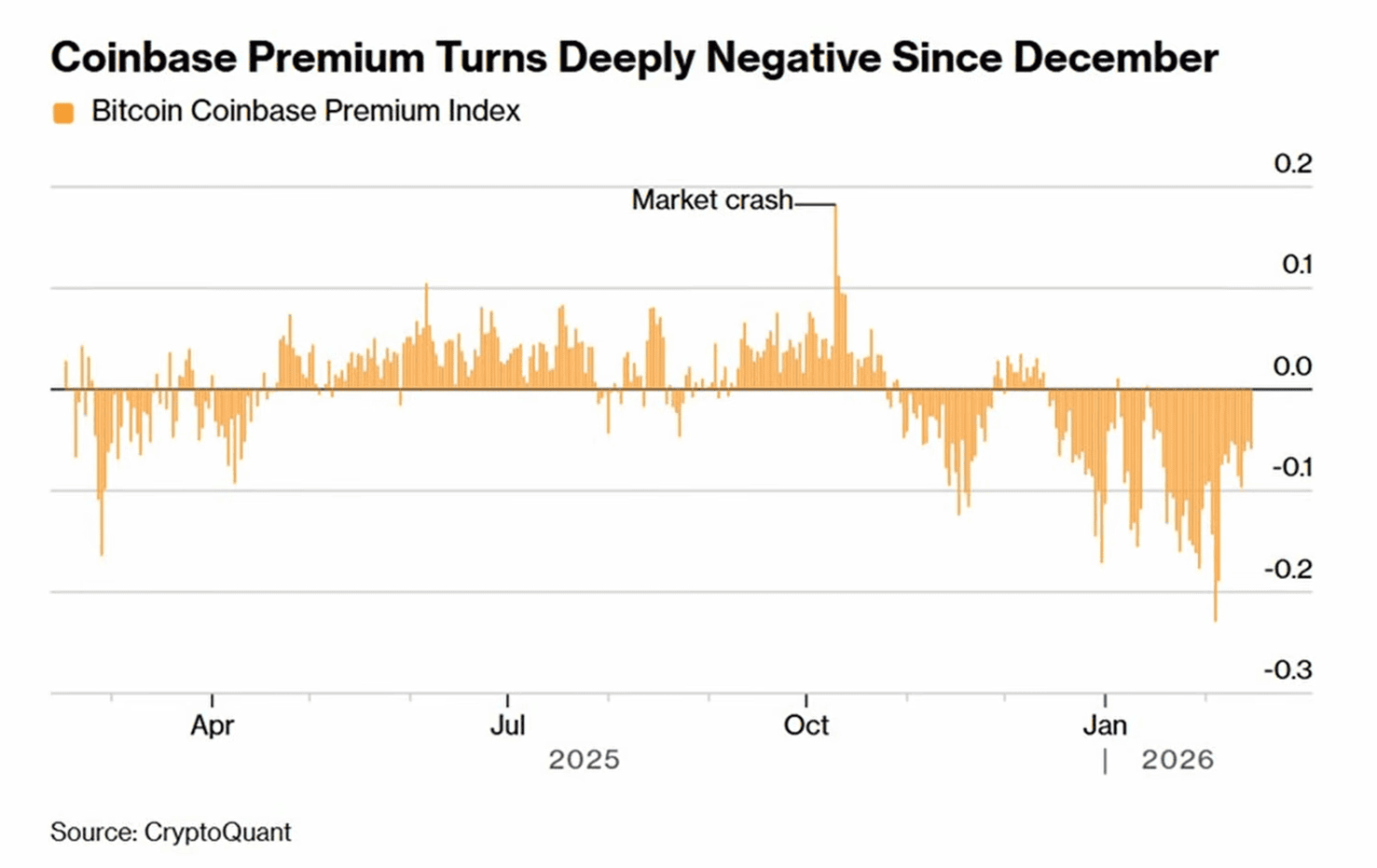
Institutional indicators show mounting stress. The Coinbase premium, which tracks price differences between Coinbase and Binance, has been deeply negative for months, indicating selling pressure primarily from United States institutions, the very market that was supposed to form crypto’s new foundation.
BlockFills, a Chicago-based prime broker serving 2,000 institutional clients and facilitating $61 billion in trading volume last year, suspended all deposits and withdrawals in early February.
MicroStrategy, rebranded as Strategy, reported a $12.6 billion loss in the fourth quarter of 2025, driven by marking Bitcoin holdings to market. The firm established a $2.25 billion cash reserve by selling equity, not to purchase more Bitcoin, but to pay dividends on preferred shares for the next two and a half years.
World Liberty Financial’s dealings have drawn scrutiny beyond market performance. Senator Elizabeth Warren alleged a possible quid pro quo involving the Trump family and Binance’s former chief executive.
Binance’s ex-leader, Changpeng Zhao, who was later pardoned by President Donald Trump, has denied the allegations. A Bank of America survey showed that investor positioning in the U.S. dollar has dropped to its most underweight level since January 2012.
Eric Trump said he remains bullish on Bitcoin, maintaining a $1 million price target. But the disappearanceof promotional posts from his social media feed and continue sliding of prices despite unprecedented political support represent something else.
