
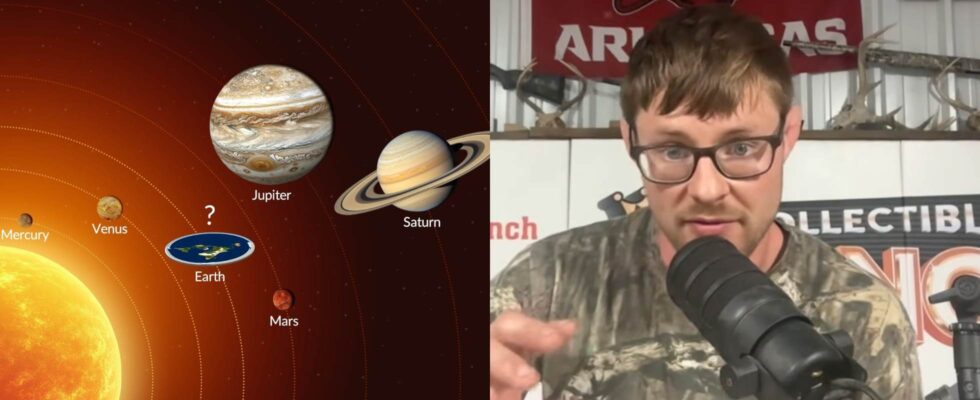
UFC star Bryce Mitchell dedicated a significant portion of his ArkanSanity podcast episode to explaining why he believes other planets do not exist, building on his previous assertion that Earth is flat.
His reasoning centers on a biblical interpretation that, even when examined within its own framework, contains logical inconsistencies and contradicts observable phenomena that anyone can verify.
During the episode, Mitchell stated his position clearly: “I don’t believe in other planets. I believe what the Bible teaches is that there’s one Earth and it’s the only planet and that we’re stuck inside of a firmament.”
He expanded on this view by claiming that extraterrestrial life cannot exist because Genesis provides no place for it.
Mitchell stated: “When we were created, everything is laid out in Genesis there. It says that humans were made in the image of God. There’s no such thing as an alien who is more divine than human creation is, that’s more significant than human creation.”
He continued: “The only creature made in the image of God as humans. I’m just telling you there’s not an alien out there. And if you read Genesis, there’s not other planets created for them to live. There’s not a place for these aliens to live.”
Mitchell connected this belief to his conviction about government deception: “If somebody was to say, ‘Hey, I’ve seen an alien.’ Like, I do believe that you’ve seen something. I’m not calling you a liar. Trust me, I believe you. Okay? But what I’m saying is just because you think you saw an alien from another planet, I’m telling you, I don’t believe in other planets.”
The most significant flaw in Mitchell’s reasoning appears when his interpretation is tested against the biblical text itself. Even within a biblical framework, the claim that other planets do not exist faces serious difficulties.
Ancient observers clearly distinguished between fixed stars and wandering stars, the visible planets like Venus and Jupiter that move across the sky in patterns distinct from background stars.
The Gospel account of the Magi following a star to Bethlehem presupposes astronomical awareness. Many biblical scholars have suggested this celestial phenomenon could have referred to a planetary conjunction involving Jupiter or Venus. If the Bible acknowledges these wandering celestial bodies in its narrative, then claiming the Bible denies planetary existence becomes problematic.
Furthermore, the creation narrative in Genesis lists the sun, moon, and stars in broad theological language. It does not function as a technical inventory of every celestial body, just as it does not list galaxies, comets, or asteroids.
Mitchell himself referenced “the four corners of the earth” multiple times: “This is called the four corners of the earth. And this is what I believe in because the Bible teaches it. The Bible says there are four corners to the earth at least three times. And the reason that it says that is because I believe that there are a true four corners to the earth.”
Yet this interpretive approach creates a contradiction. If poetic language about Earth’s corners must be taken literally, why not other observational descriptions?
The Bible describes the sun rising and setting using the same phenomenological perspective that ancient people used to describe all celestial motion. This perspective does not constitute a cosmological claim about planetary existence or non-existence.
Mitchell’s claims about planets face another fundamental problem: observable planetary motion stands independently of any space agency or modern technology. Anyone with a basic telescope can observe Jupiter’s moons orbiting the planet, just as Galileo did in 1610.
Venus displays phases visible through modest magnification, demonstrating its orbit around the sun. Mars displays retrograde motion as Earth passes it in orbit, a phenomenon that ancient astronomers noted and attempted to explain.
These observations require no trust in government agencies or modern science. They are reproducible by anyone with patience and basic optical equipment.
Mitchell’s reasoning about magnetism and the North Pole reveals another logical inconsistency. He argued: “Take your compass, watch it point north. Hold it level. Watch it point north. Why is that compass needle pointing north? Okay? Because the red tip of the needle there is magnetized. And on the smooth surface of a compass, when laid level, flat, there’s so little friction that the magnetized needle can be pulled north consistently.”
He used this observable phenomenon to support his belief in a massive magnetic rock at the North Pole. Yet this same reasoning, when applied to planetary observation, should lead him to accept that planets exist. If consistent, reproducible observations with simple instruments validate his magnetic field theory, then consistent, reproducible observations of planetary motion through telescopes should validate planetary existence.
Mitchell cannot logically accept compass observations as proof of his magnetic theory while rejecting telescope observations of planets as fabrication.
