

Stanford neuroscientist Andrew Huberman has signaled that significant changes may be coming to peptide regulation in the United States. He recently hinted at government-level discussions that could expand legal access to these controversial therapeutic compounds.
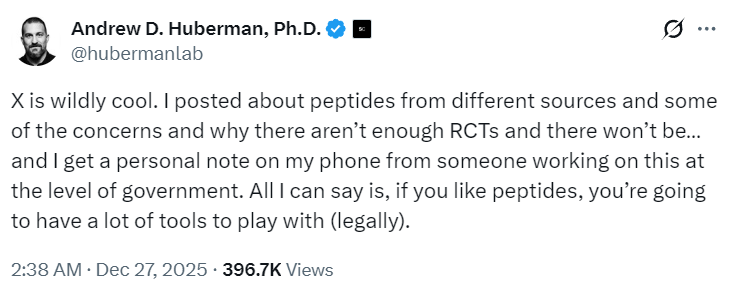
The announcement came through a series of posts on X, where Huberman revealed he received direct communication from someone working on peptide policy at the federal level.
“I posted about peptides from different sources and some of the concerns and why there aren’t enough RCTs and there won’t be… and I get a personal note on my phone from someone working on this at the level of government,” Huberman wrote. “All I can say is, if you like peptides, you’re going to have a lot of tools to play with (legally).”
The timing of Huberman’s comments aligns with shifts in health policy under the new administration.
Robert F. Kennedy Jr., recently appointed Secretary of Health and Human Services, has publicly committed to transforming the FDA’s approach to alternative medicine during an appearance on the Ultimate Human Podcast with Gary Brecka.
“We’re going to end the war at FDA against alternative medicine: the war on stem cells, the war on chelating treatments, the war on peptides,” Kennedy stated. He emphasized that this policy change would extend to vitamins, minerals, amino acids, and other nutrients that have faced regulatory obstacles.
Kennedy’s position represents a fundamental philosophical shift in how federal health agencies might operate. Rather than restricting access to treatments that fall outside conventional pharmaceutical channels, he advocates for the FDA to conduct rigorous research and inform the public while respecting individual choice.
“We don’t want to have the wild west,” Kennedy explained, “but we also want to respect the intelligence of the American people.”
The current regulatory environment has pushed many Americans to seek peptide therapies through gray market sources or compounding pharmacies operating in legal uncertainty.
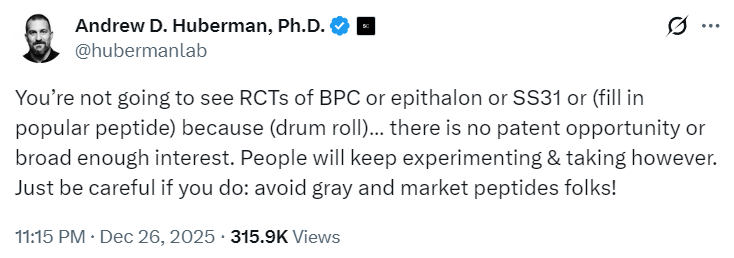
Huberman has consistently warned his audience about the risks of unregulated peptide suppliers. “Just be careful if you do: avoid gray market peptides folks!” he cautioned in one post.
One of the central challenges facing peptide research is the lack of randomized controlled trials for popular compounds. Huberman addressed this directly, noting that studies are unlikely to materialize for many widely used peptides.
“You’re not going to see RCTs of BPC or epithalon or SS31 or (fill in popular peptide) because (drum roll)… there is no patent opportunity or broad enough interest,” he wrote.
Without patent protection, pharmaceutical companies have little financial incentive to fund the expensive clinical trials required for FDA approval. This creates a regulatory paradox where compounds remain in legal limbo despite widespread interest and anecdotal reports of benefits.
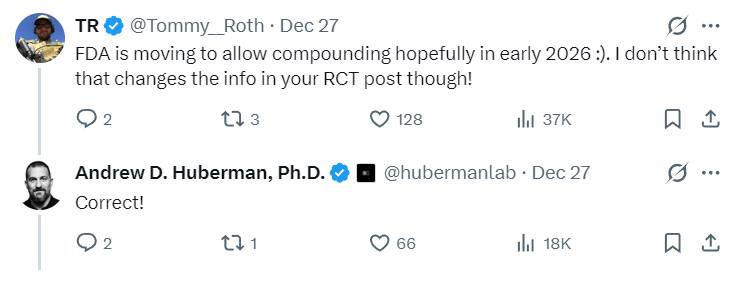
According to one commenter, the FDA may move to allow compounding as early as 2026, which would create a legal pathway for some peptide access through licensed pharmacies. Huberman confirmed this timeline but noted it wouldn’t change the fundamental challenge of limited clinical trial data.
Kennedy’s broader health agenda seeks to address what he describes as an epidemic of chronic illness consuming roughly 90% of America’s healthcare budget. He oversees HHS, which commands a $1.9 trillion budget, which is twice the size of the Pentagon.
Kennedy noted that when President John F. Kennedy was in office, the United States spent essentially nothing on chronic conditions. Today, that figure has reached approximately $1.6-1.7 trillion annually.
The new HHS Secretary has pointed to research from Peter Gøtzsche, a founder of the Cochrane Collaboration, indicating that pharmaceutical treatments are the third leading cause of mortality in America, after heart conditions and cancer. This statistic underpins Kennedy’s argument for expanding treatment options beyond conventional pharmaceutical channels.
Kennedy’s personal experience illustrates the current regulatory landscape. He revealed that he traveled to Antigua to receive stem cell treatment for his throat condition because such therapies aren’t readily available domestically.
“They helped me enormously. Why did I have to go to Antigua for that?” he asked, highlighting what he views as unnecessary barriers to care.
Part of Kennedy’s strategy involves addressing conflicts of interest within regulatory agencies. He noted that seven of the eight most recent FDA commissioners went to work for pharmaceutical companies immediately after leaving government service, creating what he sees as problematic incentives.
Kennedy plans to redirect 20% of the National Institutes of Health’s $46 billion budget toward replicating studies and publishing peer reviews with greater transparency. He has also suggested potentially moving away from publication in major medical journals, which he claims have become compromised by pharmaceutical influence.
For Huberman’s millions of followers, many of whom have expressed interest in peptide therapies for everything from recovery to longevity, the neuroscientist’s hints about regulatory changes represent potentially welcome news. However, he has made clear that expanded legal access won’t necessarily come with the clinical trial data many would prefer.
The neuroscientist acknowledged that individual experimentation with peptides will likely continue regardless of regulatory status, but emphasized the importance of obtaining compounds from legitimate sources once legal channels become available.
As Kennedy put it during his podcast appearance, “A healthy person has a thousand dreams. A sick person only has one.”
With 60% of Americans reportedly managing chronic conditions, the potential regulatory shift on peptides represents just one element of a broader rethinking of how the federal government approaches healthcare access and individual medical choice.
