
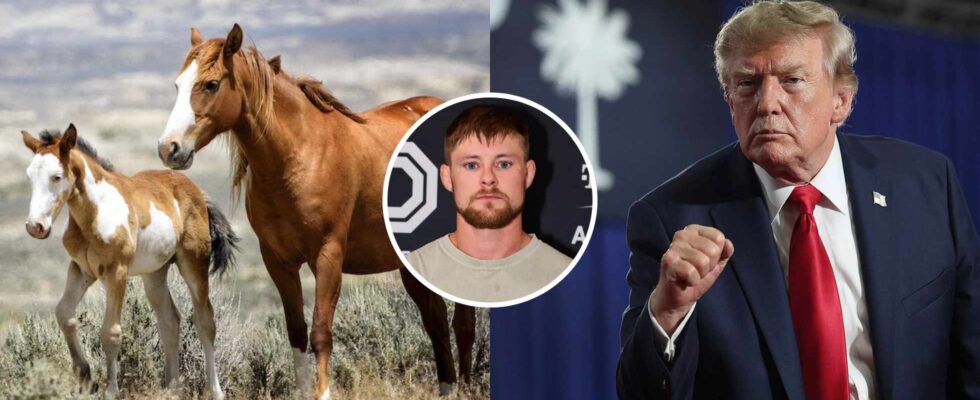
Bryce Mitchell has never been shy about sharing his theories with the world, and his latest one connects two things you wouldn’t expect to see in the same sentence: the Trump administration and the fate of America’s wild horses.
The UFC bantamweight took to social media with a strange claim. According to Mitchell, the removal of wild mustangs from Western rangeland isn’t about ecological balance or herd management at all. It’s about mobility, and who gets to have it.
“I believe that Trump is actually k*lling all of the horses because they’re going to be a viable source of transportation for our rebel army once they cut our power and our fuel,” Mitchell said.
He didn’t stop there.
“Yes, they’re also going to grind these horses up and put them in hamburger meat and sell them back to us, you know, for pennies on the dollar and it’s going to hurt the American farmers, I get that too,” he noted. “But the real reason they’re k*lling these horses is so we can’t use them for transportation. They’re about to shut our grid down. God bless y’all and get ready. Thank you.”
It’s a striking picture: a future where the power grid goes dark, fuel becomes scarce, and the last mode of transportation left to ordinary citizens gallops across the plains, unless the government gets to them first.
The wild horse roundups Mitchell is referencing are very real, even if the motive he assigns them isn’t backed by anything the Bureau of Land Management has said publicly. Reporting from NPR affiliate coverage in Colorado followed one such operation this month in the Piceance-East Douglas Herd Management Area, about an hour outside Meeker, where a helicopter chased small bands of mustangs across the sagebrush and pushed them toward a capture pen. Around 1,000 horses were slated for removal in that single gathering.
The BLM, a branch of the Interior Department, manages both the horses and the rangeland they live on across ten Western states. When officials decide the population has outgrown what the land can sustain, they thin the herd.
Nationally, the agency currently holds roughly 60,000 horses in off-range facilities, at a taxpayer cost of about $100 million a year. Meanwhile, an estimated 85,000 or so mustangs remain free on public land, a number dwarfed by the millions of cattle that also graze there.
The people who watch these roundups happen don’t always agree on what they mean. Horse advocate Robyn Smith, who has traveled across the West photographing mustangs, described the heartbreak of watching families torn apart in the process.
“That’s a family. That’s a family out there,” she said. “It’s a family broken.” The BLM does keep young foals with their mothers when possible, but beyond that, reunions are unlikely.
Others see the roundups differently. Rio Blanco County Commissioner Callie Scritchfield, a former rancher, argues that captivity beats starvation. She’s watched horses struggle in the wild and doesn’t romanticize it. She recalled finding one stuck in a mud hole, “trying to get the last drop of water, but he’s bogged down. He don’t have the strength to get out. It’s not pretty.”
Inside the holding pens, she said, “You never see a skinny one in there. He’s always got something to eat every day, and he’s got a drink of water every day.”
Range specialist Troy Osborn, a former U.S. Forest Service employee, frames the issue as one of shared land under pressure from too many grazing mouths, horses and cattle alike.
“We want to see the ground healthy. We want to see it productive,” he said. “We want to see it used by all animals, by all species.”
Ranchers counter that their cattle are tightly managed, while wild herds can double in size within a few years if left alone, which is the justification the BLM gives for stepping in.
Not every horse that gets rounded up ends up in long-term holding. About 8,000 were adopted or sold last year.
Even among the horses being loaded onto trailers, there were flashes of resistance. Advocate Heather Hellyer watched several animals rear against the helicopter before being caught, and a few slipped past the wranglers entirely, vanishing back into the open country.
The controversy deepens with reports that some captured mustangs may be ending up with questionable buyers. Wild horses have reportedly been sold for as little as $25 and later appeared at livestock auctions frequented by slaughter buyers, with some eventually being exported to Canada, where horses can fetch up to $750 at slaughter plants.
In one case, four horses sold to Ohio livestock trader Brandon Jones were reportedly found at a Tennessee auction frequented by slaughter buyers, although Jones denied sending horses to slaughter. Similar patterns were reportedly found at adoption events, including one in Oklahoma where at least 55 mustangs later appeared at auctions in Kansas and Texas. The BLM maintains that it does not sell or send horses to slaughter and says allegations of violations are taken seriously, but critics argue the agency is allowing third-party buyers to exploit a loophole in the system.
