
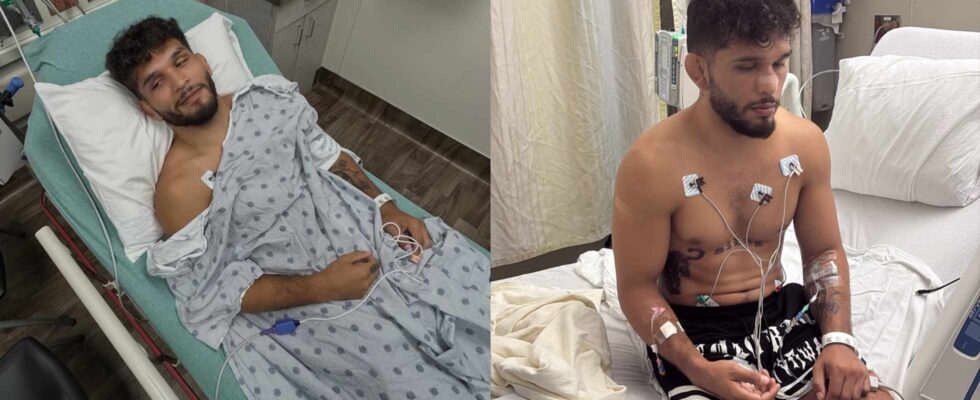
Danny Silva’s promising mixed martial arts career has come to an abrupt and unexpected end at just 29 years old after a medical emergency that nearly cost him his life.
The UFC flyweight recently shared the devastating news on social media. According to it, he discovered multiple blood clots in his body, including a massive thrombosis in a vein in his neck.
Part of that clot broke off and traveled to his lung, causing a pulmonary embolism, a potentially life-threatening condition that doctors say claims half of those who experience it.
“Two weeks ago I thought I had a rib out. I pushed through like every fig hter does,” Silva wrote in an emotional social media post. What he initially dismissed as a minor injury turned out to be something far more serious, though the warning signs were subtle enough that he continued training at full intensity.
The discovery came after an evening training session where Silva mentioned to his team that his left arm and rib were bothering him. After his teammates helped with cupping and scraping therapy, he headed out for what should have been a routine three-mile run at 8 p.m.
“On the 3rd mile, my body was shutting down. I pushed because I won’t quit on myself, and 3 miles should be nothing,” Silva explained. When he returned home, swelling had developed on the left side of his neck and chest. It was alarming enough that a doctor friend urged him to go to the emergency room immediately to rule out a heart attack.
After nine hours of testing, including EKGs and CT scans, medical staff delivered the life-altering diagnosis. Silva spent three nights in the hospital as doctors worked to stabilize his condition and prevent further complications.
In a twist of irony, the very conditioning that defined Silva’s career may have been what saved his life. “The fact that I was training, sparring, and pushing myself may have saved my life,” he reflected. His cardiovascular fitness likely helped his body withstand the clots that were silently threatening his existence even as he continued sparring just days before the emergency.
The realization that he had been competing at such a high level while harboring a potentially lethal condition speaks to both his toughness and the dangerous nature of combat sports, where athletes routinely train through pain and discomfort.
“The fact that I was still sparring and in such good shape just tells me how tough I can be in the face of adversity. Because I’m in such good shape I was able to survive,” Silva said.
Now out of the hospital, Silva faces months of medication and an uncertain future. For someone whose identity has been built around physical performance and competition, the sudden halt to training represents more than just a career setback.
“My worst enemy has always been me. My mind is strong. It sucks when something out of your control tries to take you away from your dream,” he admitted, capturing the frustration of an athlete sidelined not by an opponent, but by his own body.
Silva expressed gratitude to the medical professionals who cared for him and the loved ones who remained by his side throughout the ordeal. “My nurses and doctors were incredible, and I’m beyond grateful for the care I received. To my friends and family who showed up, stayed with me, and never left my side, I felt all the love.”
While Silva has not yet made a definitive statement about retirement, the severity of his condition and the extended recovery period make a return to competition highly uncertain.
“I won’t give up. I’d rather try, as bad as that sounds, especially because I was close to that moment,” Silva wrote, his determination evident even in the face of a medical crisis that has fundamentally altered his path forward.
