

A grassroots football club and one of its players have allegedly violated Football Association regulations by allowing a transgender athlete to compete in women’s matches months after new restrictions took effect, according to recent reports.
The West Yorkshire Whippets, a volunteer-run club in northern England, reportedly fielded the player in multiple fixtures during the summer season, including on June 1—the very day the FA’s ban on transgender women in female football officially came into force.
Team sheets published on the FA’s official website indicated that the player started in two matches and appeared on the bench for a third during the West Yorkshire Whippets Developers Women’s opening fixtures in the Harrogate & Craven Junior Girls Football League.
The alleged breach came to light after SEEN in Sport, an advocacy group focused on fairness in women’s athletics, brought the matter to the attention of football authorities. The FA has since confirmed that the individual’s registration has been cancelled, though details surrounding any potential disciplinary measures remain unclear.
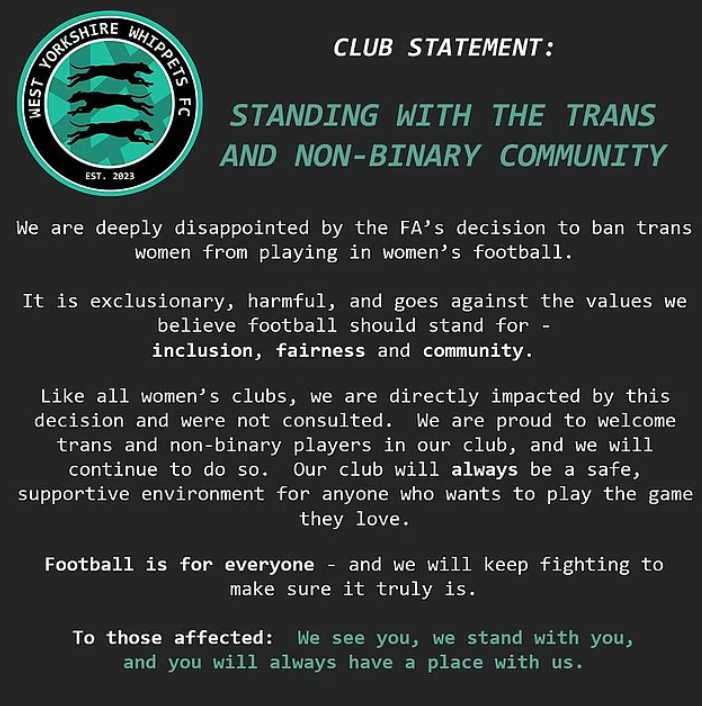
The West Yorkshire Whippets had previously made their position clear when the FA announced its policy change in May. In a public statement, the club condemned the new rules as “exclusionary, harmful, and goes against the values we believe football should stand for—inclusion, fairness, and community.”
When contacted about the current allegations, the club maintained its stance on player privacy. “We’re a small, volunteer-run grass-roots club focused on creating a safe and welcoming environment for everyone,” a club representative stated. “We do not comment on individual players for privacy and safeguarding reasons.”
The club’s earlier statement had emphasized their commitment to inclusion: “We are proud to welcome trans and non-binary players in our club, and we will continue to do so. Our club will always be a safe, supportive environment for anyone who wants to play the game they love.”
Sue Wong, spokeswoman for SEEN in Sport, questioned the apparent disparity in enforcement. “A girl was punished with a six-match ban last year just for asking why there was a man on a women’s team,” Wong said. “Why is there no similar reaction to breaches of the new FA policy? Every week that went by with inaction from the league, women faced unfair sport, injury risk, harassment and discrimination.”
The FA’s policy shift followed a landmark Supreme Court ruling in April that determined the terms “woman” and “sex” in the Equality Act refer specifically to biological women and biological sex. Prior to the ruling, the FA had permitted transgender women to participate in women’s football under certain conditions, including testosterone reduction requirements.
Following the court decision, the governing body acted on legal counsel and implemented a complete ban on transgender women competing in the female game. The policy change affected approximately 20 transgender women who had been playing in grassroots football the previous season.
At the time of the ban’s announcement, the FA acknowledged the impact on affected players. “We understand that this will be difficult for people who simply want to play the game they love in the gender by which they identify, and we are contacting the registered transgender women currently playing to explain the changes and how they can continue to stay involved in the game,” the organization stated.
Both the FA and West Riding FA, the regional governing body, declined to provide specifics when questioned about potential disciplinary action against the club or player involved in the alleged violation.
“We are not in a position to discuss individual cases,” a West Riding FA spokesperson explained. “However, we can confirm that we have worked with the relevant league to find a resolution to this matter.”
The West Yorkshire Whippets had joined other organizations in co-signing a letter calling for the FA to reverse its policy changes, emphasizing their belief that “football is for everyone.”
