

The reel starts with a familiar kind of promise. A man talks about discipline and personal change, hinting at a dramatic transformation. Then, almost casually, he directs viewers to the link in his bio. The caption reads: “I used to avoid mirrors. Now I can’t believe what I see.”
That link leads to a Payhip storefront run under the name Victor Sterling, the account behind @sterlingfitness__ on Instagram. There, visitors can browse four fitness products priced between $12.99 and $19.99, including a recipe guide credited with helping lose 100 pounds (45 kg) and a twelve-week workout program.
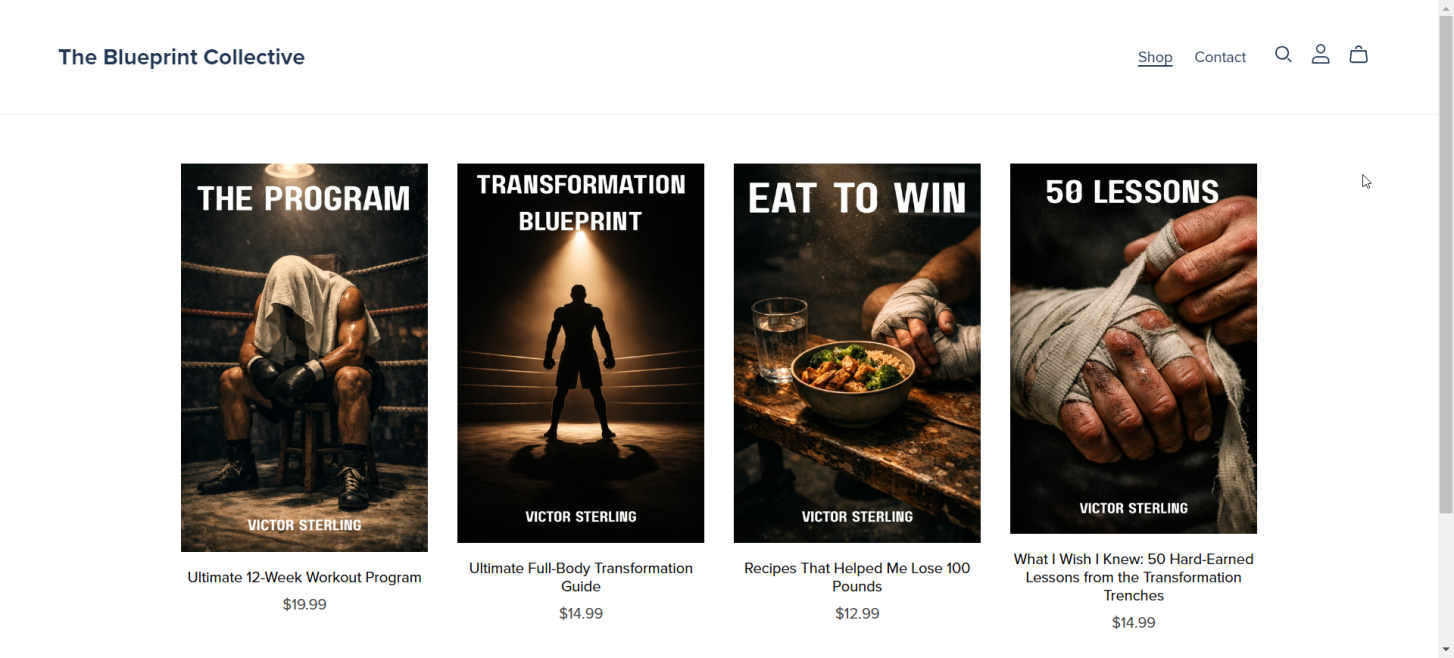
Every single cover image appears to have been generated by artificial intelligence. There is no about page. Nowhere on the site does it disclose whether the content is AI-produced.
The reel in question has drawn 2.6 million views. Sterling’s account, by contrast, has roughly 4,000 followers, a gap that speaks less to the creator’s reach and more to the mechanics of how short-form video gets distributed.
Sterling’s operation is modest compared to what has emerged elsewhere in the AI wellness space. Earlier this year, an account operating under the names Yang Mun and Yangmug built roughly 2.4 million followers across Facebook, TikTok and Instagram in approximately three months.
The persona presented as a Chinese healing monk offering spiritual health guidance, with content aimed at health-conscious American users. Researchers who examined the account concluded that the scenery, voice, facial features, displayed characters and scripted dialogue were all AI-generated, forming what appeared to be a fully automated production pipeline.
In one widely circulated video, the character spoke directly about anxiety and used the moment to promote a paid program: “What once protected the child becomes exhaustion in the adult. Anxiety is not a brokenness. It is adaptation. It is the nervous system saying, I learned this to keep you safe. Healing does not come from fighting the system, but from slowly teaching it that survival is no longer required. This is why the 30-day healing journey exists, not to fix you, but to gently guide the body out of constant alertness, one day at a time.”
That program was priced at $49.99. The account also promoted a $10.99 ebook. Despite the account’s reach, AI disclosure notices, when they appeared at all, were reportedly small enough to miss.
