
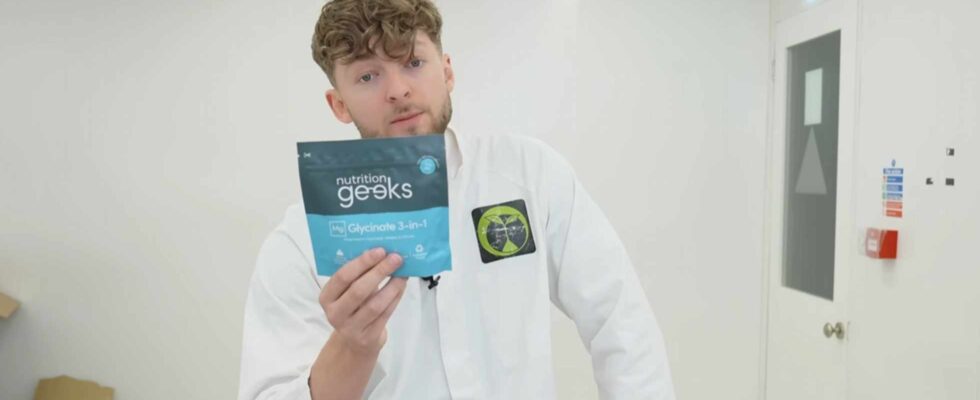
A UK-based health content creator who runs the channel Logan Talks Health has published a follow-up video after Nutrition Geeks disputed his third-party lab testing of their supplements. The company said his testing methods were inappropriate, released its own lab results, and reportedly threatened legal action if the original video was not removed.
In his response video, the creator addressed the company’s statement point by point, starting with magnesium, an issue Nutrition Geeks did not mention at all in their public reply. He had originally pointed out that the forms of magnesium listed on the label, citrate, malate, and glycinate, cannot chemically add up to the total elemental magnesium claimed. The maximum possible from those forms totals 254 mg, 130 mg short of the labeled amount.
To verify this, he consulted Professor Dr. Jürgen Vormann, former president of the German Society for Magnesium Research, who has published 280 studies on magnesium.
“That’s simple chemistry, because the citrate anion is larger than the magnesium. Roughly about only 15% of the whole is magnesium. You can’t change it. You cannot fill in more magnesium into the citrate. You can’t do this. The chemistry is, you can’t betray the chemistry,” Vormann said.
When asked whether brands might list a higher dose while quietly adding oxide, he added, “This can’t work. You can’t fool the chemistry. This is not possible.”
On milk thistle, the creator noted the lab report Nutrition Geeks supplied was for a different batch, and the lab is not ISO 17025 accredited. He argued their preferred UV testing method is not what modern pharmacopoeias recommend for measuring silymarin, HPLC is.
Prof. Dezső Csupor, a Hungarian authority on medicinal plant testing, explained that UV spectrometry cannot separate silymarin’s individual compounds.
“This is some kind of a very severe bias, which makes that the amount that you measure with UV is usually higher or much higher than that you measure by HPLC,” he said. Nicholas Oberlies, PhD, agreed the compounds share nearly identical UV profiles, making HPLC the more refined measurement.
For ashwagandha, Nutrition Geeks’ supplier, KSM-66, said its product doesn’t claim compliance with the United States Pharmacopoeia and instead uses an in-house method reportedly shared only under non-disclosure agreements.
Ashwagandha Standards Alliance co-founder Blake Ebersole described this pattern industry-wide: “A lot of consumers are getting ch3ated on whatever they think they’re getting. They’re not getting whatever milligrams of withanolides that is on the label. They’re getting whatever is in the product.”
The creator said he first raised these questions with Nutrition Geeks on July 16, 2026, and had received no response as of filming on August 23. He said he remains open to a follow-up video if the company shares its testing methods.
