

Ross Ulbricht spent over eleven years learning the specific sound of a steel door sealing him inside a cell, and in a clip aired by CSPAN, he described that sound as something that never stopped registering.
“When you are in prison, there is a certain sound that a steel door makes when it closes behind you and you’re locked inside,” he said. “I heard that sound every day for over 11 years.”
He compared liberty to something invisible until it disappears.
“Freedom is like air. You don’t think about it. You don’t notice it. But when it’s gone, you gasp, you suffocate, you do everything you can to get it back.”
The founder of Silk Road, the online marketplace shut down by federal agents in 2013, framed his prosecution as an injustice from the start.
“I lost my freedom to a corrupt federal investigation,” he said. “I was accused of crimes I did not commit.” He described the toll of a public case built against him. “I was smeared in the media, and even as a first time offender, I was sentenced to die in prison. No parole.”
What kept him going, in his telling, was the refusal of the people closest to him to give up.
“I thought I had lost everything, but my wife never stopped. My mother never stopped.The most beautiful women I know.”
He said the circle widened beyond his household into a community of strangers who adopted his case as their own. “And we were not alone. People I had never met. Libertarians, Bitcoiners, just normal Americans who care about freedom and justice.”
That momentum, he said, eventually reached the man who would become his path out.
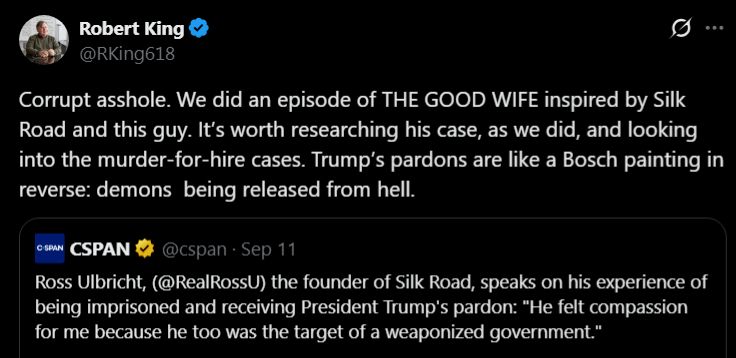
“Because they would not stop, President Trump heard about my case. He felt compassion for me because he too was the target of a weaponized government.” He recounted a campaign promise turned into policy on day one. “He said that if the American people sent him back to the White House, he would free me. The day after he took office, he pardoned me. He kept his word and I walked out.”
The clip found its way to television writer and producer Robert King, who was unmoved. King, whose credits include an episode of The Good Wife that drew on the Silk Road saga, made clear he had spent real time examining Ulbricht’s record before forming an opinion, and what stuck with him were the murder-for-hire allegations that trailed the case, allegations Ulbricht was never convicted on but that shadowed his prosecution regardless.
King described Trump’s approach to clemency in stark visual terms, likening it to a classical vision of the underworld run in reverse, with troubling figures being sent back out into daily life rather than kept away from it.
The moment carried its own layer of irony given that King’s show aired on a network with its own reported ties to the president, even as that same network’s investigative unit had previously dug into the mechanics behind the administration’s use of the pardon pen.
Ulbricht’s story, as sympathetic as he made it sound, is one thread in a much larger pattern of clemency decisions that have defined this presidency. Political allies have received relief. Every participant charged over the events of January 6 was cleared.
Financial figures convicted of elaborate schemes have walked free after arguing, in the same language Ulbricht used, that prosecutors had gone after them unfairly. The pattern has become predictable enough that a specific kind of professional has emerged to exploit it: people who position themselves as go-betweens capable of getting a case in front of the president, for a price.
According to sources, Ammon Covino found this out firsthand. Convicted on wildlife trafficking charges and having already served nearly two years, he tried the traditional route first, submitting an application through the Department of Justice, and was turned down.
He then reached out to a dozen brokers advertising influence, and the replies came back fast, one pair answering within seven minutes. Those two, Jack Burkman and Jacob Wohl, described themselves as capable of applying pressure “from all directions in a consistent way to force his hand,” and priced their services at $300,000, a package that included event tickets, a possible fundraiser seat costing $10,000 on its own, and access to unnamed contractors and influencers who claimed proximity to decision makers. A standard clemency petition, by comparison, costs the price of a stamp.
Covino was not their only client.
A rapper going by a stage name Boosie Badazz paid the same two brokers $600,000 upfront after receiving text messages naming a list of well-connected figures, including a prominent commentator, a nonprofit leader, the Speaker of the House and a White House aide, as people who could move his petition forward.
No pardon ever arrived. Every name on that list has denied any involvement, and the rapper is now suing to get his money back.
Law professor Mark Osler has watched the shift with concern, describing the current process as something closer to a free-for-all than a system, one that rewards applicants who frame themselves as targets of an overreaching Justice Department rather than those who express remorse for what they did.
The numbers back up his read: roughly seventy percent of this term’s clemency grants have skipped the Department of Justice’s review process entirely, a figure that climbs to ninety-two percent once the January 6 cases are folded in, all while some sixteen thousand applications sit untouched in the department’s queue.
Money keeps surfacing near the outcomes. One recipient of clemency had funneled close to two million dollars into campaign coffers beforehand. A cryptocurrency exchange made a financial contribution tied to a Trump family business venture around the same time one of its executives caught a break.
A healthcare executive’s mother wrote a check for a million dollars to attend a Mar-a-Lago fundraiser before a favorable outcome followed. Ed Martin, who recently led the DOJ’s pardon office, has rejected any suggestion of a direct exchange, dismissing the brokers themselves as little more than con artists cashing in on desperate people. The White House has offered its own dismissal, characterizing anyone paying for this kind of access as simply throwing money away.
Set against that backdrop, Ulbricht’s televised gratitude reads differently to different audiences. To his supporters, he is proof that a grassroots campaign, built by a spouse, a mother and strangers online, can still move a president to act.
To critics like King, he is a data point in a much less flattering trend, one where the line between a genuine wrongful conviction and a well-managed public relations campaign has grown difficult to see.
