
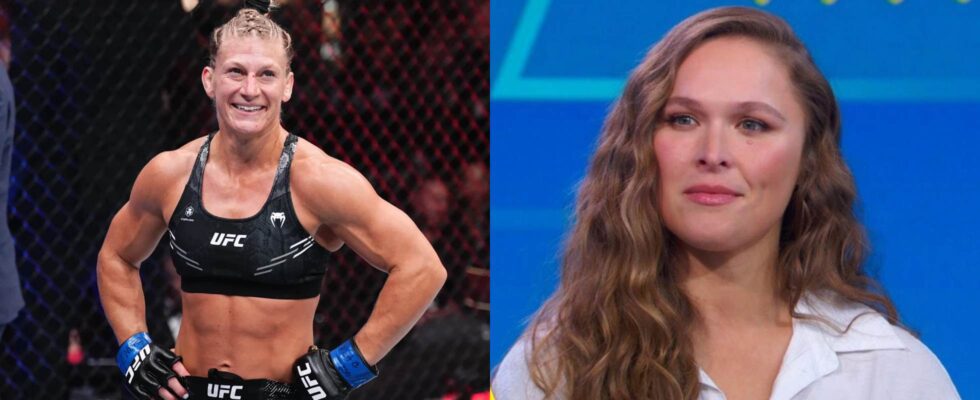
Ronda Rousey has built women’s MMA from the ground up and in a recent interview, she turned her focus to the current state of the women’s 135 lbs (61.2 kg) bantamweight division and talked about where today’s athletes are coming up short.
“In general, everybody’s doing a good job,” she said. “But everybody’s too afraid to offend.”
For Rousey, the problem runs deeper than tactics or technique. She sees a fundamental misunderstanding among the current generation of women about what their role actually requires.
“A lot of the women are having the same issue that they were having when I first came into women’s MMA,” she said. “They think that their job is to be liked, to be universally liked, and to avoid criticism. I think it’s their job to drive discussion and to create stories behind their matches.”
She also pointed to a false sense of security within the division as part of what is holding athletes back.
“They need to remember that they’re always still competing for their place,” she said. “They’re always still competing to be a headliner.”
The area where Rousey sees the widest gap is media. She described her own approach to interviews as a deliberate, ongoing exercise in self-improvement.
“I think about every question that could be asked of me and try to already think of what would be a good answer for that,” she said. “And every time I answer a question, I think, how could I have said that more succinctly? How could I have said that better? And if I’ve said it too many times, how can I answer that in a different way?”
What she observes from athletes today is the opposite of that preparation.
“A lot of the women, you can tell they’re not putting any thought into it until they’re asked, and it shows. Nothing memorable is coming out of their mouths.”
For Rousey, a lack of memorable moments is a genuine threat in a sport built on spectacle and personality.
“That’s what sets MMA apart from the Olympics,” she said. “This is entertainment. You are professionals and your job is not just to show up and compete. Your job is to get people to watch you compete.”
And she made clear that playing it safe does not serve that goal.
“Outrage drives engagement. You’ve got to be a little bit outrageous sometimes.”
