
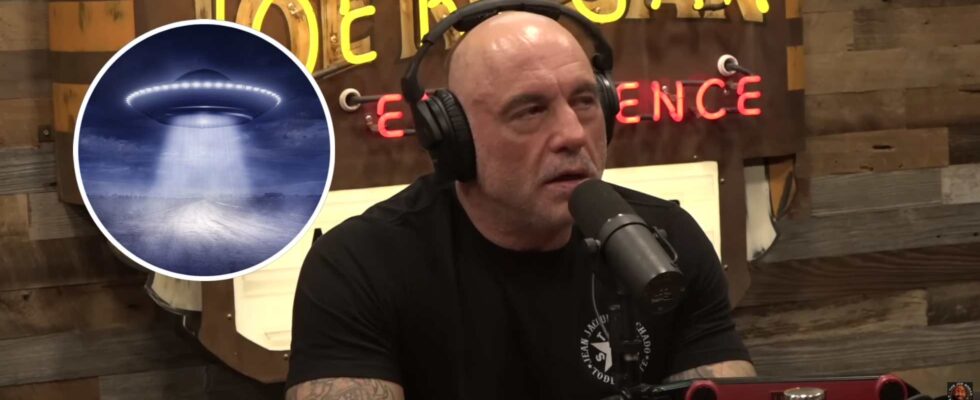
In a conversation with filmmaker Dan Farah on The Joe Rogan Experience, host Joe Rogan made clear his frustration with those who dismiss UFO phenomena outright. He positioned skepticism itself as an obstacle to understanding what multiple government officials now claim is real.
The interview, which promoted Farah’s documentary “The Age of Disclosure,” saw Rogan repeatedly challenging common dismissive arguments while championing the credibility of whistleblowers and military witnesses.
“The idea that people can’t keep secrets—shut the f**k up. Yes, they can,” Rogan declared, directly confronting one of the most common rebuttals to UFO conspiracy theories.
He argued that by the time someone reaches the level of “high-level operative in the United States government,” they’ve proven capable of maintaining secrecy, especially under threat of legal consequences or personal harm.
Rather than UFO believers needing to prove their case against default skepticism, Rogan suggested skeptics are the ones creating problems by refusing to engage with accumulating evidence. He pointed to Farah’s documentary, which features interviews with senators, intelligence officials, and military personnel, as providing the kind of institutional credibility that should overcome reflexive doubt.
The conversation revealed Rogan’s particular frustration with arguments that dismiss UFO stories based on the implausibility of government cover-ups. When Farah noted that his documentary features “34 people of different political parties, different government groups” all saying similar things, Rogan embraced this as vindication.
The alternative—that all these officials coordinated an elaborate hoax—struck both men as far less believable than the possibility that something genuinely unusual is occurring.
Rogan also addressed the “blurry photo” problem that has long plagued UFO evidence. Rather than seeing poor image quality as reason for doubt, he accepted Farah’s explanation that the craft create “space-time bubbles” that naturally distort photography. This willingness to accept complex theoretical explanations for evidentiary problems demonstrates how Rogan has moved beyond neutral curiosity into active belief.
Throughout the interview, Rogan repeatedly invoked Bob Lazar, whose claims about working on alien technology at Area 51 have been controversial for decades.
He said: “The Bob Lazar story to this day is like… that documentary by Jeremy Corbel was the reason why I went all the way back in with UFOs. I’m like, ‘All right, god damn it. I believe Bob.'”
For Rogan, Lazar’s consistency over time and his willingness to face ridicule constitute their own form of proof.
The conversation also touched on the cultural stigma surrounding UFO belief. Farah explained that “the stigma around this was created by the people covering this up” through psychological operations designed to make people “think they’re crazy.” Rogan enthusiastically agreed, framing skepticism as a form of social control rather than rational inquiry.
What emerged most clearly was Rogan’s view that we’ve reached a tipping point where the accumulation of official testimony should override traditional evidentiary standards. When Farah argued that “someone of note putting their name and reputation on the line” constitutes “the greatest evidence that exists”—even stronger than photos or videos—Rogan offered no pushback.
In Rogan’s view, the question is no longer whether extraordinary claims require extraordinary evidence, but rather why skeptics continue to doubt when so many credible people are speaking up. The burden of proof, in his telling, has shifted entirely.
