

Dr. Rhonda Patrick, a leading voice in nutritional science and aging research, has built her longevity strategy around simple, evidence-based interventions that require minimal effort yet deliver substantial results.
Her approach centers on three core pillars: optimizing micronutrient intake, consuming cruciferous vegetables for detoxification, and engaging in vigorous exercise.
The Foundation: Essential Micronutrients
Patrick identifies vitamin D, omega-3 fatty acids, and a basic multivitamin as the most accessible interventions for extending healthspan.
She emphasizes that 70% of Americans have insufficient vitamin D levels, with 30% classified as deficient. This matters because vitamin D functions as a steroid hormone, regulating over 1,000 genes involved in immune function, brain health, and aging.
Research using Mendelian randomization demonstrates that genetically low vitamin D levels increase all-cause mortality, respiratory-related deaths, and cancer mortality. Most compelling are studies showing that correcting vitamin D deficiency reversed biological age by nearly two years and reduced white matter brain damage in a dose-dependent manner.
Patrick recommends 4,000 to 5,000 IUs daily, targeting blood levels between 40 and 80 nanograms per milliliter.
For omega-3 fatty acids, Patrick presents data showing that low omega-3 status rivals smoking as a mortality risk factor. Analysis of the Framingham cohort revealed that smokers with high omega-3 levels had identical life expectancy to non-smokers with low omega-3 levels.
This finding suggests that omega-3 deficiency carries the same mortality burden as cigarette smoking. She notes that achieving an omega-3 index of 8% or higher requires just 1.5 to 2 grams of quality fish oil daily.
Perhaps most surprising is Patrick’s advocacy for a standard multivitamin. Three COSMOS trials demonstrated that older adults taking Centrum Silver daily for two years improved global cognitive function equivalent to reversing two years of brain aging. Episodic memory improvements corresponded to nearly five years of age reversal.
Detoxification Through Sulforaphane
Patrick prioritizes sulforaphane from cruciferous vegetables, particularly broccoli sprouts, which contain 100 times more of the precursor glucoraphanin than mature broccoli. Sulforaphane activates the NRF2 pathway, regulating hundreds of genes involved in cancer prevention and toxin elimination.
Human studies show that consuming 85 grams of watercress daily reduced DNA damage by 24%, while 250 grams of broccoli lowered oxidative DNA lesions by 41%. Research conducted in China found that 40 micromoles of sulforaphane extract increased benzene excretion by 60% within 24 hours. Men with low-grade prostate cancer who supplemented with 60 milligrams daily slowed PSA doubling by 86%.
Vigorous Exercise: The Most Powerful Intervention
Patrick reserves her strongest emphasis for vigorous intensity exercise, defining it as activity performed at 80 to 85% of maximum heart rate where conversation becomes difficult. She presents data showing that low cardiorespiratory fitness carries mortality risk comparable to smoking, type 2 diabetes, and cardiovascular disease combined.
The evidence is compelling: each one-unit increase in VO2 max corresponds to 45 additional days of life expectancy. Elite cardiorespiratory fitness confers five additional years of life and an 80% lower mortality risk compared to low fitness levels. Even among those with high fitness, elite performers maintain a 20% mortality advantage.
Dr. Ben Levine’s landmark study demonstrated that 50-year-old sedentary adults who completed a two-year progressive exercise protocol including the Norwegian 4×4 method reversed cardiac aging by 20 years. Their hearts structurally resembled those of 30-year-olds, growing larger and more flexible.
The mechanism involves lactate production during intense exercise, which acts as a signaling molecule triggering brain-derived neurotrophic factor release. BDNF promotes neurogenesis, enhances learning and memory, and improves neuroplasticity. Vigorous exercise also increases serotonin and norepinephrine, neurotransmitters governing mood, focus, and impulse control.
A 2011 study found that older adults who exercised at 70 to 75% of maximum heart rate for two years not only prevented the typical 1 to 2% annual hippocampal atrophy but achieved 2% growth in this memory-critical brain region.
During another recent conference, she also talked about her workout routine. She describes training as non-negotiable, saying she works out “about five hours a week when I’m at home and not traveling.”
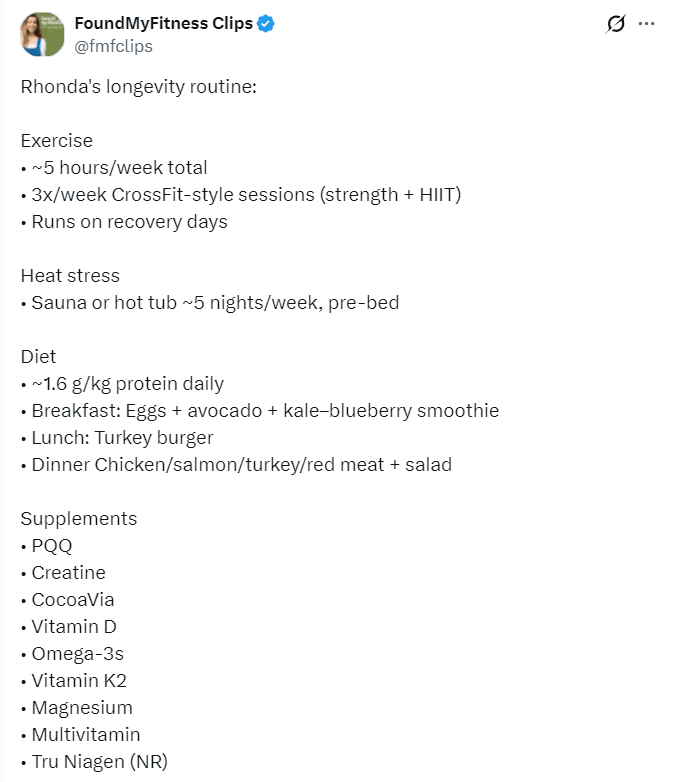
She also adds that high-intensity exercise and resistance training are habits she treats like daily hygiene: “It’s like you can’t miss brushing your teeth. And that’s how I do this. I have to do it.”
Her preferred method is CrossFit-style training, which she values for combining multiple longevity levers at once: “I do CrossFit training… because it incorporates both high intensity and resistance training. It starts out with strength training and then incorporates the cardiovascular work: rowing, biking, sprinting.”
Beyond structured workouts, Patrick also emphasizes movement as a mental and neurological reset. On days she runs, she frames it less as performance and more as cognitive recovery: “It’s kind of my recovery day… my brain kind of cleans out. I go through all the stuff that’s in my head. It’s this mental cleaning out that I love.”
Exercise Snacks: Making It Practical
For those unable to commit to structured training, Patrick advocates exercise snacks, short bursts of intense activity lasting one to two minutes performed three times daily.
Large-scale studies using accelerometers found that non-exercisers who incorporated these brief vigorous bouts reduced cancer mortality by 40%, cardiovascular mortality by 50%, and all-cause mortality by 40%.
Even workplace interventions show promise: performing 30 air squats every 45 minutes throughout an eight-hour workday improved glucose regulation more effectively than a 30-minute walk.
Patrick’s longevity routine distills decades of research into actionable steps: correct micronutrient deficiencies with targeted supplementation, consume cruciferous vegetables for detoxification support, and prioritize vigorous intensity exercise for cardiovascular and cognitive health. Her emphasis on low-effort, high-impact interventions makes longevity science accessible to everyone.
