

During episode #2461 of The Joe Rogan Experience, Robert F. Kennedy Jr. discussed the regulatory landscape surrounding peptides and his plans to restore legal access to these treatments.
Kennedy explained the history of peptide regulation in America. “There were 19 peptides that were widely formulated by compounding pharmacies during the Biden administration,” he said. “They illegally move those to category 2, which says do not formulate. It was illegal because they’re not supposed to do that unless there’s a safety signal. And they didn’t have a safety signal.”
The HHS Secretary emphasized that the reclassification violated proper regulatory procedure. “They’re not allowed to look at efficacy. They’re not allowed to say, ‘Well, we don’t believe these are efficacious or whatever.’ They can only look at safety,” Kennedy stated.
This regulatory change created unintended consequences. “What happened? There was huge demand for peptides. And so a black market came out and the black market is run by companies that say that they’re making the peptides for animal use or for research purposes,” Kennedy explained. “And that peptide now basically completely replaced the legal market.”
Kennedy contrasted the quality control between regulated and unregulated sources. “The legal market for peptides, the compounding pharmacies were getting those peptides from FDA inspected facilities and some of them in India and China but they were the same one that the pharma industries are buying them and we inspect those. You know, you’re getting a good product. You know, you’re getting what you bought, what was advertised. With the grey market, you have no idea. And a lot of this stuff that we’ve looked at is just very, very substandard.”
The Secretary expressed his personal support for these treatments. “I’m a big fan of peptides. I’ve used them myself and used them with really good effect on a couple of injuries,” he shared.
Kennedy outlined his intention to reverse the previous administration’s decision. “I’m very anxious to move, not probably not all of those peptides. Some of them are in litigation, but about 14 of them back to making them more accessible. And FDA is in the middle of, I think within a couple of weeks we will have announced some kind of new action.”
He stated his goal for the regulatory outcome: “My hope is that they’re going to get moved to a place where people have access from ethical suppliers.”
Rogan acknowledged the core problem with current black market peptide sales. “That’s ultimately the problem with all this black market stuff, right? A lot of people are getting bogus peptides and they don’t have any idea how they, if they work, whether to test them. They just take a chance. They take a risk.”
Kennedy agreed, noting the pattern of prohibition creating dangerous markets. “I mean, we created the black market, which we do with every very dangerous black market, which they’ve done during prohibition. They’re doing it right now with everything else.”
Recently, Stanford neuroscientist Andrew Huberman signaled that meaningful regulatory changes on peptides could be on the horizon. In a series of posts on X, Huberman revealed that after publicly discussing peptides, he received direct communication from someone working on peptide policy at the federal level.
“All I can say is, if you like peptides, you’re going to have a lot of tools to play with (legally),” he wrote, hinting that expanded lawful access may be closer than many expect.
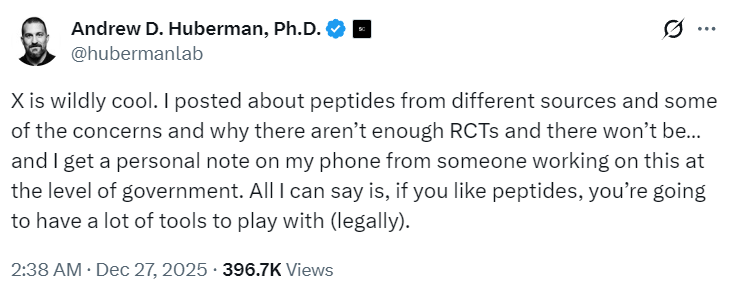
At the same time, Huberman has consistently cautioned his audience about the dangers of gray market suppliers. He has warned followers to “avoid gray market peptides,” noting that the lack of patent protection for many popular treatments makes large-scale pharma-funded RCTs unlikely.
