

On an episode of the Joe Rogan Experience (#2537), Harvard longevity researcher David Sinclair made a striking claim about GLP-1 receptor agonist treatments, linking them to a dramatic rise in cases of sudden blindness.
Sinclair raised the issue while discussing his lab’s gene therapy work on vision-related diseases, noting that one of the conditions his research targets is NAION, nonarteritic anterior ischemic optic neuropathy.
“It’s called NAION, which is now twice as more prevalent because of the GLP1 d**gs,” Sinclair told Rogan. “Obviously, companies don’t want to talk about it, but yes, sudden blindness has doubled seemingly because of these meds.”
Rogan was taken aback. “Holy s**t! Sudden blindness has doubled because of GLP1s,” he said.
Sinclair explained further: “Due to NAION, which is like a stroke in your eye. And then your other eye can go, which is pretty scary, and there’s nothing you can do about it.”
He pointed to Harvard ophthalmologist Joe Rizzo in support of the claim: “There’s a scientist at Harvard, you could look up his work, Joe Rizzo. It looks like it’s repeatable across the planet.”
When Rogan pulled up a search result describing the overall risk as “very low,” Sinclair pushed back: “It’s still in 10,000 people. One in 10,000.” A partial result from the same search suggested GLP-1 users were “68.6 times more likely to develop this,” a figure that added urgency to the exchange.
Rogan tied the discussion to a broader frustration with uncritical enthusiasm for the drugs: “There are so many people out there just telling everyone they should get on GLP1s.”
Sinclair acknowledged real benefits while standing by his concerns. “The GLP-1 drugs have probably saved millions of lives already and they’re pretty common,” he stated. “I think it’s 10% of people are trying them and 25% want to.”
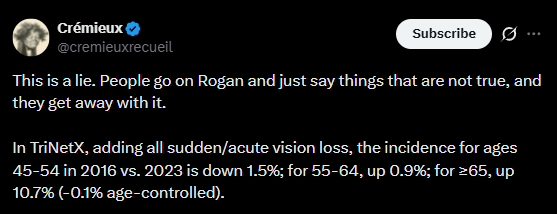
However, population-level data tells a more complicated story than the one presented on the podcast. When examining sudden and acute vision loss rates across multiple age groups between 2016 and 2023, the numbers do not reflect a widespread crisis.
For adults aged 45 to 54, the rate actually declined by 1.5%. For those aged 55 to 64, it rose by just 0.9%. Among adults 65 and older, the increase was more notable at 10.7%, but when adjusted for age across the full population, the overall change was essentially flat, at negative 0.1%.
More importantly, the elevated risk identified in the research is concentrated almost entirely among people with diabetes, not the broader group taking GLP-1s. A 2026 review found that diabetics using the medication showed a higher risk for NAION, while those taking it for weight loss without diabetes showed no clear increase.
For metabolically healthy people using a GLP-1 for appetite control, the evidence does not support the claim that their risk has doubled.
