
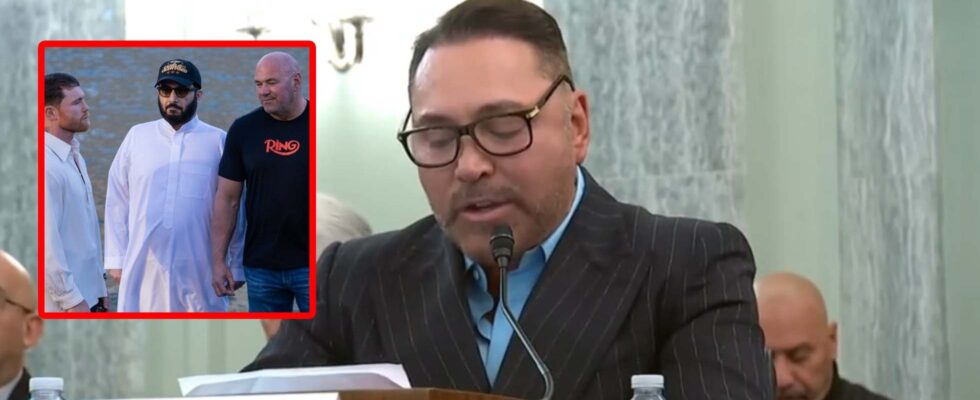
In a pointed Senate committee appearance, boxing legend Oscar De La Hoya delivered a sharp rebuke of proposed amendments to the Muhammad Ali Boxing Reform Act, drawing a direct line between the financial backing behind Zuffa Boxing and what he characterized as a deliberate effort to reshape the sport’s power structure at the expense of its athletes.
De La Hoya, a U.S. Olympic gold medalist and 11 time world champion across six weight classes who now heads Golden Boy Promotions, opened his remarks by leaning on lived experience rather than legal theory. He recalled arriving as a teenager from East Los Angeles with an Olympic gold around his neck and no attorney in sight.
“When I won the Olympic gold at 18 years old, I had promoters coming at me from every direction. My family and I didn’t have access to legal advice. I signed the first contract put in front of me without fully understanding it. It didn’t take long to realize I had been taken advantage of,”
he told the committee.
That experience, he argued, is not an outlier in boxing history but rather a recurring pattern the Ali Act was specifically written to disrupt. Passed in 2000, partly through collaboration with Senator John McCain, the legislation introduced financial transparency requirements for promoters and sanctioning bodies while establishing rules to prevent promoters from doubling as managers. De La Hoya described McCain, a former Golden Gloves participant and prisoner of war, as someone who
“understood the risk fighters take and the need to protect them.”
The proposed Ali Revival Act, backed by UFC president Dana White and Saudi entertainment chairman Turki Alalshikh, and introduced in July by Congress representatives Brian Jack and Sharice Davids, would create a new category called Unified Boxing Organizations. Under this framework, a single entity could serve simultaneously as promoter and governing body, setting its own rankings, titles and access standards.
De La Hoya was direct about what that would mean in practice.
“This principal change of the proposed amendment allows a promoter to create an entity that serves as both promoter and governing body, a so-called Unified Boxing Organization. This mirrors the existing MMA model and creates a closed system controlling rankings, titles, and access to opportunity.”
The asymmetry of oversight he described was a central concern. Traditional promoters operating under the existing Ali Act would still face full financial disclosure requirements. A Unified Boxing Organization, provided it followed its own internal rules, would not.
“One system operates under transparency and accountability while the UBOs do not,”
he said.
“This is a fundamental shift in power.”
De La Hoya also pointed to the track record of the model being imported into boxing. The UFC and its parent company, TKO Group Holdings, reached a $375 million antitrust settlement after athletes alleged the organization had suppressed wages and limited competition. That same corporate structure, he noted, is now being positioned to enter boxing with the backing of Saudi capital.
“Zuffa Boxing is fully funded by the Saudis,”
De La Hoya said, before drawing a comparison to another high profile sports venture.
“We’ve already seen how that kind of funding reshaped another sport through LIV Golf. We should be honest about what is happening here. That was sportwashing, a clear effort to use sports to reshape reputation.”
He went further, warning that the LIV Golf situation offered a cautionary template.
“This should serve as a warning,”
he said.
On the contractual terms already embedded in Zuffa deals, De La Hoya described a structure that leaves athletes little room to negotiate.
“In current Zuffa contracts, fighters are locked into rigid earning structures with little to no ability to negotiate. The promoter controls all major revenue streams, including media rights, ticket sales, and sponsorships, while fighters are limited to guaranteed purses and discretionary bonuses, with only narrow participation in upside revenue.”
A separate point he pressed on was the exclusion of MMA athletes from the bill’s proposed protections. If the legislation were genuinely driven by a desire to improve safety and athlete welfare, he reasoned, it would not carve out the sport whose model it explicitly seeks to replicate.
“If this proposal is truly about protecting fighters, why are MMA athletes not included at all? They compete in a similar dangerous sport, yet they are completely excluded. That raises serious concerns about whether it’s truly about protection or about restructuring control of boxing.”
The opposition to the Ali Revival Act extends beyond De La Hoya’s testimony. The Association of Professional Boxing Commissions has characterized the bill as a rollback of hard won protections. APBC president Albert Low called the proposed legislation
“a disgrace,”
stating that it
“will open the door for self-serving ‘Unified Boxing Organizations’ to operate outside the current sanctioning framework, effectively allowing one corporation, in this case TKO Group, to both regulate and promote under its own banner.”
That position has put the APBC at odds with the California State Athletic Commission, which voted 6 to 0 in favor of the Ali Revival Act. CSAC executive director Andy Foster has defended the decision publicly, arguing in part that the narrative around athlete pay in boxing versus MMA is overstated.
“The idea that boxers are now making a lot more than MMA fighters, or UFC fighters in particular, is false. That is a fairy tale. It’s a fable. It’s not true. I’ve got the numbers,”
Foster said.
For De La Hoya, the stakes of the debate are not abstract. He closed his testimony by framing the bill’s consequences in terms of what athletes would actually face, fewer options, diminished leverage and reduced control over their own careers.
“When that happens, it will not be the sport that failed them. It will be us.”
