

If you have spent any time scrolling through podcast charts lately, you may have noticed something: a lot of men, talking to a lot of other men. New data confirms that observation is not a coincidence.
A November 2025 report from the USC Annenberg Inclusion Initiative analyzed gender and racial representation among hosts across 592 of the top Spotify podcasts from 2024, along with guest appearances on the top 100 shows.
The findings reveal that podcasting, for all its promise as an open and democratic medium, has largely become a male-dominated space from the microphone to the guest chair.
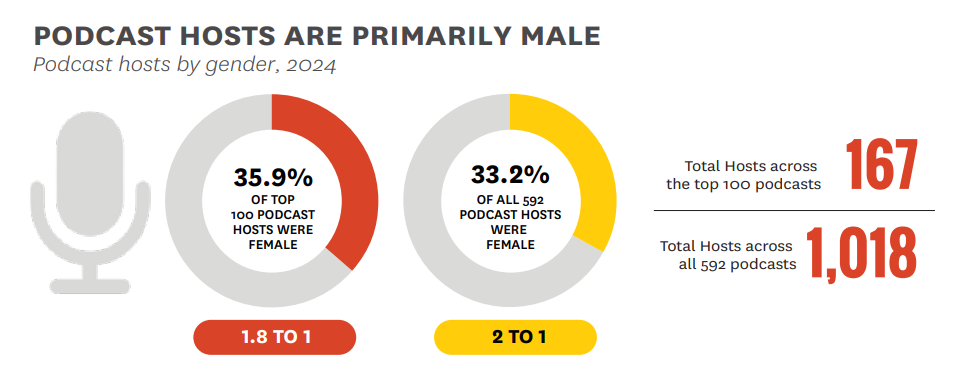
Among the top 100 podcasts, 64.1% of hosts were men and 35.9% were women. That gap grows when the full sample of 592 shows is examined, where male hosts account for 66.3% compared to 33.2% female, roughly a 2-to-1 ratio.
The imbalance becomes even more pronounced by genre. Business and technology podcasts showed a male-to-female host ratio of 12 to 1. Sports and fitness came in at 4.3 to 1, and comedy at 3.2 to 1. True crime was the lone exception, with women making up 53% of hosts in that category.
The guest data reinforces the pattern. Of the 6,340 guests with identifiable gender appearing on the top 100 podcasts, 72.8% were male and 27.2% were female. Nearly two-thirds of popular podcast episodes featured no female guests at all.
On shows hosted exclusively by men, women appeared as guests only 17.9% of the time. The contrast is notable when female hosts are involved: podcasts with at least one woman hosting saw female guests make up 45.3% of appearances, suggesting that who holds the microphone directly shapes who gets invited into the conversation.
Race adds a further dimension to the disparity. Across the top 100 podcasts, 77.1% of hosts were white, with underrepresented racial and ethnic groups representing just 22.3%, a ratio of roughly 3.5 white hosts to every 1 host from an underrepresented group.
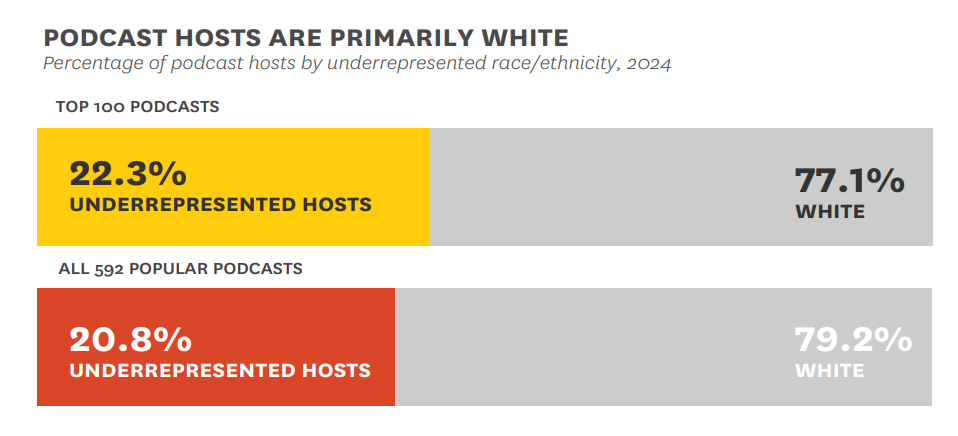
That figure sits well below the 41.6% of Americans who identify as non-white. Women of color face the steepest barriers, holding just 6.6% of top 100 podcast host slots, the lowest representation of any group across podcasting, film, television, or music in 2024. A
Sitting comfortably at the center of this male-dominated landscape is Joe Rogan. A new comprehensive study from Precision Strategies and Tunnl, called “The Manosphere Index,” surveyed 3,000 men and 3,000 women nationwide and found that 47% of all men say they trust Rogan as a source of information.
Among Millennial Hispanic men, that number climbs to 66%, placing Rogan above traditional news outlets, public officials, and community leaders for that demographic.
The study points to a significant platform shift behind these numbers. YouTube has become the primary space where men form opinions, with 86% of male respondents using it weekly and nearly 60% classified as heavy users spending six or more hours there per week.
Podcasting follows closely, with six in ten men listening weekly. Millennial men across all racial groups show the highest engagement, but Millennial Hispanic men stand out, spending twice as much time on podcasts as any other demographic. Their economic circumstances may help explain the pattern, with 51% of Gen Z Hispanic men relying on supplemental income from gig work, and many appearing to turn to voices like Rogan for perspective on financial uncertainty and personal responsibility.
Other figures attract significant male attention in the manosphere ecosystem, including Tucker Carlson, Ben Shapiro, Stephen A. Smith, and Candace Owens. None, however, match Rogan’s reach across demographic and ideological lines. Among faith-guided men, who represent 53% of those surveyed, trust in Rogan rises to 67%.
The study also found that 57% of men agreed that the content recommended to them “gets more and more controversial over time,” with Millennial and Gen Z men reporting this most frequently.
Awareness of the pattern does not lead to stepping away from it. The men most conscious of escalating content recommendations are also among the most heavily engaged with these platforms, with some groups spending up to 48% of their weekly leisure time online.
Researchers describe the pull toward creator-driven media as rooted in a combination of economic pressure and institutional distrust. Forty-one percent of men surveyed said it is difficult to find a good-paying job, a condition the study calls “provider pressure.” When traditional institutions fail to speak to those concerns, alternative voices step in.
While Rogan’s audience continues to grow, recent research suggests his core content territory carries a cost in one specific arena: dating. A study examining 74 male hobbies, involving 814 participants with equal gender representation, asked women to rate each hobby as “attractive” or “unattractive.”
Consuming manosphere content ranked last, with 96.9% of women rating it negatively. An earlier Change Research poll of more than 1,000 people aged 18 to 34 found that 55% of women view listening to the Joe Rogan Experience as a potential red flag in a partner.
The broader hobby rankings placed several other behaviors near the bottom, including online arguing at 87.7%, and cryptocurrency trading at 76.9%. At the top of the attractive end, reading earned a 95% positive rating from women, alongside learning foreign languages, traveling, and developing practical or artistic skills.
Men showed reasonable intuition about female preferences but had notable blind spots, with an average prediction error of 12%. They significantly overestimated women’s tolerance for several items near the bottom of the list, suggesting a gap between what entertains large male audiences and what actually appeals to potential partners.
