
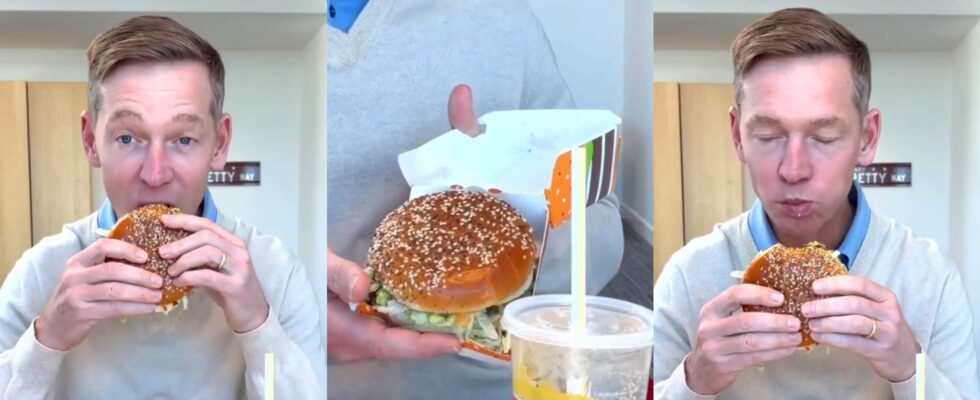
A McDonald’s marketing video intended to drum up excitement for the company’s new Big Arch burger has instead become a viral sensation for all the wrong reasons. The CEO Chris Kempczinski delivered what social media users are calling one of the most unconvincing product endorsements in corporate history.
The promotional clip shows Kempczinski attempting to showcase the oversized burger. From the moment he opens the box, his facial expression suggests surprise, as though encountering the item for the first time.
“Holy cow, God, that is a big burger,” Kempczinski begins, before launching into a description that carefully avoids calling anything by its proper name. He refers to a “unique kind of sesame, poppy sort of bun” and mentions “two quarter pound patties” without specifying whether they contain beef or any particular protein.
The only ingredients he definitively identifies as food are lettuce, pickles, and onions: everything else falls under the vague umbrella of “product.”
The word choice hasn’t gone unnoticed. Throughout the minute-long video, Kempczinski repeats variations of “I love this product” and “it’s a delicious product” rather than calling it a burger, sandwich, or meal.
For viewers already skeptical about fast food quality, the corporate terminology only reinforced suspicions about what exactly goes into McDonald’s offerings.
“I don’t even know how to attack it,” he says while holding the burger with both hands in an awkward grip that suggests unfamiliarity with the basic mechanics of consuming a hamburger.
The comment sparked immediate comments online, with one Reddit user noting, “You’ve never eaten a hamburger before?”
Kempczinski finally takes a bite and calls it “a big bite,” despite appearing remarkably small on camera. However, his expression shifts to what viewers interpreted as a grimace.
“That is so good,” he declares with the enthusiasm of someone fulfilling a contractual obligation rather than genuine enjoyment.
The video cuts immediately after he takes the bite, leading to speculation that he never actually swallowed it.
“The video cuts after he takes a bite. Didn’t even swallow it,” one user commented on social media.
Kempczinski’s then describes the taste as: “It’s distinctively McDonald’s.”
The awkward promotional attempt comes at a particularly unfortunate time for the fast food giant, as public scrutiny of ultra-processed foods reaches new heights.
Longevity researcher Bryan Johnson recently released a detailed analysis of McDonald’s most popular menu items, revealing health concerns that go far beyond basic nutrition facts.
According to Johnson’s investigation, McDonald’s famous french fries, the chain’s most ordered item worldwide, exploit an FDA labeling loophole by claiming “zero grams of trans fat” when they actually contain amounts below the 0.5-gram reporting threshold. The fries are fried in refined seed oils that Johnson says oxidize under high heat to form aldehydes.
Johnson’s analysis also highlighted that McDonald’s fries contain acrylamide levels approximately 20 times higher than a homemade baked potato. These compounds form when starch encounters ex treme temperatures and have been linked to various health concerns in laboratory studies.
Johnson describes this sugar content as deliberately calibrated to create an insulin response that leads to a subsequent crash, engineering a cycle of cravings that drives repeat purchases.
McDonald’s Chicken McNuggets face particular scrutiny for their sodium aluminum phosphate content, a leavening agent that Johnson’s research suggests exposes consumers to concerning levels of the neurotoxic metal.
According to studies he cited from French populations, a 20-piece McNuggets box delivers 2.8mg of aluminum. This is 28 times higher than levels associated with cognitive concerns in research subjects.
The nuggets also contain TBHQ (tertiary-butylhydroquinone), a petroleum-derived preservative that showed concerning results in laboratory studies, including cellular damage and increased tumor growth in animal subjects.
McDonald’s beverage menu drew similar criticism, particularly the caramel frappé with its 70 grams of added sugar per serving. Johnson referenced Swedish longitudinal research demonstrating that a modest 5% increase in added sugar intake correlated with a 23% rise in mortality rates across all causes.
