
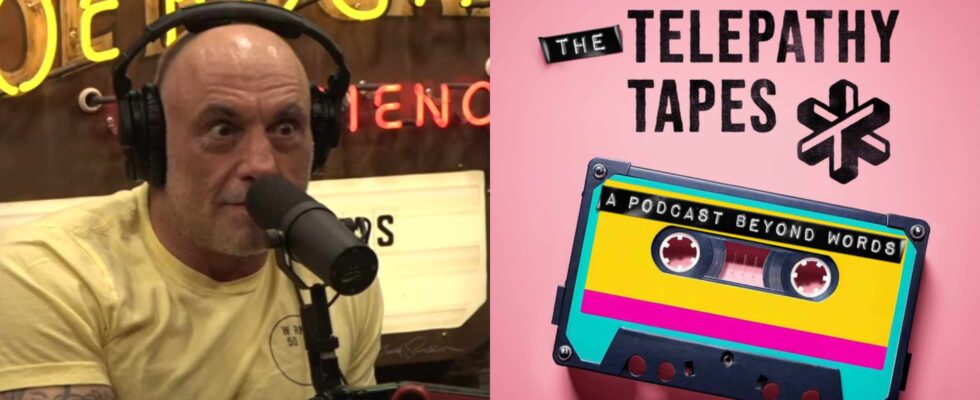
Joe Rogan has once again brought attention to The Telepathy Tapes, the podcast and documentary project that claims some non-speaking autistic people can communicate telepathically, access information beyond ordinary sensory channels and meet in a shared realm they describe as “the hill.”
During The Joe Rogan Experience #2558 with Tyler Engle, Rogan brought up the series while discussing ancient civilizations, consciousness and purported connections between different cultures. The conversation quickly moved from the podcast’s claims about non-speaking autistic children to speculation about ancient descriptions of hills, dream temples and a supposed shared realm.
“Is there a place like the hill described on telepathy tapes in ancient descriptions of anything?” Engle asked.
Engle said he was familiar with The Telepathy Tapes, although he was not familiar with the concept of “the hill.” Rogan then explained the premise, saying, “So, the Telepathy Tapes, they talk about these non-verbal autistic kids that all meet up telepathically in this place that they refer to as the Hill. Like people that have not encountered each other physically all talk about this area.”
Engle then engaged with the idea, suggesting that the location described by the children might not necessarily be a literal hill.
“I was thinking, the Hill is…. maybe it’s a hill, maybe isn’t a hill, you know? It’s out somewhere in the subconscious or wherever they’re actually going,” he said.
The discussion later went even further, with Rogan and Engle entertaining the possibility that some of the children featured in The Telepathy Tapes could somehow obtain information from this supposed realm.
Rogan then pointed to one of the series’ more extraordinary claims: that some of the children can supposedly recognize ancient Egyptian hieroglyphs despite having no conventional education in them.
He said, “You know, one of the weird things about these kids, these Telepathy Tape kids, is some of them could read hieroglyphs. No education.”
Engle responded by speculating that this could mean the children had “downloaded that information” from the hill.
But there is a major problem with the foundation of The Telepathy Tapes.
At the center of the controversy is facilitated communication (FC), a technique in which a facilitator physically supports or guides a disabled person’s hand or arm while they point to letters, symbols or a communication board.
The technique became prominent in the late 1980s and early 1990s, when proponents claimed that people who could not speak were suddenly able to produce sophisticated written language with a facilitator’s assistance.
In experiments, researchers would give the facilitator and the disabled person different information and then ask the person to respond. When the facilitator knew the answer, the resulting communication could appear accurate. When the facilitator did not know the answer, however, the responses failed.
The results indicated that the facilitator could be unconsciously influencing the person’s movements rather than simply helping them express independently generated thoughts. This is consistent with the ideomotor effect, in which unconscious movements can produce an outcome without the person consciously realizing they are controlling it.
The American Speech-Language-Hearing Association (ASHA) has consequently taken an explicit position against facilitated communication. Its official position statement describes FC as a “discredited technique” and says there is no scientific evidence validating it, while citing extensive evidence that messages are authored by facilitators rather than the disabled people themselves.
ASHA also warns about documented harms associated with FC, including false allegations of SA and other forms of maltreatment.
According to sources, The Telepathy Tapes effectively gives an extraordinary explanation to a phenomenon that researchers have historically investigated as facilitator influence.
The series, created by Ky Dickens, presents non-speaking autistic individuals who appear to communicate sophisticated thoughts through spelling and then explores the possibility that they possess telepathic abilities.
Critics have pointed out that this creates a fundamental problem: if the communication method itself has not been demonstrated to be independent of facilitator influence, the resulting messages cannot automatically be treated as evidence of telepathy.
That does not mean every non-speaking autistic person is incapable of communicating or lacks understanding. The scientific objection is not to the idea that non-speaking autistic people have thoughts, intelligence or a desire to communicate. It is to whether facilitator-dependent methods reliably demonstrate that the resulting messages originate independently from the person being assisted.
ASHA specifically warns that facilitator-dependent techniques are inconsistent with communication autonomy because the resulting messages may reflect the facilitator rather than the person with the disability.
