
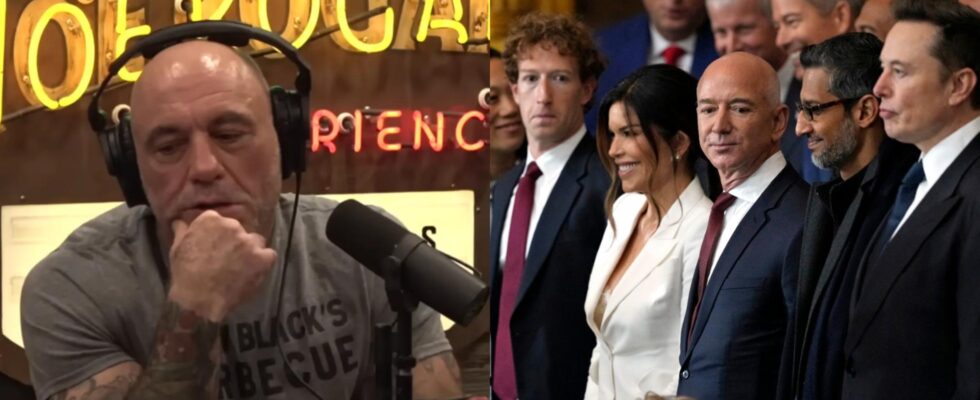
Joe Rogan, the podcast host worth an estimated $100 million, has built a media empire on the back of working-class resentment. But a closer look at his rhetoric reveals a pattern that serves a very specific purpose: dismantling public confidence in government to protect the wealthy from higher taxes.
On a recent episode of his podcast, Rogan sat down with billionaire tech investor Chamath Palihapitiya to discuss wealth inequality. What followed was a masterclass in misdirection.
Palihapitiya steered the conversation toward a legitimate point, that wealthy individuals pay far lower effective tax rates than middle-class workers because their income comes through capital gains rather than wages, and that mechanisms developed since the 1980s have allowed the ultra-wealthy to defer and shelter that income almost indefinitely.
Rather than engaging with those conclusions seriously, Rogan pivoted. His response, predictably, was to question where tax revenue goes and who manages it, declaring the federal government “completely inept” at handling money. He leaned heavily on DOGE as supposed evidence of rampant government fraud and waste.
Rogan’s concept falls apart under basic scrutiny. Medicare operates with roughly 3 cents of administrative cost per dollar spent. Private health insurance consumes around 20 cents per dollar before fraud is even considered.
The IRS, for every dollar invested in enforcement, returns between five and seven dollars in recovered revenue. DOGE, far from uncovering savings, actually increased costs through the chaotic way it dismantled agencies.
Additionally, the information about how government spends money is publicly available, often more accessible than equivalent data from large private companies. The idea that government operates in financial secrecy, while corporations remain transparent and accountable, is simply not supported by facts.
What makes Rogan’s approach particularly effective is that it sounds reasonable on the surface. He acknowledges wealth inequality is real. He agrees teachers should be paid more. He even concedes that billionaires pay lower effective rates than wage earners.
But then, every time the conversation edges toward a solution, the frame shifts to government incompetence, and the implication is clear: taxing the wealthy more would only funnel money into a corrupt, wasteful system.
This is not a coincidence. Rich people have long shaped the narrative around deficits and government spending, not out of genuine fiscal concern, but because cutting spending keeps workers more economically dependent and therefore more compliant.
This pattern becomes even more revealing when compared to comments Rogan made previously, where he mocked the idea of returning to the top marginal tax rates of the 1950s and early 1960s, calling the person who proposed it a “dork” and an “i*iot,” and arguing they had no right to an opinion because they did not earn over $3 million annually.
A $100 million podcaster telling his largely working-class audience that they cannot trust the only institution capable of redistributing wealth is not commentary. It is a service rendered to the people who benefit most from the status quo.
