

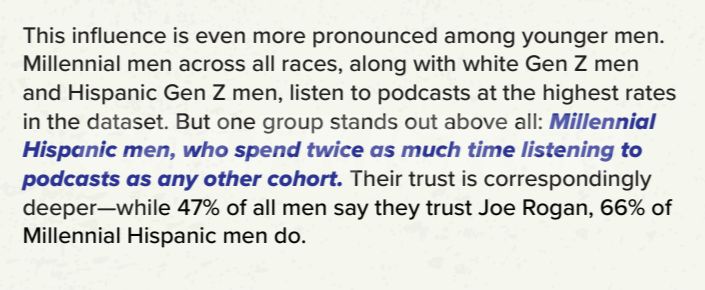
Joe Rogan ranks as the most trusted media figure among American men according to The Manosphere Index, a study by Precision Strategies and Tunnl. Forty-seven percent of men surveyed say they trust him and among Hispanic Millennial men the number reaches 66%.
The data shows a major change in where men get information. Trust in legacy outlets is lower while long-form creators such as Tucker Carlson, Ben Shapiro, Stephen A. Smith and Candace Owens attract large male audiences, especially younger men dealing with financial pressure and uncertainty.
Faith does not reduce engagement with manosphere-adjacent
content – it often coexists with it, and in some cases reinforces
it. Men who say faith gives their life meaning are more likely
to describe themselves as “very masculine” (48%, compared
to 29% of non-religious men). They are also significantly more
likely to have voted for Donald Trump (58% vs. 36%) and to trust
manosphere-adjacent cultural figures: 67% of religious men see
Joe Rogan as a trustworthy source, compared to 49% of nonreligious men.
Six in ten men listen to podcasts weekly. Twelve percent spend six hours or more on long-form audio. Many of these creators hold more influence in daily life than journalists or public officials because men hear from them more consistently and for longer periods of time.
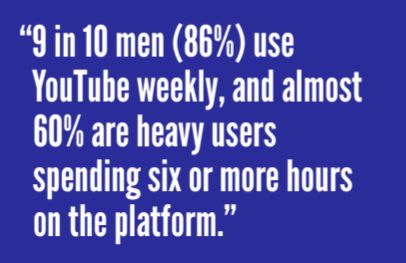
YouTube plays a central role in this pattern. Nearly nine in ten men use the platform weekly and close to 60% are heavy users who spend six hours or more on it. The site functions as a major hub for news clips, commentary, tutorials and entertainment. For many men it has replaced regular television.
Podcast creators now film full episodes and post them on YouTube along with clips and extra footage. This makes the platform the main space where long-form commentary is watched, not just heard.
The study also shows the economic pressure men feel. Forty-one percent say finding a good-paying job is difficult and this affects their sense of stability. Many turn to online creators for routine and conversation.
Men are aware that their feeds are becoming more inflammatory. Fifty-seven percent say recommended content becomes
“more and more controversial over time.”
Despite noticing this they continue to watch. The groups most aware of the trend are also the ones with the highest screen time.
These habits matter for anyone trying to reach male audiences. Approaches based on television ads or short social posts miss where men actually spend time. The figures with real reach are creators who speak for hours, appear regularly and build familiarity through long-form conversation.

Rogan‘s position reflects a wider change in men’s media habits. Many men prefer creators who speak plainly, invite disagreement and avoid scripted messaging. Traditional outlets have not adjusted to this pattern and the gap between their communication methods and men’s actual media use keeps widening.
