
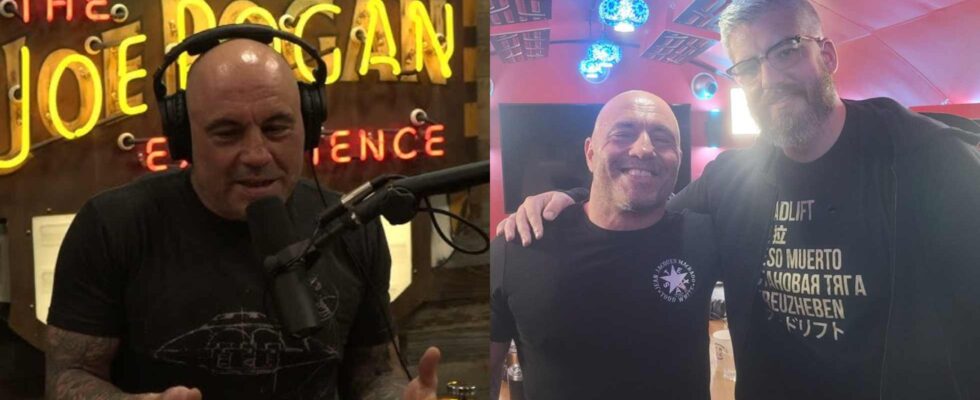
MMA analyst Luke Thomas has opened up about the quiet end of his relationship with Joe Rogan while also explaining why he has become one of the podcast host’s most outspoken critics over the UFC’s involvement with President Donald Trump’s White House event.
Speaking during a recent live Q&A, Thomas was asked whether he had ever reached out to Rogan privately before publicly criticizing his politics and worldview. His answer was no, but he went on to explain that the two were once on friendly terms.
“There was a while there where after I went on, even before that, where he would text me back and forth,” Thomas recalled. “I remember one time I was like tweeting about a new computer, and he texted me like, ‘Oh, I just got this computer, you should check it out.’ He was real friendly.”
According to Thomas, there was no argument or falling out. The communication simply stopped.
“And then one day he just stopped responding to texts,” he said. “Nothing happened. I didn’t say anything, I mean to my knowledge I didn’t say anything. I didn’t do anything. Nothing happened. And he just stopped returning texts.”
Rather than repeatedly trying to reconnect, Thomas said he eventually accepted the situation.
“There was at least a couple more times where I would let a couple months pass, or maybe even more than that, and I would try again and it was just no dice,” he explained. “And I was like, okay, well, I guess this is done now.”
He said he never felt the need to chase an explanation.
“That’s life,” Thomas said. “People want to talk to you, great. If they don’t, the last thing I want to make someone do is talk to me if they don’t want to talk to me. He just stopped responding. So okay, that’s where we are now.”
Thomas added that he had no plans to confront Rogan over it.
“I’m not going to hunt him down and be like, ‘You’ve got to give me an explanation for why all of a sudden we were talking and now all of a sudden we’re not,'” he said. “He made some kind of decision about it and you’d have to ask him what it was about. I don’t know.”
While he admitted he has his own theory about why the friendship faded, Thomas declined to share it publicly.
“I’ve got my theory certainly,” he said, “but it’s just a guess.”
The timing appeared to coincide with Thomas becoming increasingly critical of Rogan’s political commentary, although Thomas stopped short of confirming that was the reason.
He noted that one viewer had suggested he had become “more and more critical of his politics and worldview,” but he neither confirmed nor denied that interpretation.
He ended the topic with a simple observation.
“He chose silence,” Thomas said. “So silence it is.”
When one viewer suggested Rogan frequently changes his phone number, Thomas said he had already ruled that possibility out.
“Yeah,” he replied, “but I verified it. With others, I mean.”
In another video, Thomas addressed the UFC’s White House event, explaining why he strongly disagreed with Joe Rogan’s defense of it.
He began by stressing that his criticism was not aimed at everyone who attended the event, nor was it about revisiting the event itself. Instead, he took issue with those who attended and later dismissed criticism as nothing more than partisan outrage.
“I’m speaking specifically about Joe Rogan,” Thomas said, referring to comments Rogan made on his podcast.
Thomas explained that a friend had sent him a clip he had initially missed. In it, Rogan described the event as a “kumbaya moment,” arguing that it did not matter whether someone was on the left or the right because everyone was coming together for a positive occasion.
Rogan also suggested that attending the event should not automatically be viewed as endorsing President Trump’s policies.
Thomas rejected that framing outright.
“F**k that,” he said. “We’re adults here. Do you think we’re all st*pid? Because we’re not.”
He also criticized the timing of Rogan’s remarks, noting they came during the same podcast episode in which Rogan was speaking with a guest Thomas described as an expert in government.
According to Thomas, Rogan encouraged people not to make the event political and instead enjoy the spectacle of UFC 250. Thomas argued that this ignored what the event actually represented.
He described it as “essentially a celebration of Trump’s birthday,” rather than anything connected to Independence Day, with Trump “sitting in his king’s throne in the front row.”
After playing another clip from Rogan’s podcast, in which Rogan and his guest suggested the solution was “ego death” so people could move beyond partisanship and see things more clearly, Thomas expressed disbelief.
“Can you believe the balls on this person,” he said, “to say what really has to happen here is ego death so that everyone can just return to some kind of peaceful rational normal state?”
Thomas argued that the White House event served a much broader political purpose.
“The whole freaking point is to laud and magnify this guy through this process, or to make it just seem normal, to make it just seem ordinary,” he said. “That’s what this entire thing was designed to do.”
He went on to argue that Rogan’s framing treated Trump as though he were simply another conventional political figure rather than, in Thomas’ view, someone who attempted to overturn the 2020 election through a fake elector scheme, whose actions contributed to the events of January 6, and who ultimately returned to office while facing serious criminal investigations.
Returning directly to Rogan, Thomas criticized what he viewed as efforts to normalize Trump’s image.
“I cannot believe the temerity of people who want to look at what Trump has done, how he got here,” he said. “The UFC helped this guy stay out of prison. This was their reward. And what they want you to do is look at him like he’s Bob Dole.”
Thomas concluded by reiterating that he was not interested in arguing over who attended the event. His objection, he said, was to portraying it as politically neutral.
“He’s a threat,” Thomas said, “and we’re not blind to it.”
