
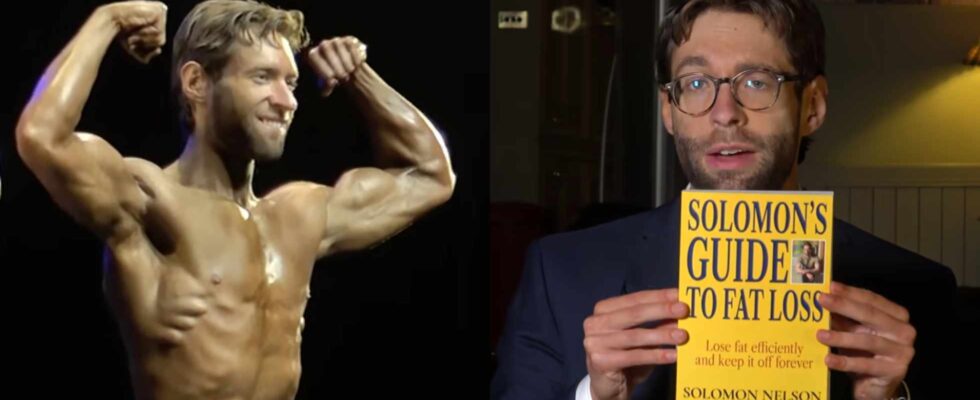
A fitness influencer who documented his bodybuilding preparation online has released a book about cutting weight and contest prep, despite finishing in last place at his debut natural bodybuilding competition.
Solomon Nelson, best known for his criticism of fitness influencer Mike Israetel’s dissertation, stepped on stage at 143 pounds and 5’10” tall. The result was a last-place finish that sparked considerable discussion in online fitness communities, particularly after Nelson announced he was selling a $50 book on how to implement a proper cut.
In his post-competition video breakdown, Nelson acknowledged the outcome but maintained an unapologetic stance.
“I didn’t win my show. I didn’t place well at all, for that matter,” he said. “Bad placing not withstanding, I’m really happy with how things went and the look I brought to the stage.”
According to observers who watched his preparation series, Nelson’s approach raised eyebrows from the start. Comments from fellow competitors and viewers noted that he crash dieted into the show and initially resisted carbohydrate loading before the competition until his coach insisted. The prep appeared to prioritize rapid weight loss over the balanced muscular development typically required for competitive success.
The judges provided clear feedback after the show. While they praised his upper body development, calling his chest, lats, and shoulders “genuinely impressive,” they pointed out a significant weakness that likely cost him a better placement. His leg development lagged far behind his torso, creating an imbalanced physique that didn’t meet competitive standards.
Rather than accepting this critique as constructive guidance, Nelson dismissed the judging criteria entirely.
“Why would I overhaul my training to conform to some arbitrary aesthetic standards set by a judge of bodybuilding competitions?” he asked in his breakdown video. “Why wouldn’t I just pursue my own personal aesthetic goals?”
He elaborated that “these are qualities that I don’t necessarily care for. That is, I don’t really want a physique more like the people who beat me and less like my own.”
Nelson compared himself to professional bodybuilder Patrick Moore, arguing that competitive success doesn’t equal aesthetic superiority.
“Better in a competitive bodybuilding sense doesn’t necessarily equate with better in my own personal subjective aesthetic judgment of what makes a physique look good.”
The disconnect between his stated indifference to competitive standards and his decision to compete at all has puzzled observers.
Nelson’s physique metrics have also raised questions about his credibility as an authority on bodybuilding preparation. Even accounting for stage leanness, his fat-free mass index falls below what many consider average for someone who has trained for nearly a decade.
Despite the overwhelming evidence that his preparation fell short of competitive standards, Nelson framed the experience as a success. He claimed his goal was never to win, but rather to demonstrate what “a relatively genetically average natural trainee, with a life outside of bodybuilding” could achieve using his rapid fat loss methods.
“I achieved what I set out to achieve from the start, and that makes me happy,” he concluded.
The timing of his book release has amplified the scrutiny. Selling a guide on contest preparation immediately after a last-place finish strikes many as premature at best.
Nelson has built his online presence partly through critical analysis of other fitness influencers, including detailed takedowns of Dr. Mike Israetel’s dissertation and recent content targeting Jeff Nippard’s training programs. His willingness to criticize others while deflecting criticism of his own performance has created an uncomfortable contrast.
Nelson stated in his breakdown that he plans to compete in two more shows this season before retiring from competitive bodybuilding. He maintained that he sees no reason to build his legs to match his upper body, questioning how doing so would “make me lead a measurably better or happier life.”
The fitness community’s reaction has been mixed. Some appreciate his transparency about competing as a natural athlete and acknowledge that stepping on stage takes courage regardless of placement.
Critics say that a broader problem has been created by this intersection of social media and bodybuilding: online influence can sometimes become disconnected from competitive results. Nelson and Mike Israetel are both examples of figures who have built substantial audiences through analysis, criticism, and educational fitness content, while their own competitive bodybuilding achievements have not necessarily matched the authority they have established online.
That creates an unusual dynamic where having a large following can give someone more perceived expertise than their competitive record alone might suggest.
Additionally, both men have publicly pushed back against criticism surrounding their bodybuilding performances while maintaining strong opinions about the training and physiques of others.
