

Joe Rogan has built an empire on saying things other people are afraid to say, and on his podcast last week that fearlessness collided with germ theory. During a conversation about the childhood vaccine schedule, Rogan waved off one of medicine’s oldest fears with a shrug.
“It’s wild because tetanus is not dangerous,” he said. “If you have an open wound with tetanus, you just wash it out and you won’t get tetanus.”
He went further, claiming the actual case count among people exposed was next to nothing: “Like in the number of cases of people that got tetanus, like zero.”
He then chimed in with a memory of childhood warnings about rusty nails, dismissing the whole thing as a scare tactic: “When I was a kid, I was like, don’t get tetanitis. Get that tetanus sh0t. I was worried to get a rusty nail. A rusty nail is going to give me a tetanus. F**king idiots.”
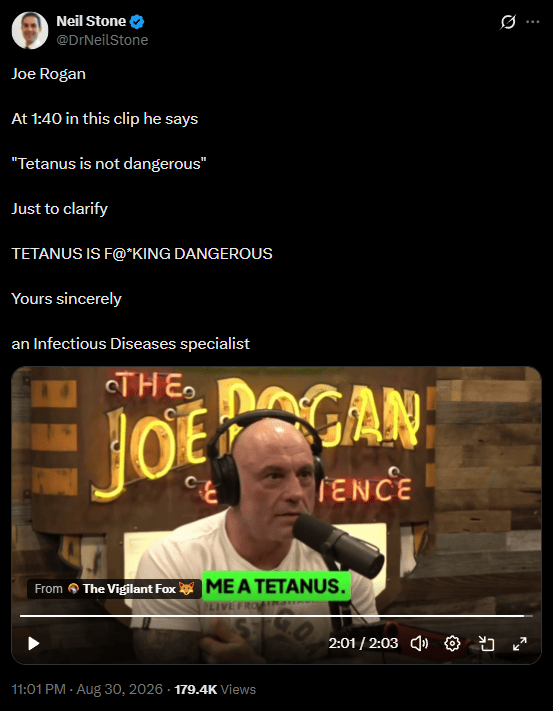
The clip spread fast, and it found its way to Dr. Neil Stone, an infectious diseases specialist who did not bother with a lengthy rebuttal. He quoted Rogan’s timestamp, then answered in five words that needed no elaboration: “TETANUS IS F@*KING DANGEROUS.” He signed the post, only half joking, “Yours sincerely, an Infectious Diseases specialist.”
What Rogan is describing as an overblown scare is, in reality, one of the more punishing ways a body can fail. Tetanus is not caused by a virus passed person to person. It comes from Clostridium tetani, a bacterium that lives in soil as a spore and waits for the right opportunity, a deep puncture wound, a splinter, a scrape packed with dirt, anywhere oxygen is scarce enough for it to wake up and multiply.
Once it does, it releases a toxin that attacks the nerves controlling muscle movement, and the result is not subtle. The jaw locks shut, the forehead furrows into a fixed grimace doctors have long called the “sardonic smile,” and the back arches so severely that the body can bend into a bridge shape known as opisthotonos.
Ancient physicians from Hippocrates to the Roman writer Celsus described the same progression thousands of years ago, and Celsus noted that patients who lived past the fourth day had a chance, an implicit admission that most did not get that far. Left untreated, tetanus carries a fatality rate close to total.
That is not ancient history. In 2017, a six-year-old boy in Oregon cut his forehead while playing on a farm. His parents cleaned the wound and stitched it themselves at home. He had never been vaccinated. Six days later he began crying uncontrollably, clenching his jaw, and spasming in his arms, then his neck arched backward and his whole body stiffened. By the time paramedics reached him he was struggling to breathe.
He spent 57 days in the hospital, 47 of them in intensive care, sedated in a darkened room because any stimulation, even light or sound, could trigger more spasms. He needed a tracheostomy and mechanical ventilation just to keep breathing, plus a cocktail of drugs to manage his blood pressure and pain while his muscles were chemically paralyzed to stop the contractions.
The bill for that hospital stay alone came to $811,929, not counting his air transport or the rehabilitation that followed, a total roughly 72 times the average cost of a pediatric hospital stay in the United States. It was the first pediatric tetanus case recorded in Oregon in more than three decades. He eventually recovered enough to walk and ride a bicycle again. His parents still declined the rest of his vaccinations afterward.
The reason cases like his are rare in wealthy countries is not that tetanus is mild. It is that the vaccine works. Since the 1940s, when tetanus toxoid immunization became widespread, the United States has seen a 95 percent drop in cases and a 99 percent drop in deaths from the disease.
Between 2009 and 2015, the country still recorded 197 cases and 16 deaths, almost entirely among people who were unvaccinated or under-vaccinated. Globally, the toll is far heavier. The World Health Organization estimated that in 2013 alone, 49,000 newborns di3d of neonatal tetanus, contracted when the umbilical cord is cut with unsterilized tools, a horrifying number that nonetheless represents massive progress from the nearly 800,000 newborn deaths recorded from the same cause in 1988.
An effective vaccine did not exist until 1923, when French bacteriologist Gaston Ramon figured out how to neutralize the tetanus toxin while preserving its ability to train the immune system. Before that breakthrough, doctors could offer little beyond sedatives and, in one 19th century case documented in Bologna, an experimental jolt of electric current that briefly loosened a patient’s contracted muscles before the spasms returned and claimed him anyway.
Unlike smallpox, tetanus can never be fully eradicated, because its spores live in ordinary soil rather than only in human hosts. That is precisely why continued vaccination matters. The bacterium isn’t going anywhere, so the only real defense is keeping the population immune.
Joe Rogan
At 1:40 in this clip he says
“Tetanus is not dangerous”
Just to clarify
TETANUS IS F@*KING DANGEROUS
Yours sincerely
an Infectious Diseases specialist pic.twitter.com/AInI40QzMx
— Neil Stone (@DrNeilStone) August 30, 2026
