
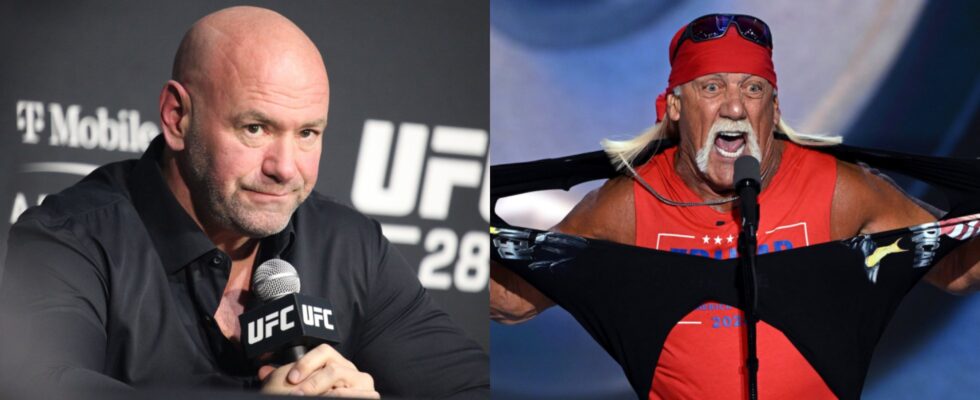
On a recent episode of The Ariel Helwani Show, veteran MMA journalist Ariel Helwani used Hulk Hogan’s documented political journey as a reference point while discussing Dana White’s increasingly visible alignment with one side of the political aisle, and what that could mean for the UFC’s standing with its audience.
The conversation was prompted by a viewer who challenged the show’s coverage of the UFC’s proposed White House event, accusing Ariel of letting political bias shape his MMA reporting. In response, Helwani pushed back firmly, arguing that ignoring the political context of a card held on the White House lawn, on Donald Trump’s birthday, would amount to a failure of basic journalism. It was in that context that he introduced Hogan as a cautionary example.
“If you watch the Hogan documentary,” he said, “he talks about this. He struggled with this for the longest time. He didn’t want to be political. He wanted to be like Michael Jordan. He believed that Republicans buy sneakers, too. The opposite for Hogan, but you get the point.”
According to Helwani, Hogan’s internal conflict eventually gave way to a decision he felt he could no longer avoid. “He felt like a hypocrite,” he said. “He felt like, I can’t just stay quiet anymore. I want to go out and tell the world how I feel about the current things. And I want to support my guy.”
Helwani went on to argue that the outcome of that decision carried real professional consequences.
“He showed up at the last convention and he ripped off his shirt and he said, ‘I’m that dude,'” he said. “And people booed him for it and people didn’t like him for it and felt like he ruined his legacy and he had to deal with those consequences. But that’s political. That’s a political decision.”
He was careful to frame Hogan’s choice not as right or wrong, but as an illustration of what happens when a public figure in sports and entertainment steps off the fence. The parallel to White, in Helwani’s view, was unmistakable.
“He’s allowed to go out as an owner of a sports league,” he said. “He could go out and do whatever the h*ll he wants. I’m not saying Republicans are bad or Democrats are bad. But don’t insult us by saying that’s not political. What does that even mean? By virtue of you standing there, it is a political statement that you are making.”
For the UFC, with its massive global fan base, Helwani argued that context simply cannot be ignored, no matter how much anyone might prefer it otherwise.
