This week ESPN contributor Pablo Torre attempted a deep dive into Riley Gaines which he framed through internal documents, teammate testimony and on-record reporting from Madison Pauly. The project was clearly designed to pull apart the polished public image Gaines has built since 2022. Yet as Torre’s investigation bounced across social media, one voice cut through the noise — former teammate Paula Scanlan, who denounced the framing and defended Gaines with raw, unfiltered detail from her own experience.
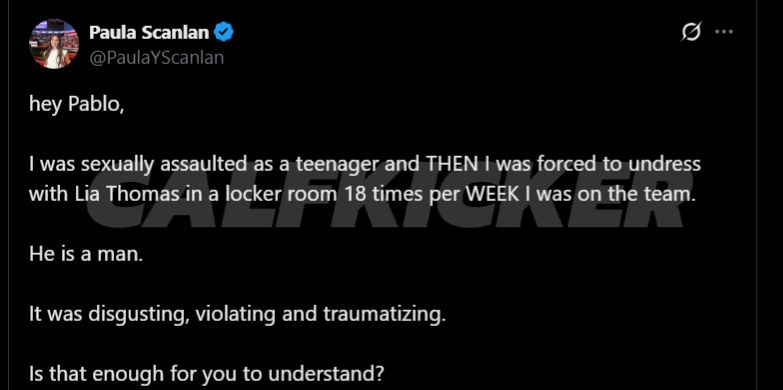
“I was s**ually assaulted as a teenager and THEN I was forced to undress with Lia Thomas in a locker room 18 times per WEEK I was on the team. He is a man. It was disgusting, violating and traumatizing. Is that enough for you to understand?”
Scanlan’s pushback immediately reframed the conversation. Instead of a story about someone “cashing in,” it reminded people why this debate is so volatile in the first place. Her testimony doesn’t magically erase gaps or contradictions in Gaines’s public narrative — but it also makes clear that not experiencing abuse in one scenario does not disqualify someone from feeling discomfort, fear or violation in another. The idea that Gaines is somehow disallowed from having boundaries because she didn’t suffer the “right” kind of trauma is a moral test the media never applies consistently.
Torre’s investigation sought to widen the lens. Gaines — who rose into conservative prominence after tying for fifth with Thomas at the 2022 NCAA Women’s Championships — now commands $25,000 speaking fees and appears regularly on Fox News. She stood beside President Trump during his executive orders aimed at trans athletes, and her public profile grew in lockstep with political machinery backing her, including the DeVos family and institutions like the Leadership Institute.
A lot of leftist media has tried to portray Gaines as a mediocre swimmer — which is not exactly right. To make the podium at NCAA you already have to be operating at a level so selective that most of the country will never get close, and this talking point misses the mark by a mile.
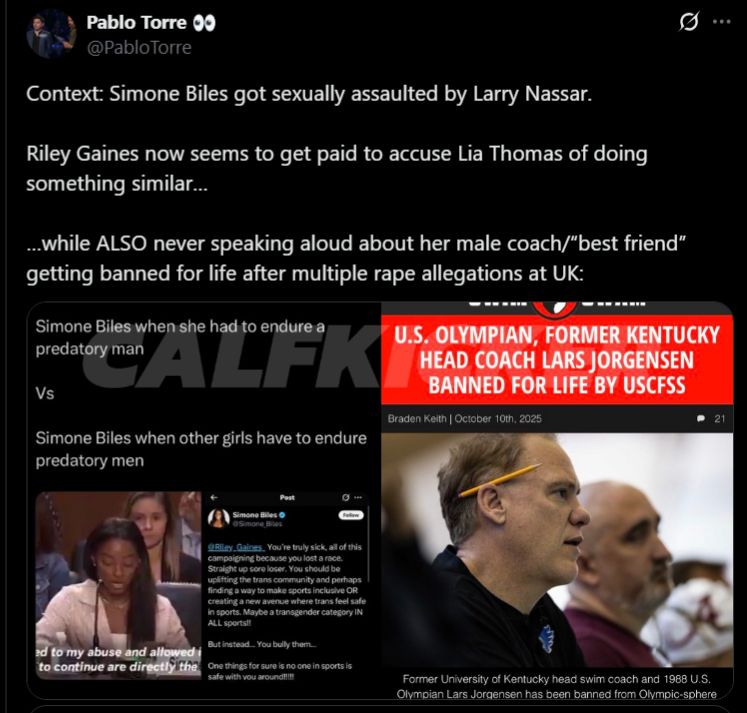
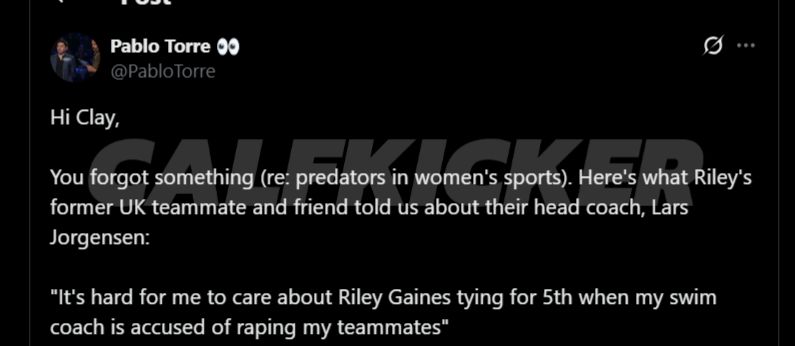
Where Torre’s reporting grows sharper is in the contrast between Gaines’s political rhetoric and the years she spent under University of Kentucky coach Lars Jorgenson. Former teammates described an unstable program with punishment swims, body-fat pressure and widespread depression. They recall Jorgenson calling Gaines a “LOFT” and pushing athletes toward disordered eating while presiding over a culture that felt unsafe to many. The absence of these experiences from her memoir became its own statement.
The allegations only darkened from there. Assistant coach Chip Klein was found to have harassed swimmers in 2019, and Jorgenson received a suspension for failing to report him. Two former athletes later accused Jorgenson of SA-ing them multiple times, resulting in his lifetime ban from the US Center for SafeSport. Yet Gaines still described him as “one of my best friends” even after the accusations surfaced.
Torre contrasted her silence about documented harm with her increasingly forceful statements about Thomas. Gaines once expressed empathy for Thomas’s transition, but later said sharing a locker room with Thomas amounted to “s**ual assault” and “voyeurism.”
But Scanlan’s defense demonstrates why the topic refuses to flatten into one unified narrative. For her — and for many women who share her view — the issue is not political engineering, nor is it about whether someone else’s trauma happened in the same way. It’s about boundaries, privacy, and the reality that being uncomfortable in a locker room with a pre-op trans swimmer doesn’t suddenly become illegitimate because some in the media find it inconvenient.
Torre’s investigation may highlight omissions, funding pipelines or inconsistencies. But Scanlan’s testimony underscores the part of the story that rarely gets treated with the same seriousness: women’s discomfort doesn’t require institutional abuse to be real. It doesn’t require a political motive to be valid. And it doesn’t disappear just because someone else decided which version of events is more narratively useful.
The collision between these two realities — institutional trauma and political weaponization, private experience and public influence — leaves Gaines positioned not just as an activist but as a lightning rod. Torre argues her brand is built on selective storytelling. Scanlan argues the story isn’t selective at all — it’s simply one the media prefers not to hear.