
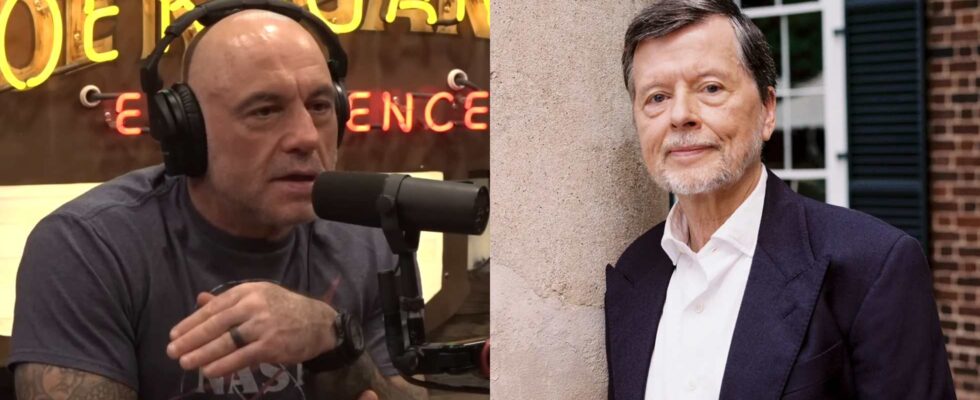
When Ken Burns started a press tour for his latest documentary series on the American Revolution, his team came prepared with strategic materials designed to help him navigate unfamiliar media terrain.
Among his stops: Joe Rogan’s massively popular podcast, a platform known for its freewheeling conversations and diverse audience. But the acclaimed documentarian had no interest in calculated preparation.
“People were trying to give me briefing books about how to talk to Joe Rogan,” Burns revealed in a recent interview. “I said, ‘No, I’m just going to talk to him and tell him how excited I am about this show.'”
That decision to reject strategic coaching in favor of authentic enthusiasm resulted in one of the more substantive conversations in recent JRE history. It was a nearly three-hour discussion spanning American history, documentary filmmaking, and the complexities of national identity.
Despite his well-known political leanings as a Democrat and vocal Trump critic, the filmmaker has maintained a commitment to presenting history without partisan advocacy. “We’re umpires calling balls and strikes,” he explained, a phrase he says he uses consistently whether addressing Rogan’s audience or schoolkids across America.
The documentarian’s decision to appear on podcasts hosted by Rogan and Theo Von raised eyebrows among some observers, given the political diversity of their audiences. But Burns sees such engagement as essential rather than strategic.
“I don’t necessarily agree with them politically — some things I do,” he acknowledged, before drawing an analogy to his daily life in rural New Hampshire.
“I live in a tiny town in New Hampshire — it’s like going to a ball game. Nobody asked to see where you’re registered when you go in, right?” Burns said. “In my town, I walk every day, three miles or so. I wave at everybody. I don’t care what their bumper sticker says; I don’t care what their bumper sticker doesn’t say. I just go, ‘Hi, neighbor!'”
That neighborly approach extended to his conversation with Von, where Burns found genuine moments of connection. “At one point, [Von] goes, ‘Liberty’s like a pilot light!'” Burns recalled with evident delight. “It was so great to have somebody coming to this understanding.”
Burns’ media strategy, if it can be called that, rests on a fundamental belief in storytelling over argumentation and curiosity over ideology. His appearance on Rogan’s show allowed him to discuss the American Revolution not as a mythology of heroic figures but as a complex historical moment involving diverse people with competing interests—a civil war, a world war, and a revolution all at once.
The filmmaker’s approach also reflects his longtime commitment to intellectual rigor paired with accessibility. While maintaining scholarly standards, he seeks to reach Americans across political and geographic divides, something he’s accomplished through PBS for decades.
Burns emphasized that his refusal to pander or adjust his message for different audiences stems from professional discipline rather than political neutrality. “I’m a citizen — I have the right to free speech,” he noted, acknowledging that advocacy filmmaking serves an honorable purpose. But he’s chosen a different path, one that requires “the self-discipline” of presenting multiple perspectives.
That discipline has earned trust across the political spectrum. Burns noted with pride that his Vietnam War documentary received funding from both David Koch and a liberal Obama bundler. “I have conservative underwriters and left-wing ones, and they trust me,” he said.
