

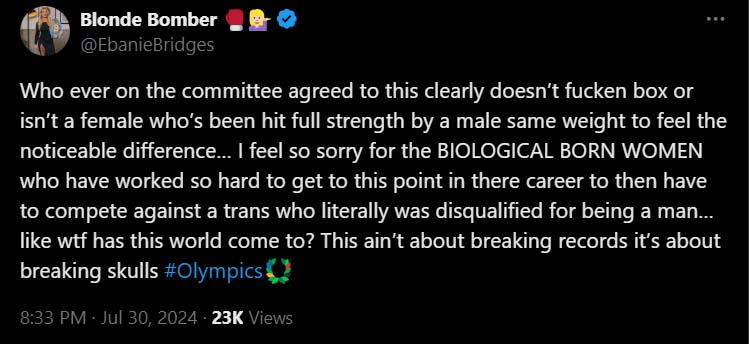
The recent Olympic boxing match between Italy’s Angela Carini and Algeria’s Imane Khelif has ignited a fierce controversy. The bout, which lasted just 46 seconds, ended with Carini visibly upset, declaring the match “unjust” after receiving only two punches. The incident has raised significant concerns over gender qualification in sports, as Khelif had previously been banned from a major boxing contest due to failing testosterone tests.
Now there’s some confusion about her status as well as a PR campaign. Khelif failed the gender test – with IBA president Umar Kremlev telling a Russian news agency at the time that Khelif has “XY chromosomes,” as per Reuters. This likely means Khelif and one other disqualified boxer are intersex – and not trans. This isn’t the first intersex controversy in the history of the Olympics.
Infamous runner Caster Semenya was told she was to lower her testosterone to meet eligibility criteria to run after it was discovered she was intersex. Semenya argued she had severe negative impacts of taking testosterone-reducing medication, and tried lobbying against it. There’s currently no indications that Olympics is taking this case as seriously.
Angela Carini abandons her fight against Imane Khelif, a biological male, just a few minutes into the match.
Ban men from competing in women’s sports! pic.twitter.com/GLVBgJycvF
— Clown World ™ 🤡 (@ClownWorld_) August 1, 2024
In the ring, Carini, 25, displayed evident distress. She threw her helmet to the floor, refused a handshake, and fell to the canvas in tears. Despite her efforts, she couldn’t withstand the blows, which she described as the strongest she’d ever experienced.
‘I got into the ring to fight. But I didn’t feel like it anymore after the first minute. I started to feel a strong pain in my nose. I didn’t give up, but a punch hurt too much and so I said enough. I’m leaving with my head held high.’
‘I am not in the position of saying this is right or wrong. I am not. I did my job as a boxer, entering the ring and fighting. I didn’t manage to, but I am exiting with my head held high and with a broken heart.
‘I am a mature woman, the ring is my life. I’ve always been very instinctive, but when I feel something is not going well, it’s not a surrender but having the maturity to stop.’
Carini’s coach in the mix zone after the fight said: ‘I don’t know if her nose is broken. I have to speak with the girl. But many people in Italy tried to call and tell her: ‘Don’t go please: it’s a man, it’s dangerous for you.’
After the fight, the Algerian Boxing Federation gloated about Khelif’s victory, posting on Facebook: ‘Congratulations to the Algerian boxer Iman Khalif, who responds strongly in the ring and qualifies for the quarterfinals, after defeating the Italian Angelina Carini in less than 46 seconds, effortlessly.’
The Italian Boxing Federation protested Khelif’s inclusion before the match, highlighting the broader issue of gender eligibility in sports. Critics, including former athletes and sports scientists, argue that the current lack of clear policies on gender testing creates a vacuum that allows such controversial situations to occur. They stress that the physical advantages associated with higher testosterone levels present a significant challenge to maintaining fair competition.
As the Olympics continue, one other boxer in a similar situation. Lin Yu‑ting of Taiwan also failed the gender test and will be competing later on.
