
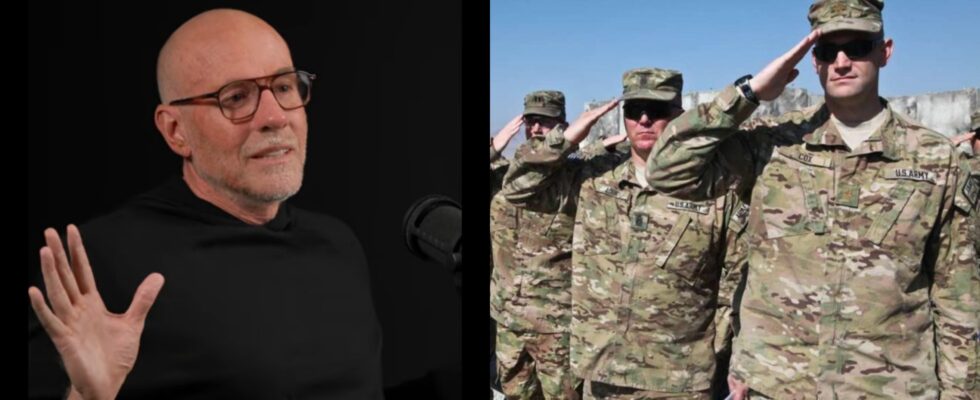
Marketing professor and NYU Stern School of Business faculty member Scott Galloway made a declaration during his appearance on the Huberman Lab podcast. He stated that if he could implement one policy change, it would be mandatory national service for young people.
The comment emerged during a conversation with host Andrew Huberman about masculinity, male purpose, and what Galloway described as a growing crisis among young men. When pressed on what single policy he would prioritize, Galloway did not hesitate to give a direct answer.
“If I could have one policy, one blanket, if I had a magic one, one policy, it’d be mandatory national service,” Galloway said.
To support his argument, Galloway pointed to international examples that he believes demonstrate the potential mental health benefits of structured national service. He specifically highlighted two countries with notably low levels of depression among young adults.
“If you look at the lowest levels of young adult depression in the West, it’s two countries. It’s Israel and Singapore,” he said.
Galloway then expanded on what he sees as the core psychological and social benefits of mandatory service, arguing that many young people today lack a clear sense of purpose and belonging. In his view, national service can fill that gap by placing individuals in situations that demand responsibility and teamwork.
“What does mandatory national service do? It gives you the sense that you’re serving the agency of something bigger than yourself. It gives you purpose. You’re handling dangerous equipment. It’s the great equalizer,” he explained.
He went on to describe the social leveling effect of shared service, emphasizing how high-stakes environments can strip away social divisions and force people to evaluate one another based on competence and reliability rather than background or identity.
“You don’t care that this gay kid is totally different than you. You respond to his or her character and competence because if you’re getting fired on, you don’t care how rich their father is. All you want to know is, is this person good at what they do? And you put people’s lives in your hands and they put their life in your hands,” Galloway said.
At one point in the conversation, Galloway referenced his own observations from visiting an Israel Defense Forces battalion. He compared the experience to what Huberman had previously shared about visiting the U.S. Naval Academy in Annapolis, noting the sense of camaraderie and physical engagement he witnessed among young service members.
“These are young, beautiful, fit people outside all day meeting friends, mentors, and mates,” he said.
Galloway also drew a historical connection to what he considers one of the most politically productive eras in the United States. In his view, shared service experiences among leaders helped foster unity across party lines during the mid-20th century.
“If you look at the great legislation in America in the 60s and 70s, which was probably the most productive, unified time in America, it’s because many of our elected leaders had all served in the same uniform. And they saw themselves as Americans before they saw themselves as Republicans or Democrats,” he argued.
Additionally, Galloway clarified that his vision of national service is not limited to military duty. He stressed that meaningful service can take many forms, particularly in civilian roles that contribute directly to communities.
“I’m not just saying military service, senior care, donating time at a no-kill animal shelter, being a smoke jumper. There’s a lot of ways to serve,” he said.
He also addressed a common criticism, that advocating for mandatory service is easier for someone who is no longer eligible to participate. Speaking as a parent, Galloway pushed back on that notion and expressed confidence that well-designed programs could be rewarding for young people.
“People say, ‘Well, it’s easy for you to say you’ve aged out.’ I can tell you as a father of boys, if we set it up well and invested in it, I think they would really enjoy a rotation through different parts of America and different opportunities to serve,” he said.
