

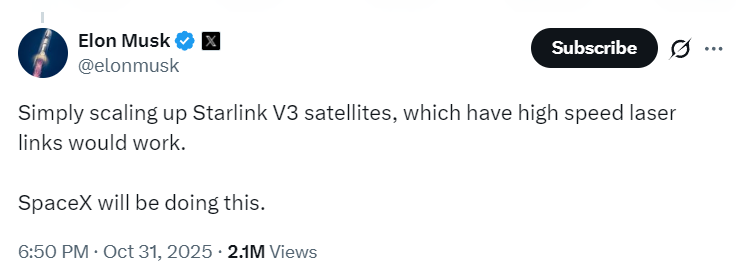
The race to dominate artificial intelligence is leaving Earth’s atmosphere. SpaceX chief Elon Musk has publicly declared his company’s intention to construct data centers in orbit by scaling up the Starlink V3 satellite platform.
“SpaceX will be doing this,” Musk announced on X, signaling a dramatic expansion beyond the company’s current broadband internet business.
The concept isn’t merely theoretical speculation. SpaceX has already incorporated this satellite-based AI computing vision into discussions surrounding a share sale that could value the company at approximately $800 billion, according to people involved in those conversations.
This represents Musk’s latest high-stakes wager on space infrastructure solving terrestrial problems. But he’s far from alone in believing that orbital computing platforms represent the future of AI development.
Others Join the Space AI Race
According to sources, Jeff Bezos has predicted that gigawatt-scale data centers will be constructed in space within 10 to 20 years. His company Blue Origin has maintained a team working on orbital AI data center technology for more than a year, according to someone familiar with the operation. Blue Origin recently achieved a significant milestone by successfully launching its new orbital rocket, carrying two NASA satellites on a Mars atmospheric research mission.
Not to be left behind, Google announced Project Suncatcher in November, a space-based data center initiative scheduled to begin test launches in 2027. The tech giant already holds roughly 7% of SpaceX, an investment potentially worth around $100 billion at the company’s rumored $1.5 trillion valuation, creating an interesting dynamic where Google benefits from Musk’s success even as it pursues competing technology.
Eric Schmidt, former Google CEO, acquired Relativity Space in May 2025, driven by his interest in orbital data centers. Meanwhile, OpenAI’s Sam Altman has reportedly explored a potential acquisition of Stoke Space, a Seattle-area startup developing fully reusable rockets, to establish his own orbital fleet.
Sources indicate Altman “lights up” when discussing space and is prepared to commit billions to secure an off-planet position. According to those familiar with his thinking, Altman agrees with Musk on the underlying physics of space-based computing, though their ongoing legal battles make collaboration unlikely.
A Silicon Valley investor described the urgency facing OpenAI: “Space is such an essential frontier in the AI race that OpenAI has to do something relatively quickly. Otherwise, they run a real risk of being left behind. Sam’s not going to allow that to happen. … He’s thinking very long-term.”
Other industry leaders have voiced support for the concept. Nvidia CEO Jensen Huang has reportedly endorsed the approach, while Philip Johnston, chief of startup Starcloud, which is already developing space-based data center concepts, stated bluntly: “It is not a debate—it is going to happen.”
Why Space Makes Sense for AI Computing
The push toward orbital computing stems from mounting constraints on Earth. Major technology companies including Meta, OpenAI, Microsoft, and Amazon are collectively investing hundreds of billions of dollars into data centers worldwide. OpenAI alone has committed approximately $1.4 trillion to data center-related projects.
Sources state that ground-based facilities increasingly face obstacles: power availability shortages, local opposition, concerns over rising utility bills, and water scarcity issues. Smaller companies are taking on significant debt and financial risk just to compete in this infrastructure arms race, while nations like Saudi Arabia are pouring resources into their own AI data center ambitions.
Orbital data centers could theoretically sidestep these limitations. Advocates highlight continuous solar power availability as a transformative advantage. By positioning satellites in high orbits with constant sunlight exposure, they can harvest energy around the clock without nighttime interruptions, cloud cover, or electric bills.
At a recent conference, Musk declared that space-based data centers would become the most economical method for training AI within five years.
The Starlink Evolution
The technical foundation already exists in nascent form, according to sources. Quilty Space research director Caleb Henry states that satellites already perform many data center functions, including data transmission, storage, and onboard processing.
SpaceX’s current Starlink constellation provides high-speed broadband to millions of users globally and is reportedly profitable. The company has methodically upgraded its satellite capabilities over successive generations.
Early operational Starlink satellites launched approximately five to six years ago weighed around 660 lbs (300 kg) and delivered 15 Gbps capacity. The current Starlink V2 Mini satellites achieve maximum downlink capacity of approximately 100 Gbps.
The planned Starlink V3 satellites represent a substantial leap forward. Expected to weigh approximately 3,300 lbs (1,500 kg), these next-generation platforms are projected to increase downlink capacity tenfold to approximately 1 Tbps. They will feature high-speed laser inter-satellite links, enabling data to travel between satellites without returning to ground stations.
SpaceX plans to launch approximately 60 Starlink V3 satellites per Starship launch. Initial deployments could occur in the first half of 2026.
The company has already tested a satellite dispenser system aboard Starship vehicles.
Current rockets cannot lift the heavy cooling systems that AI chips require. Starship’s unprecedented payload capacity changes that equation, enabling massive satellites that function less like internet routers and more like orbiting supercomputers.
Hurdles Ahead
Despite the enthusiasm from technology luminaries, critics argue that orbital data centers are economically impractical and that supporters underestimate the technical challenges involved.
Deploying satellites capable of meaningful AI computing presents significant engineering obstacles. The expense of launching large numbers of satellites into orbit remains substantial, even with reusable rocket technology reducing costs.
Skeptics contend that achieving performance comparable to large, ground-based AI data centers will prove far more difficult than proponents suggest, and that technical risks are being minimized. They also note that future easing of power and infrastructure constraints on Earth could undermine the economic case for orbital alternatives.
Whether orbital computing becomes a revolutionary solution or an expensive detour remains to be determined. But with SpaceX, Blue Origin, Google, and potentially OpenAI all pursuing variations on this theme, the concept has moved well beyond science fiction.
SpaceX did not immediately respond to requests for comment.
The AI infrastructure race has now officially extended beyond our planet, with Musk positioning himself at the forefront of what could become the next frontier in computing, or his next audacious bet on the future.
