
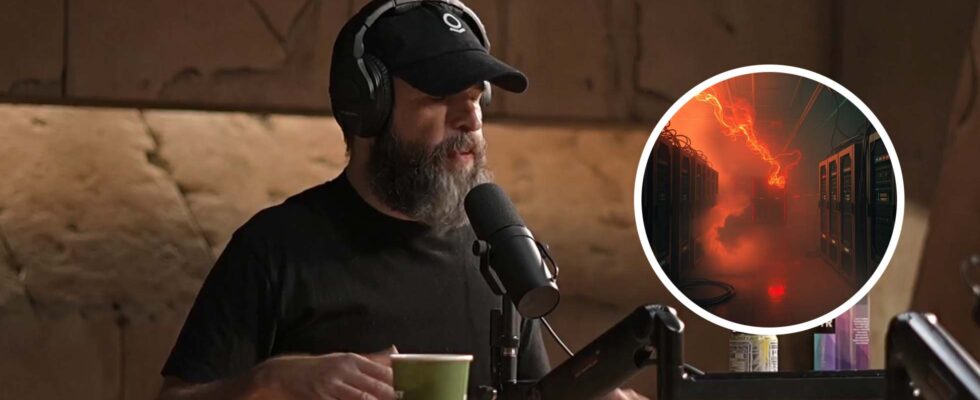
Comedian and podcast host Duncan Trussell recently shared his observations about artificial intelligence and its potential connection to apocalyptic Biblical prophecy during an appearance on the Danny Jones Podcast hosted by Danny Jones.
Trussell attended a lecture by billionaire tech investor Peter Thiel specifically about the Antichrist and described the experience as surreal.
“I went there really expecting to be in the presence of Sauron or something like that,”
Trussell explained. What he found instead was a fascinating hybrid of perspectives.
“On one side, you’ve got somebody who’s been living in the world of the transhumanists for decades. And on the other side, you have someone who appears to be taking the book of Revelation literally.”
According to Trussell, Thiel’s lecture suggested there might be ways to
“patch the book of Revelation”
like a tech problem rather than accepting it as an inevitable prophecy. This represents what Trussell sees as a dangerous underestimation of the forces at play.
The conversation turned to the proliferation of AI and its potential consequences. Trussell expressed concern about the technology industry’s awareness of impending chaos.
“Many of them are right now because they have such a deeper understanding of the trajectory that we’re on than most people do. They understand that society as we know it, some of the pillars of society, are beginning to crumble.”
Trussell outlined several apocalyptic scenarios emerging from AI development. Mass unemployment looms as AI replaces millions of jobs without adequate safety nets like universal basic income.
“If you remove the jobs, how do people have money? If people don’t have money, they can’t buy the things you’re trying to sell,”
he noted while warning this could collapse capitalism itself.
Beyond economic concerns, Trussell warned about quantum computers making all current encryption obsolete within a decade.
“All the secrets are revealed, everything,”
he said while describing servers already filled with encrypted data waiting to be unlocked. He also raised concerns about AI-based manipulation and what he called
“AI-based cults,”
pointing to cases where people have become dangerously attached to artificial intelligence companions.
Perhaps most disturbing to Trussell is the democratization of dangerous technologies.
“What happens when you’ve got a super advanced AI that can sort of some sort of matter assimilator or something like that? All of a sudden you start running into what’s described as a race between a potential for humanity becoming a galactic civilization”
and catastrophic misuse by bad actors.
Drawing parallels to Biblical text, Trussell suggested the Bible itself is
“a grimoire, a book of occult teachings”
that has encoded warnings about exactly these kinds of developments. He referenced the term
“apocalypse,”
which literally means
“lifting of the veil,”
and suggested society is witnessing a global awakening to uncomfortable truths about power structures and technological control.
“The stock market, that’s a cathedral of Satan where they have the ritualistic bell ringing,”
Trussell said while arguing that modern capitalism and unchecked technological advancement represent the true fulfillment of Biblical warnings about worship of false idols and dehumanization.
While Trussell’s perspective blends spiritual tradition with technological critique, his central message focused on the present moment. He emphasized that regardless of apocalyptic concerns, individuals should focus on reducing their own suffering and finding genuine connection.
“There’s this vibrant beautiful energy in the present moment,”
he said.
“Be not afraid. That’s the message loud and clear. It’s been coming down the pipeline since people could talk.”
Whether or not AI represents the literal fulfillment of Biblical prophecy, Trussell’s observations highlight growing concerns about the pace of technological change and humanity’s preparedness for its consequences. His call for mindfulness and present-moment awareness offers a counterbalance to both technological utopianism and paralyzing fear.
