
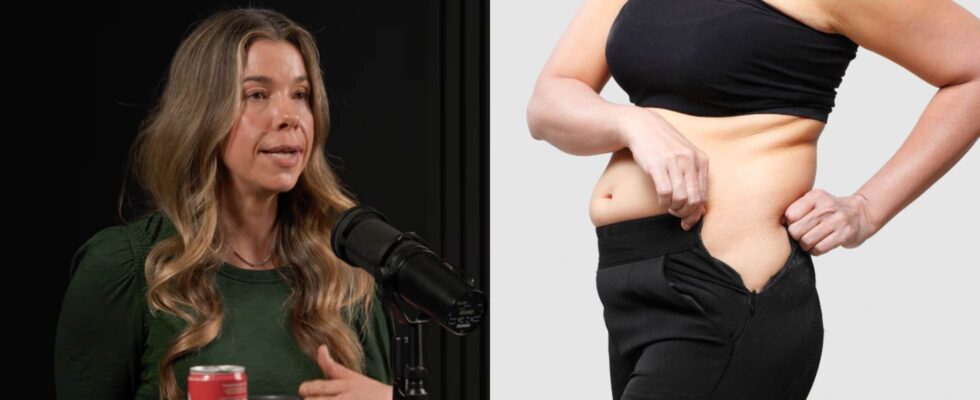
On a recent episode of the Huberman Lab podcast, Dr. Rhonda Patrick spoke at length about visceral fat, what causes it, and why it is far more dangerous than most people realize.
Patrick began by sharing her own personal experience with stubborn abdominal fat, despite maintaining healthy habits.
“I noticed that everything that I was doing, I eat healthy, I exercise a lot, and yet I was sort of gaining more fat in the belly section, the visceral fat,” she said. “And the only thing that really helped me stop that, put the brakes on, was getting more in a caloric deficit.”
She was direct about the health risks associated with visceral fat, emphasizing that its impact goes well beyond appearance.
“Visceral fat is associated with double the risk of early death,” Patrick explained. “People that have high visceral fat have a 44% higher chance of having cancer, many different types of cancers.”
She also noted how common the issue becomes with age, adding that roughly 70% of women over 50 and 50% of men over 50 carry high amounts of visceral fat.
For people who do not have access to advanced body composition tools like a DEXA scan, Patrick offered a simple and practical guideline.
“Women that have a waist circumference of 35 inches or above are considered to have a higher amount of visceral fat,” she said. “Men that have a waist circumference of 40 inches or above are considered to have a higher amount of visceral fat.”
Patrick then explained why visceral fat is uniquely harmful compared to subcutaneous fat, which sits just under the skin.
“It is almost like an endocrine organ because it is secreting hormones, secreting inflammatory factors. It is metabolically active, it is constantly breaking down triglycerides,” she said. “The location of it is very dangerous because it is right surrounding the liver, and that is very close to the portal vein. So you are constantly getting this sort of mainlining of free fatty acids to the liver.”
One of the more surprising findings she highlighted is that visceral fat can accumulate even when body weight stays the same, challenging the common assumption that visible weight gain is the only warning sign.
“You can gain visceral fat without gaining a pound,” Patrick said. “People are skinny and can have high amounts of visceral fat. Those people exist. And so you can have a high amount of visceral fat but not really look like you do.”
She pointed to research involving healthy young men that demonstrated how quickly this process can happen. After consuming an additional 1,200 to 1,500 calories per day from foods high in saturated fat and sugar, participants experienced rapid metabolic changes.
“They did cause their brain to become insulin resistant and they did not gain weight, but they gained visceral fat and they started gaining fat around their liver,” she explained. “And that happened after five days.”
Patrick also stressed that diet is not the only factor driving visceral fat accumulation. Hormones and lifestyle habits, particularly stress and sleep, play a major role.
“Chronic elevated cortisol makes you store fat viscerally,” she said. “Sleep loss, there are studies showing that if you take healthy men and sleep deprive them for a couple of weeks, four hours of sleep a night, they can start gaining visceral fat pretty rapidly with only gaining a pound of weight.”
When it comes to reducing visceral fat, Patrick emphasized that the most effective approach combines both nutrition and exercise.
“There are a couple of ways that you can really powerfully lose visceral fat, and one of them is doing aerobic exercise,” she said. “High-intensity interval training can also really powerfully do it, but also being in a caloric deficit. When you start to get the combination of both, that is what really worked for me.”
