

What began as a straightforward academic critique has evolved into perhaps the worst damage control campaign in the history of exercise science. The story centers on Dr. Milo Wolf, a PhD in sports science, and a single catastrophic miscalculation in his defense of Dr. Mike Israetel’s doctoral dissertation.
On September 30, 2025, Solomon Nelson released his critique of Mike Israetel’s doctoral thesis. Two days later, Milo Wolf sent Nelson a direct message requesting Mike’s thesis.
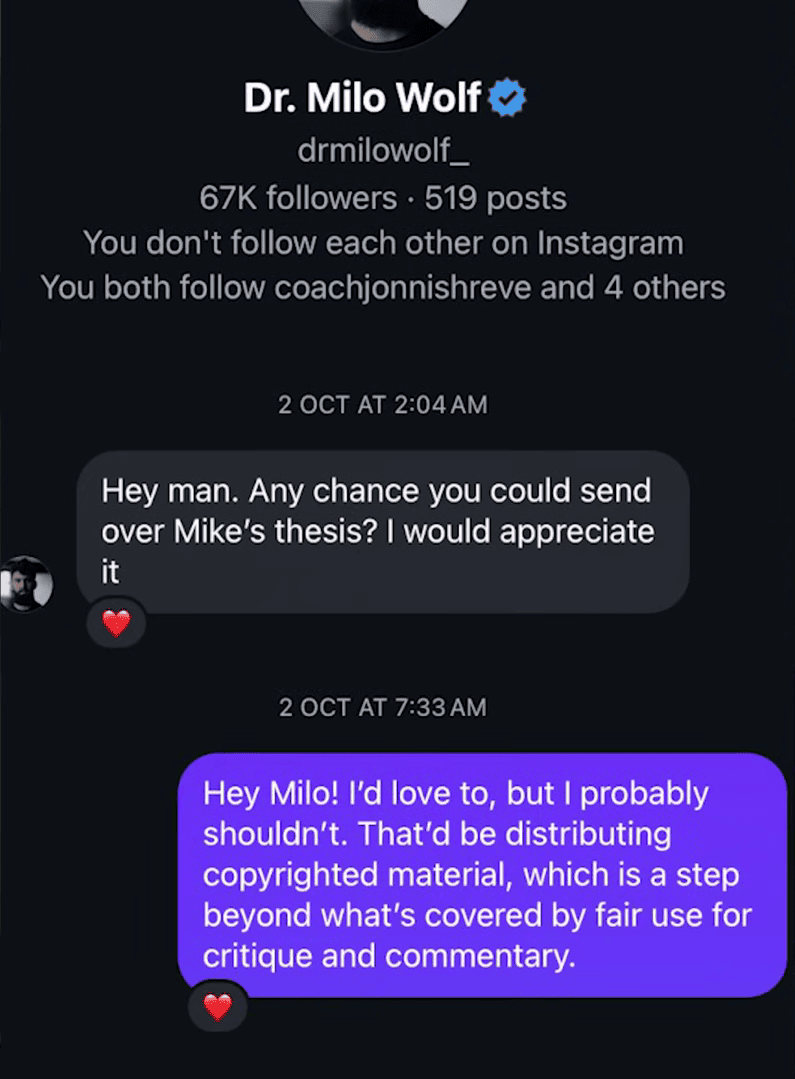
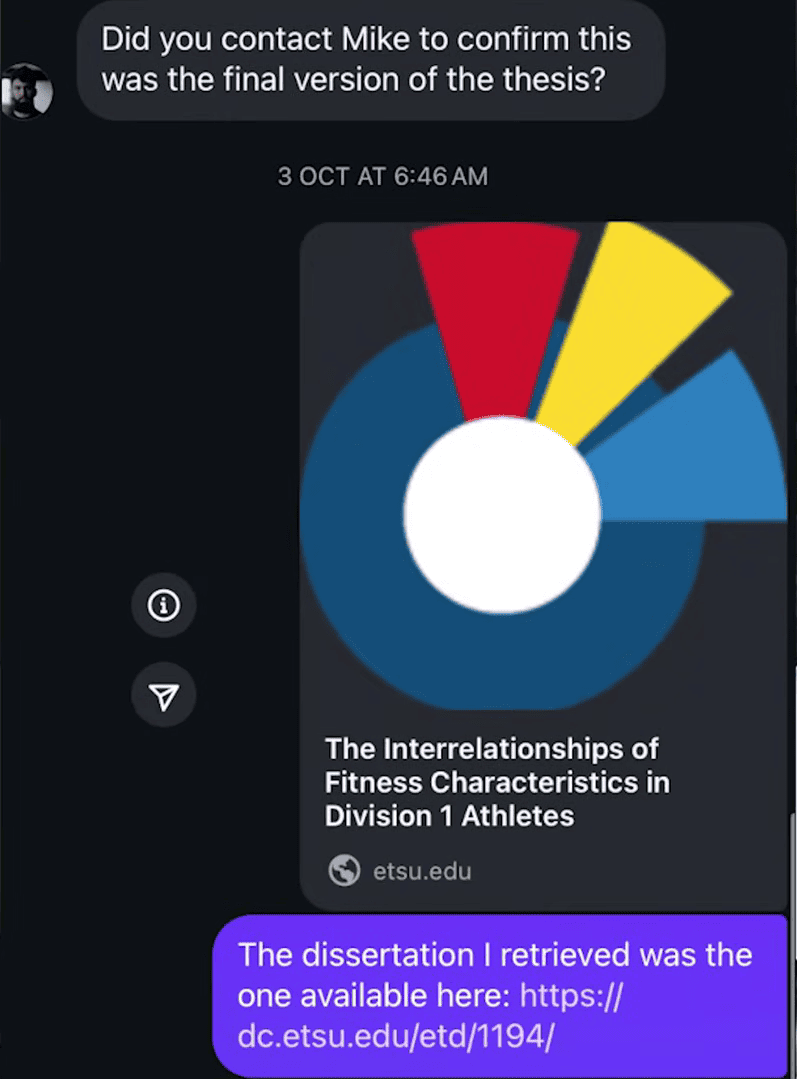
When Nelson declined, citing copyright concerns, Milo asked whether Nelson had confirmed with Mike that he was reviewing the final version. Nelson replied that he had retrieved the dissertation from the official East Tennessee State University repository.
On October 4, 2025, Milo released a 38-minute video titled “Solomon Nelson: Worst of the Fitness Industry.” The central premise was clear: Nelson had reviewed an outdated draft, not the final defended dissertation. Milo claimed to possess a much later version with over 1,500 edits made by the university itself. He stated he had read the citation in full and interviewed Mike directly.
“The version Solomon reviewed wasn’t even the final dissertation. It was an earlier draft, the kind of draft examiners send back with corrections,” Milo asserted. He claimed that half of Nelson’s biggest critiques didn’t even appear in the version Mike actually graduated with.
Milo presented what he called smoking gun evidence: Nelson’s version listed the department as “Exercise and Sport Science,” while the correct name was “Kinesiology, Leisure, and Sport Sciences.” Milo linked his version in the video description, though the file metadata showed it was owned and last modified by Pivix Contino, a digital marketing agency working with Milo.
Throughout the video, Milo dismissed Nelson’s findings one by one. A typo reading “test rest reliability” instead of “test retest reliability” had allegedly been corrected in his version. Contradictory correlation values were explained as dropped minus signs. Impossible standard deviations simply weren’t there in his copy, Milo claimed.
However, the defense collapsed entirely on October 6, 2025. Mike Israetel posted a public statement confirming that Nelson had indeed reviewed the correct document. “Upon review, the dissertation Solomon examined was indeed the correct document,” Mike wrote, completely retracting the wrong version narrative.
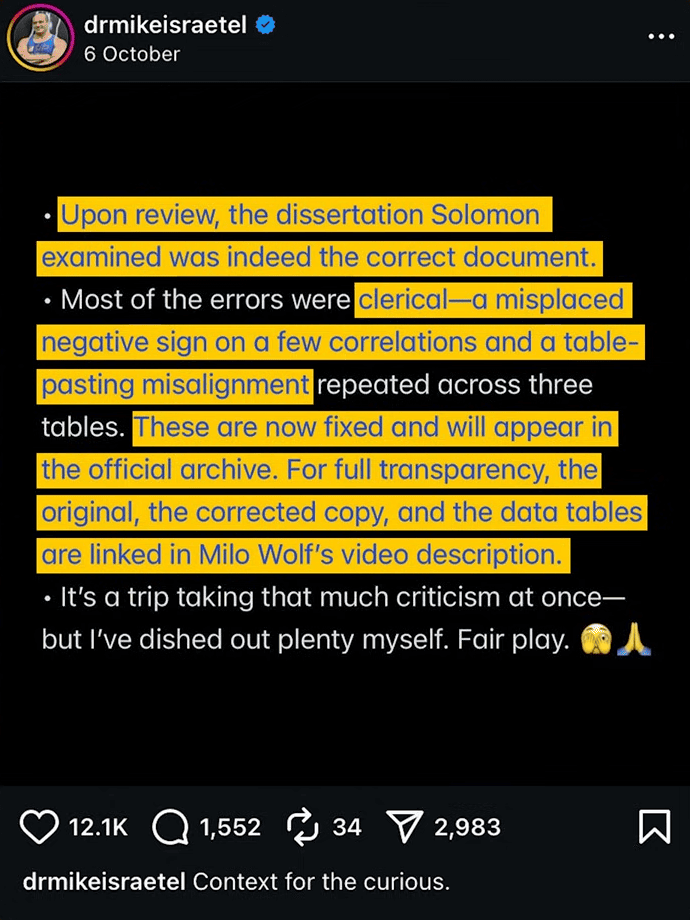
Mike attempted to minimize the errors Nelson identified, characterizing them as merely clerical issues involving a misplaced negative sign and table pasting misalignment.
He revealed that these errors had now been fixed and that the newly corrected version would appear in the official archive, a retroactive alteration of the 12-year academic record.
Shortly after, Milo posted a hastily filmed retraction video. He explained that Mike had messaged him to confirm that after looking through the versions more extensively, the version Nelson critiqued was in fact the final draft. “That renders some of the critiques I made in the Solomon response video invalid. As a result, I will be editing those out of the video,” Milo admitted.
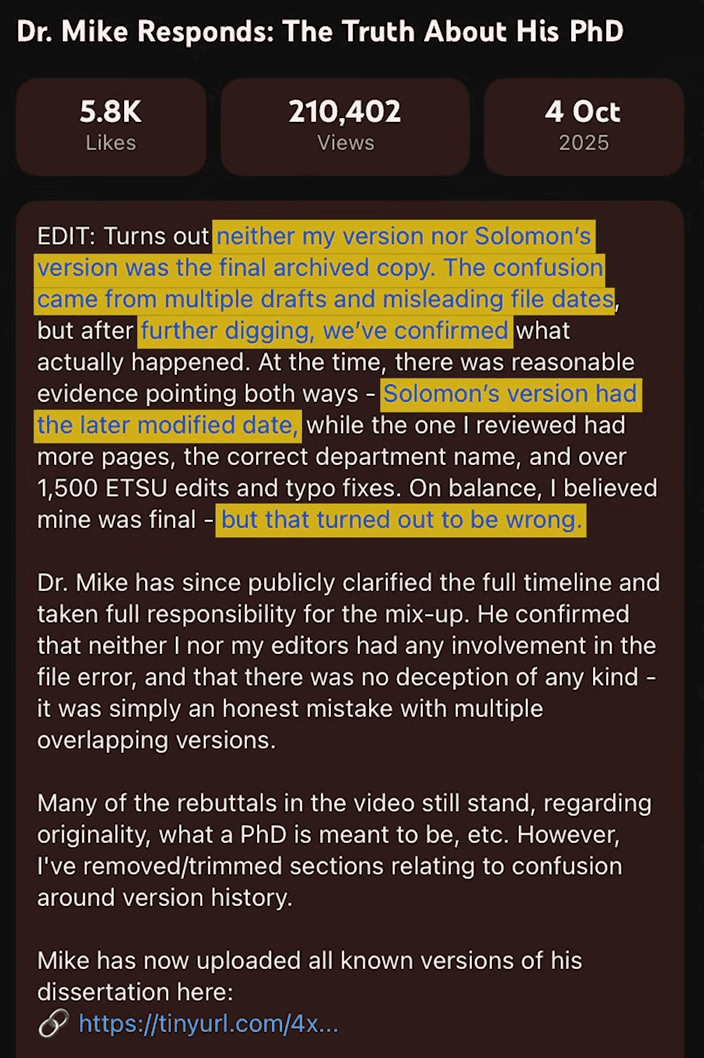
But Milo’s explanation raised more questions than it answered. He claimed that at the time, the best information from Mike suggested the version he had was most recent. He listed reasons for his confidence: his version was more polished, didn’t contain most typos, lacked the standard deviation errors, had over 1,500 edits from the university, and featured the corrected department name.
The claim of 1,500 university edits presents a fundamental problem. Universities don’t write dissertations for candidates. Committees provide feedback, but students make the corrections themselves. If Milo’s claim were accurate, it would suggest East Tennessee State University acted as a co-author, essentially ghostwriting corrections to ensure a passing grade.
Moreover, keen observers noted something troubling in Milo’s original video. At the 8:52 mark, while scrolling through the document he claimed was from 2013, a track change comment bubble briefly appeared on screen. It read: “East Tennessee State University added rate of force development and peak 3rd of October 2025 1:33 a.m.”
This single frame, later edited out, showed a university edit timestamped to October 2025, the exact week Milo was filming his response. Universities don’t revise decade-old student drafts. There is no administrative process that explains this timestamp.
In his most recent statement, Mike attempted to revise the narrative further. He claimed he had told Milo he wasn’t sure which file was correct and had sent multiple files. According to Mike, Milo then suspected one file was closer to the final version based on its formatting and length. Yet in the video, both Mike and Milo spoke with absolute certainty, not probability.
Mike stated on camera, “We now know Solomon was looking at an accidentally uploaded incorrect rough draft.” There was no hedging, no uncertainty. If Mike had truly warned Milo of his doubt, why did he deliver that line with such confidence?
The situation became more convoluted when Mike claimed his doctoral adviser sent him a third version from 2013 that he didn’t have in his own files. Mike now asserts that both the official university portal file and the file Milo used were incorrect. He attributes this to uploading the wrong file 12 years ago.
This new narrative requires believing that East Tennessee State University accepted a file from a student, failed to verify it matched the committee-approved version, and permanently archived it without anyone noticing the errors for over a decade.
Mike shared a Google Drive folder containing five files for transparency. Notably absent were the official PDF from the repository that Nelson reviewed and the mysterious PDF owned by Pivix Contino that Milo originally linked. The file Milo presented as definitive proof has been scrubbed from the record.
One file is titled “2025 updated draft with corrections from video review tentative.” This is a direct admission that Nelson’s video identified valid, uncorrected errors. The errors were real, and they are only being corrected now, in 2025.
Throughout his defense, Milo made several other questionable claims. He accused Nelson of failing due diligence by not asking Mike whether he had the correct version. Yet Nelson retrieved the dissertation from the official university repository, the standard source for academic records. Meanwhile, Milo’s investigation, which allegedly included reading a full dissertation, comparing it line by line, conducting an interview, and producing a 38-minute edited video, all occurred in under five days.
Milo also falsely claimed Nelson called for Mike’s PhD to be revoked. Nowhere in Nelson’s 70-minute critique did he demand Mike be stripped of his degree. Milo invented this radical claim to frame Nelson as an extremist before his argument began.
When defending the thesis content, Milo argued that a PhD is merely an apprenticeship or driver’s license, not a masterwork. He played clips of Mike describing his own thesis as “decent at best” and “a mediocre step one” he just had to get done. This is a propaganda technique where a subject admits to a lesser offense like mediocrity to avoid accountability for more serious problems like fundamental incompetence and impossible data.
Milo defended verbatim copy-pasting of method sections as convention and a feature supporting clarity. He compared it to a recipe book repeating “preheat the oven.” But when entire multi-page blocks are copied with their typos and errors intact, it demonstrates laziness, not clarity.
When addressing the thesis’s trivial findings, Milo invoked the replication crisis, claiming criticism of unoriginality reflects the thinking that created the crisis. But replication requires rigor. A PhD thesis must demonstrate the ability to contribute new knowledge, not just affirm what is already well accepted with data containing impossible statistics.
In his final defense, Milo questioned Nelson’s motives, painting him as driven by outrage and views. This is the genetic fallacy, attempting to invalidate claims based on their source rather than substance. Impossible statistics remain impossible regardless of who identifies them. Meanwhile, Milo is a friend and associate of the thesis author, whose most viewed videos are collaborations with Mike, and whose research was funded by Mike’s company.
Most audaciously, Milo claimed Mike has almost never mentioned his PhD outside of being directly asked about it. Yet Mike introduces himself in nearly every video with the catchphrase “Dr. Mike here.” The title isn’t incidental.
Products sold by his company Renaissance Periodization are marketed as “PhD designed” or “PhD approved.” Mike himself has stated on record that his PhD was “a really good idea” precisely because of the inherent authority it confers.
The publicly available Google Drive folder raises more questions than it answers. File names have been rewritten to match the new narrative. The original PDF Milo linked, which appeared to be owned by a marketing agency, is nowhere to be found. Instead, it has been retroactively renamed “2013 rough draft Milo response vid original.”
For 12 years, the document standing as proof of Mike Israetel’s PhD was the one Nelson critiqued. The official archived dissertation contains impossible statistics, unremarkable conclusions, and systemic errors. By claiming the official record is wrong and presenting unverified private files, Mike and Milo are attempting to separate Mike’s reputation from his public record.
The presentation of questionable documents, the claim of over 1,500 university edits, and the retroactive creation of a 2025 draft have exposed a worrying lack of integrity. The true concern has moved beyond the dissertation itself to the active misrepresentation that followed. In attempting to defend Mike, Milo has effectively accused East Tennessee State University of running a process where committees ghostwrite theses and archived records are unreliable.
