

In a social media post that has sparked considerable debate in athletic circles, Stanford neuroscientist Dr. Andrew Huberman made startling claims about the widespread use of peptides among competitive athletes and why anti-d*ping agencies haven’t been able to detect them.
During his conversation on the Flagrant podcast, Huberman shared his personal experience with BPC-157, a peptide that he credits with resolving a persistent spinal injury. But it was his subsequent comments on social media that truly raised eyebrows across the sports world.
When responding to a discussion about competitive athletics on Twitter, Huberman issued a striking warning: “Most of the guys you will run against this year are already taking peptides. Legally. TRT is another matter. But peptides are rampant in all sports now. It’s ‘supplements plus’… and they won’t be banned (most anyway).”
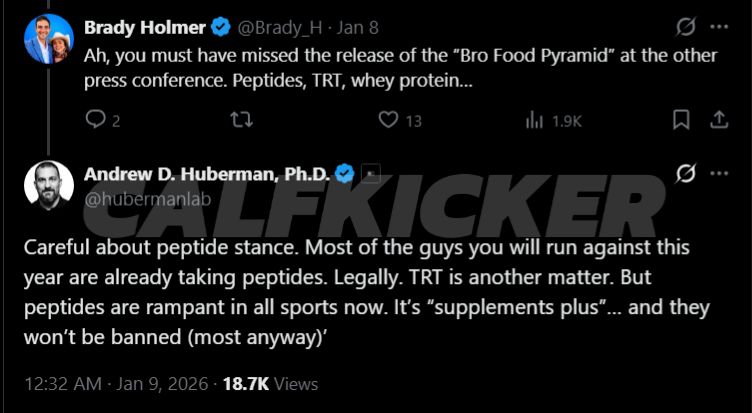
However, when another user pointed out that peptides including BPC-157 are actually prohibited by both WADA and USADA, Huberman revealed something even more concerning: “New variant with two amino acids altered not detected. No one really is using real BPC anymore.”
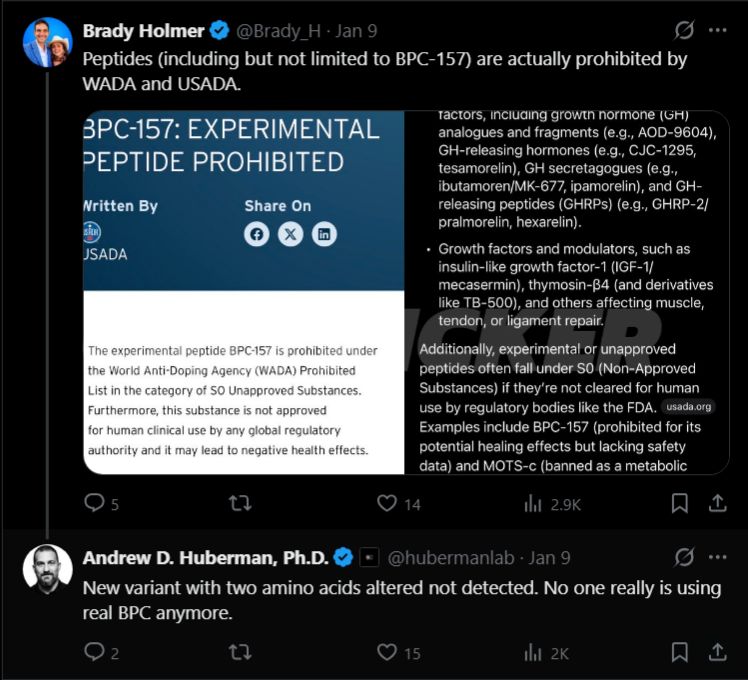
This statement suggests that athletes have found a workaround to regulations by using modified versions of BPC-157 that differ by just two amino acids. It is enough to evade current testing protocols while presumably maintaining therapeutic benefits.
Huberman’s personal testimony about the peptide’s effectiveness is compelling. He described dealing with an L5 compression in his lower spine that caused constant discomfort.
“I had a L5 compression and I was always like in pain standing up from a dumb thing. I don’t deadlift anymore, I just made a dumb mistake in terms of form. And massage, heat, electric therapy the, whole thing…” he explained.
Standard treatments offered no relief. But after just two injections of BPC-157, the results were dramatic. “Two injections of BPC-157. Look, if it was placebo, okay, I’ll take it. Gone, gone,” Huberman stated.
The neuroscientist also referenced a high-profile recovery story involving an Olympic athlete. “A few years ago, a guy tore his Achilles right before the Olympics. Came back BPC-157 was implicated in that,” he noted, highlighting the peptide’s potential for accelerating recovery from serious injuries.
BPC-157 is derived from a naturally occurring gastric peptide that the human body produces to promote tissue healing. Unlike anabolic compounds that can disrupt natural hormone production, peptides occupy a middle ground between supplements and pharmaceutical interventions, making them attractive to athletes seeking recovery advantages without certain risks.
Despite his positive personal experience, Huberman emphasized important precautions. He stressed the critical importance of obtaining clean, pure sources through licensed physicians and reputable pharmacies. The unregulated market presents genuine risks, as the purity and authenticity of products from unverified online sources cannot be guaranteed.
He acknowledged that extensive clinical studies on BPC-157 are limited compared to other peptides like sermorelin, which he personally uses three to five nights per week for growth hormone release, improved sleep quality, and enhanced recovery.
Huberman also cautioned that peptides promote growth across all tissues and should be used judiciously and cycled appropriately. He emphasized that these interventions should complement, not replace, fundamental health practices like proper sleep, nutrition, exercise, and stress management.
Major research institutions, including Stanford where Huberman serves as a professor of neurobiology, are increasingly investigating peptides for their therapeutic applications.
