
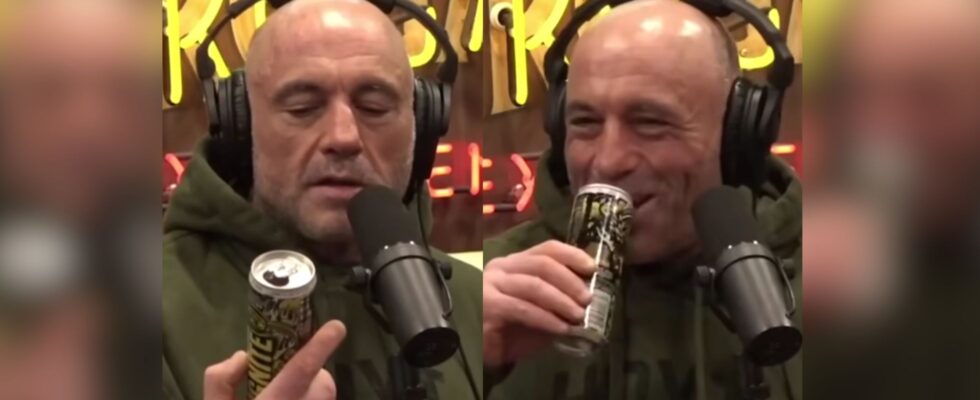
The wellness industry’s most famous voice has gone conspicuously quiet just as the products he’s promoted face an existential regulatory threat.
Joe Rogan, the podcast titan who commands one of the largest audiences in digital media, partnered with beverage company Kill Cliff in December 2020 to launch a CBD-infused drink containing 25 mg of can**bidiol extracted from roughly 125 mg of hemp per 12-ounce can.

The collaboration positioned Rogan as more than a casual observer in the burgeoning hemp market. He became a direct beneficiary of CBD’s commercialization, joining other celebrity figures credited with helping to destigmatize these products for mainstream American consumers.
Yet as federal lawmakers move to dramatically restrict the very category of products that fueled the CBD beverage boom, Rogan has offered no public commentary on the looming regulatory crisis.
His silence stands in stark contrast to the noise surrounding a recent federal spending bill that includes provisions to ban “intoxicating hemp-based or hemp-derived products,” a move industry advocates warn could devastate a market worth billions of dollars.
The proposed restrictions would prohibit final hemp-derived can**binoid products containing more than 0.4 mg of THC per container and ban synthetic cannabinoid analogues, even those derived from hemp. These measures target what regulators view as loopholes in the 2018 Farm Bill, which originally legalized hemp and its derivatives. Industry groups have raised alarms that the sweeping language could inadvertently eliminate many legitimate, non-intoxicating CBD products from the marketplace.
The regulatory threat isn’t hypothetical. The spending bill language could fundamentally reshape the American hemp industry, potentially removing entire product categories from retail shelves and wiping out businesses that have operated in what they believed was legal territory since the Farm Bill passed.
Against this backdrop, Rogan’s absence from the conversation becomes more glaring. Public figures who lend their names and reputations to commercial ventures typically speak up when those industries face regulatory annihilation. Whether through social media commentary, podcast discussions with industry experts, or direct advocacy, influential voices often defend the markets from which they profit.
Rogan’s platform would seem ideally suited for such engagement. His podcast regularly explores health, wellness, and personal freedom issues, often featuring guests who challenge mainstream regulatory perspectives.
The hemp industry’s plight combines all these themes—bodily autonomy, government overreach, economic freedom, and wellness product access. Yet no such discussion appears to have materialized.
The silence invites speculation about the nature of celebrity product endorsements in the hemp space. Was Rogan’s involvement with Kill Cliff a genuine commitment to CBD as a wellness product, or simply a brand partnership divorced from any deeper engagement with the industry’s regulatory challenges? Does he view the threat as too politically complex to wade into, or perhaps too remote from his core business interests to warrant comment?
Meanwhile, the political dynamics around hemp regulation have produced unexpected alignments. Senator Ted Cruz, the Texas Republican, voted to protect hemp products during what observers called the Senate’s first-ever roll call vote directly addressing can**bis policy. Cruz sided with an amendment from Senator Rand Paul that would have stripped the restrictive language from the funding bill, arguing that regulation should remain with individual states.
“I’ve long believed the regulation of hemp and m**ijuana products should rest with each individual state. A blanket federal ban disempowers voters in all 50 states,” Cruz stated, adding that “a one-size-fits-all federal standard will just create unintended consequences that hurts consumers.”
Cruz pointed to Texas as an example, noting that Governor Greg Abbott and state regulators have already established comprehensive rules including age restrictions, lab testing requirements, and prohibitions on synthetic or imported products.
The amendment was ultimately tabled, but the vote revealed bipartisan support for the hemp industry, with approximately two dozen Democrats and two Republicans voting to keep it alive. The bill now moves to the House of Representatives, where the hemp language could still be modified.
For an industry employing tens of thousands across farming, manufacturing, and retail operations, the stakes couldn’t be higher. The pending restrictions represent more than regulatory adjustment—they threaten the foundation of a market that has grown explosively since hemp’s federal legalization.
Celebrity endorsements helped normalize CBD products, transforming them from fringe supplements into grocery store staples and Instagram-friendly wellness must-haves.
Perhaps Rogan’s business arrangement insulates him from the ban’s potential impact. Perhaps he’s concluded that public advocacy would prove ineffective or politically fraught. Or perhaps the endorsement was always transactional, a business deal without deeper commitment to the hemp industry’s survival.
Whatever the explanation, the absence speaks volumes.
