

Gary Brecka is the controversial “human biologist” who rose to prominence through his work with UFC CEO Dana White. Recently, he sparked fresh debate in the scientific community after publishing his peptide recommendations on social media.
Among his suggestions was CJC-1295, a growth hormone releasing compound that health experts note appears far less frequently in mainstream protocols than other peptides.
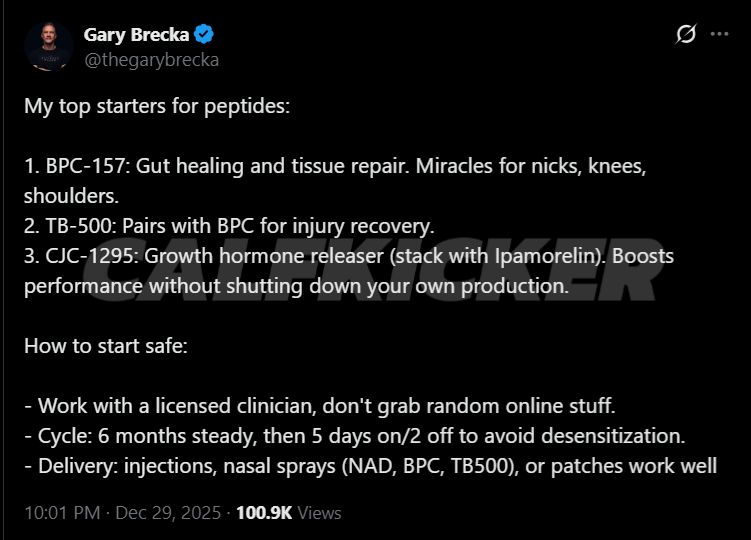
In a recent post that garnered over 100,000 views, Brecka outlined what he called his “top starters for peptides,” listing CJC-1295 as his third recommendation. He described it as a “Growth hormone releaser (stack with Ipamorelin). Boosts performance without shutting down your own production.”
The post continued with advice to “Work with a licensed clinician, don’t grab random online stuff” and suggested cycling protocols of “6 months steady, then 5 days on/2 off to avoid desensitization.”
Performance enhancement researcher Vigorous Steve has previously provided technical analysis of CJC-1295, explaining that it functions as a growth hormone releasing hormone receptor agonist.
According to Steve, the compound comes in two distinct formulations with different administration schedules. The version without D**g Affinity Complex requires dosages “between 150 micrograms to 300 micrograms administered subcutaneously up to three times daily,” while the DAC version allows for “once per week administrations between 1 milligram to 2 milligram subcutaneous one time weekly.”
Steve noted the practical advantages of certain combinations, stating: “Out of all of these the most popular combination seems to be either CJC 1295 with the d**g Affinity complex and mk677 probably because you only need one Administration per week one to 2 milligrams of CJC 1295 with DAC over the weekend.”
However, he candidly acknowledged limitations based on his personal experience, explaining that he ultimately chose pharmaceutical growth hormone over peptide protocols due to superior results in bloodwork measurements.
The recommendation has drawn attention partly because Brecka continues to face scrutiny over his credentials and business practices. Dr. Layne Norton, a nutrition scientist who has repeatedly challenged Brecka’s claims, has pointed out that “no such degree exists in legitimate academic institutions” when referring to the “human biologist” designation. Norton stated he’s only “aware of biology degrees.”
Brecka holds degrees in biology but is neither a medical doctor nor a PhD, according to reports examining his background. His association with Dana White began through the 10X Health System, co-created with entrepreneur Grant Cardone. White previously shared photos of his physical transformation and made claims about his health prognosis that aligned with the company’s marketing approach.
The 10X Health System promotes various treatments including electromagnetic field therapy, cold plunges, and red light therapy.
However, health professionals often dismiss these approaches as lacking robust scientific support. Critics argue that lifestyle factors such as proper nutrition, regular exercise, adequate sleep, and stress management provide the foundation for genuine health improvements.
Norton revealed that Brecka has avoided direct scientific debate, stating that Brecka “twice agreed to debate me and twice reneged on debating me.” This pattern suggests an unwillingness to defend his recommendations in academic settings where claims face rigorous examination.
Despite ongoing criticism from the scientific community, Brecka continues to attract high-profile clients. UFC heavyweight champion Jon Jones recently appeared to endorse Brecka’s methods following his own physical transformation. Other reported clients include podcaster Joe Rogan and actor Leonardo DiCaprio.
The business relationship between Brecka and Cardone has reportedly become strained. According to industry reporting, Brecka has been attempting to distance himself from 10X Health for over a year. His appearance on Joe Rogan’s podcast notably omitted mentions of Cardone or the 10X brand, fueling speculation about a potential split.
Social media observers have questioned the pattern behind Brecka’s recommendations. One commenter summarized the skepticism bluntly: “You’re getting health advice from a former insurance salesman. Think about it. It’s snake oil. He will always have something that you can buy that will cure your ailment.”
The scientific community remains divided on whether peptide protocols like those Brecka recommends provide meaningful benefits. While some compounds show promise in preliminary research, legitimate scientists emphasize the need for properly controlled clinical trials before making broad health claims.
Norton expressed frustration with the continued acceptance of Brecka’s advice despite repeated debunking efforts, noting that “the more nonsense he spouts, the more people lap it up and love it.”
This dynamic reflects a broader challenge in health communication, where simplified messaging from charismatic figures often resonates more strongly with audiences than nuanced scientific explanations.
As Brecka’s recommendations continue circulating on social media, questions about accountability and professional standards in the wellness industry remain unresolved.
